Author: FlatlineFiles

  • THE MEASURING HAND

    THE MEASURING HAND

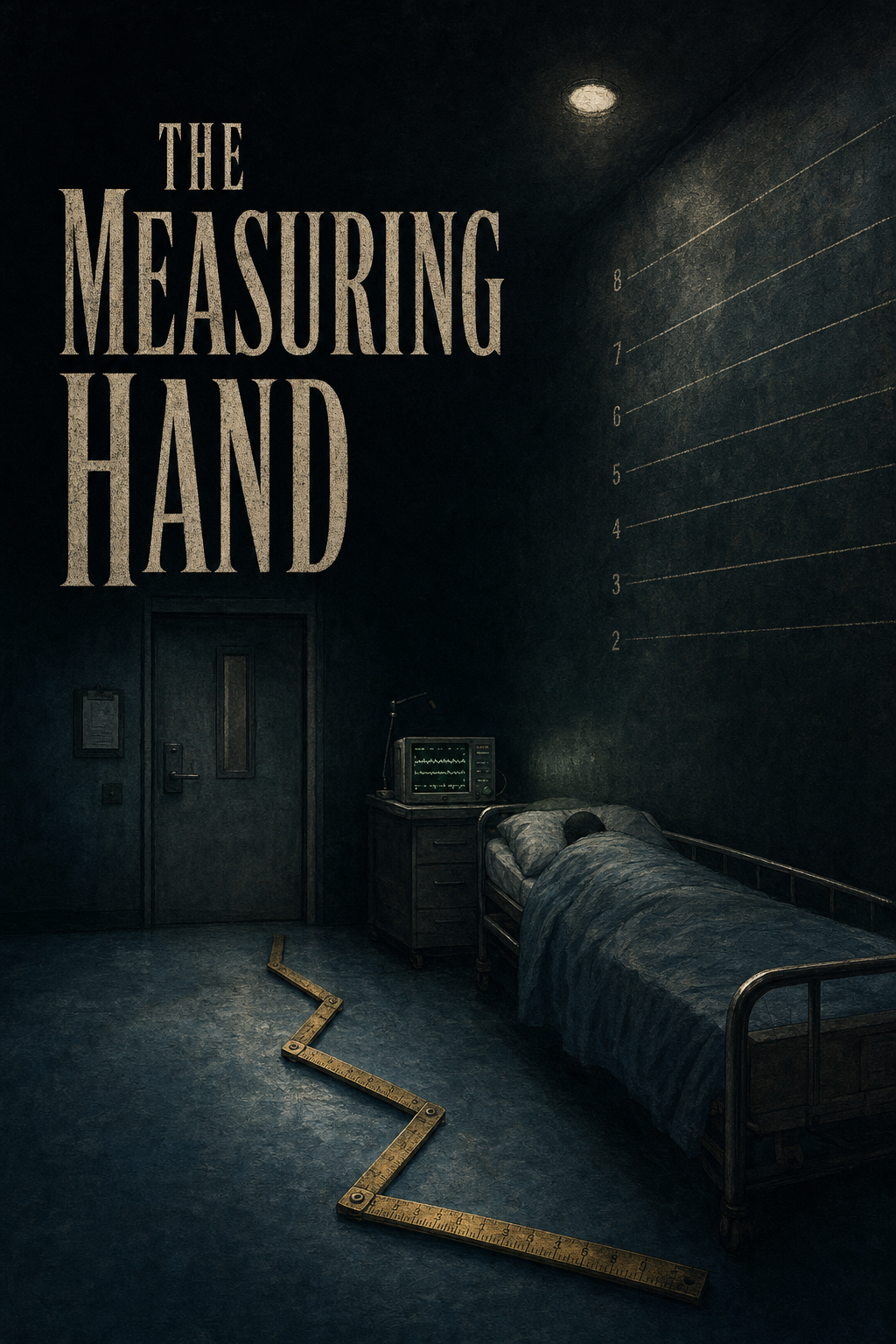
    After thirty-nine-year-old Mara Venn began waking with stabbing shoulder pain and the sick feeling that her left arm was longer than it should be, doctors considered nerve damage, migraines, seizures, medicine reactions, anxiety, and a sleep disorder. Her strength tests and X-rays were normal, yet every morning she found fresh pencil marks on walls far beyond her reach. Then, during an overnight sleep study, a camera showed Mara lying perfectly still while a metal ruler slid across the floor toward her bed.

    Chapter 1

    Mara first noticed the trouble when she woke with her left hand resting against her bedroom window. Her bed stood on the other side of the room. She slept alone, with her door locked, and there was no way she could have reached the glass without getting up.

    Her shoulder hurt so badly that morning she could not pull on a sweater. When she looked in the bathroom mirror, her left arm appeared normal. It was not longer. It was not bent. Still, when she closed her eyes, she felt it stretching through the wall behind her, feeling along pipes and wires inside the building.

    She worked restoring old maps at the county records office. All day she used rulers, soft brushes, and tiny tools. By noon, her pain had eased. She told herself she had slept in a strange position.

    The next morning, she found a thin pencil line across the wall above her bed. It ran straight from the ceiling corner to the closet door. At one end was a small mark like the side of a carpenter’s square. Mara stood on her mattress and reached as high as she could. Her fingertips stopped almost a foot below it.

    She scrubbed the line away. That night she pushed a chair under her bedroom doorknob and wrapped a scarf around her left wrist before going to sleep. She woke with the scarf still tied in place, but another line crossed the wall. This one ended at the window, where someone had written a careful number: 18.

    Mara’s pain and strange body feeling first seemed like a bad sleeping position, but the high pencil marks gave her proof that something was happening while she slept. She still believed there might be an ordinary cause, so she needed a doctor before fear made her believe the marks had come from somewhere else.

    Chapter 2

    The clinic doctor checked Mara’s reflexes by tapping below her knees. He asked her to squeeze his fingers, follow a light with her eyes, and lift both arms. Mara did everything normally. He ordered blood tests and an X-ray of her shoulder. The X-ray showed no broken bone, no joint problem, and no sign that anything had changed shape.

    He explained that nerves could make a person feel things that were not there. A pinched nerve, a migraine, a small seizure, even stress could twist the brain’s picture of the body. Mara understood that. She was not angry at him. She only wished he had seen the marks.

    Her blood tests were normal. A specialist gave her a test that measured the nerves in her arm. Small stickers sent gentle signals through her skin. The results were normal too.

    At home, Mara placed her phone on a shelf and aimed it at the bed. In the morning, the video had stopped at 2:14 a.m. The screen showed gray blocks and a frozen picture of her sleeping face.

    Her apartment wall had a new drawing. Four straight lines made a tall rectangle around the bedroom door. Beside it was another number: 18, 6, 3.

    Mara carried the measurements to work. She laid a ruler across the old plans she was cleaning that day, plans for the Venn Foundry, a brick factory torn down before she was born. Her stomach tightened. The numbers matched the size of a narrow inspection room shown on the blueprint.

    The room had been called the Gauge Chamber. Workers had measured machine parts there before they were sent into the factory floor.

    Medical tests found no injury or nerve disease, but Mara’s overnight recording failed at the exact time a new set of measurements appeared. The marks matched a long-destroyed factory room, which made her fear that her sleeping body was being used to measure a place that should no longer exist.

    Chapter 3

    Mara did not want to return to her apartment. She spent the next night at a sleep center, where a nurse placed soft sensors on her chest, head, and legs. They watched brain waves, breathing, heart rhythm, and movement. Mara tried to joke about it, but her left shoulder had begun to throb before dark.

    At 2:14, she woke to a hard click beneath the bed.

    The room was dark except for the green light of the monitor. Mara could not move her left arm. It felt pulled straight beside her, longer and colder than the rest of her body. She tried to call for help. Only a thin breath came out.

    A metal ruler lay on the floor between the bed and the wall. It had not been there earlier. Mara watched it creep forward one inch at a time. Click. Slide. Click. Slide.

    The nurse came running when Mara’s heart rate jumped. The ruler stopped at once. Her arm snapped back into its normal place with such force that Mara cried out.

    The next day, the sleep doctor showed her the video. Mara had not moved. Her legs stayed still. Her right arm stayed under the blanket. Yet the ruler had crossed the room by itself. The brain-wave record showed Mara was awake for most of it.

    There was one more thing. At 2:14, the sensors on her left arm had recorded a sudden stretch between her wrist and shoulder. Not a possible stretch. Not an injured stretch. The distance had increased by nearly three feet for eleven seconds.

    Mara went back to the records office and found the oldest file she could. In 1948, the factory had burned after an overnight shift. The report said the Gauge Chamber door had jammed. Three workers had been trapped inside while the building was measured for repairs the next morning.

    The sleep study proved Mara was awake when an ordinary ruler moved toward her and her arm briefly measured far longer than human anatomy allows. The old factory report gave the pattern a darker meaning: the destroyed Gauge Chamber had once held trapped workers, and something connected to it was still taking measurements at 2:14.

    Chapter 4

    The old foundry lot was now a vacant field behind a discount store. Mara went there at dusk with the copied blueprint folded in her pocket. Rain had softened the ground. The place smelled of wet weeds and rust.

    She found the former Gauge Chamber by counting from the cracked loading ramp. The blueprint said it should be beneath a patch of grass near a bent chain-link fence.

    Her left shoulder began to burn.

    Mara knelt and brushed away mud. A straight black line showed beneath the grass. Then another. They were not stones. They were narrow strips of old tile, making the same rectangle that had appeared around her bedroom door.

    At the center lay a brass measuring rule, black with age. Numbers were stamped along its edge. The last number was 18.

    Mara understood then that the marks in her home had not been random drawings. Something had been laying out the old room again and again, searching for its exact shape. It had used her arm because she had spent her days measuring old things, because she had carried the blueprints home in her mind.

    She picked up the brass rule. The pain stopped.

    For one warm second, Mara thought she had won. Then the ruler clicked open by itself. Its folded sections stretched across the wet ground, pointing past her shoes toward the discount store.

    The store had been built over the rest of the factory foundation.

    That night, Mara slept at her sister’s house with both arms held close beneath the blanket. At 2:14, she woke without pain. Across the dark bedroom, a long pale line appeared on the wall, starting near the floor and rising toward the ceiling.

    At its end, in careful pencil, was a new number.

    36.

    Mara found the buried outline of the Gauge Chamber and learned that the measuring force had begun rebuilding its lost room through her. Taking the old ruler ended her pain for one night, but its new measurement pointed toward the store built over the factory, and the growing number showed that the room was no longer finished with her.

  • THE MIRROR TEST

    THE MIRROR TEST

    After a routine scan for worsening headaches, thirty-four-year-old Tessa Vale began seeing a pale gray shape in every mirror, while doctors considered migraines, seizures, eye strain, medicine side effects, anxiety, and a problem with the scan itself. Her vision tests were normal, and the shape vanished whenever another person stood beside her. Then Tessa found it reflected in the black screen of a powered-off hospital monitor, standing behind her bed where no one could have been.

    Chapter 1

    Tessa first saw the shape in the bathroom mirror at the imaging center.

    She had spent forty minutes inside a loud scanning machine because of headaches that had begun three months earlier. The headaches came behind her left eye. Sometimes they made her sick. Sometimes they made her forget small things, like why she had opened the refrigerator or where she had parked her car.

    The technician had told her to drink water and wait for the doctor. Tessa went to the restroom, splashed cold water on her face, and looked up.

    A gray person stood behind her.

    It was not clear enough to be a man or woman. It had shoulders, a head, and something that might have been a hospital gown. Its face was smooth as fogged glass. Tessa spun around so hard that her elbow struck the paper-towel holder.

    The restroom was empty.

    When she looked back, the gray figure was gone. Her own face stared at her from the mirror, pale and wet, with a red mark on one cheek from the scan table.

    She told herself it was exhaustion. She had not slept well. She had been taking new migraine medicine. The imaging center had bright lights, long hallways, and too many dark windows.

    Then she noticed that the mirror had been covered in tiny fingerprints, all pressed at shoulder height from the other side.

    Chapter 2

    The scan did not show a tumor, bleeding, or anything else that could explain the headaches. The doctor said that was good news.

    Tessa tried to believe him.

    For two days, she saw nothing strange. Then, while brushing her teeth at home, she noticed the gray shape behind her again. It stood at the far end of the narrow hall outside her bathroom.

    This time she did not turn around.

    She watched through the mirror. The shape did not move. It seemed farther away than her hallway should allow, as if the hall had stretched into a long hospital corridor.

    Tessa grabbed her phone and took a picture of the mirror.

    In the photo, she stood alone.

    Her sister Mara came over that evening. Mara checked the hall, the closets, and the small storage room under the stairs. She found nothing but winter coats, a vacuum cleaner, and Tessa’s old moving boxes.

    When Tessa showed her the picture, Mara sat beside her on the couch and spoke gently. She said migraines could cause strange sights. So could lack of sleep. So could stress. Tessa had been working late at the city records office since their mother died the year before.

    Tessa agreed because she wanted the answer to be simple.

    But after Mara left, Tessa passed the dark television screen in her living room. In its black glass, a gray figure stood directly behind the couch.

    Tessa’s scan has ruled out the most immediate danger, but the gray figure returns in mirrors and dark screens even when no camera can capture it. Migraine symptoms, medicine effects, and stress still seem possible, yet the strange fingerprints and changing reflections make Tessa afraid to be alone in her own house.

    Chapter 3

    At her next appointment, Tessa described the figure carefully.

    She did not say ghost. She did not say haunted. She said she was seeing a shadow in reflective surfaces. She said it appeared during headaches. She said it was worse at night.

    The doctor asked whether she heard voices.

    Tessa said no.

    He asked whether she had lost time.

    She hesitated. Once, she said, she had driven home from work and could not remember the last ten minutes of the trip. But everyone forgot things sometimes.

    The doctor ordered an eye exam and an electrical brain test. The brain test measured the tiny signals made by the brain. It could help find seizures.

    Tessa spent a whole afternoon with small wires taped to her scalp. Nothing unusual happened. No gray figure appeared in the white exam room.

    The eye doctor found that Tessa’s eyes were healthy. Her left eye was slightly dry. That was all.

    For a few hours, Tessa felt foolish. Maybe she was making a frightening story out of headaches and grief.

    Then she stopped at a grocery store on her way home. At the end of the freezer aisle, she saw herself reflected in the dark glass door.

    The gray figure stood beside her.

    Not behind her this time.

    It held one arm against its chest, as if it was hurt.

    Chapter 4

    Tessa left her cart in the aisle and walked out without buying anything.

    At home, she pulled every curtain shut. She covered the bathroom mirror with a towel. She turned the television toward the wall. She put her phone face down on the table.

    By midnight, her headache had become a hard, pounding pain. She took the medicine her doctor had given her and sat in the kitchen with every light on.

    Her kettle began to whistle.

    She had not filled it.

    Tessa stared at it from across the room. Steam rose from the spout. In the curved metal side of the kettle, the kitchen looked bent and silver.

    The gray figure was sitting at her table.

    Its smooth face was turned toward a small notebook beside Tessa’s hand.

    Her mother had used that notebook for grocery lists before she got sick. Tessa had not opened it in months.

    With shaking fingers, Tessa flipped through the pages. Most were old lists: milk, bread, cat food, tomatoes.

    Near the back, she found a page covered in writing that was not her mother’s.

    It said: Room 407. Do not look at the glass.

    Tessa had never been in Room 407.

    But the number was printed clearly on the hospital paperwork from the day of her scan.

    The figure now appears closer and seems to point Tessa toward a notebook containing a message about Room 407, the same room where she waited after her scan. Medical tests have not found a clear cause, and Tessa begins to wonder whether the strange sight is tied to the hospital rather than her home.

    Chapter 5

    Tessa did not want to go back to the hospital. She went anyway.

    In daylight, the building looked harmless. Families pushed strollers through the front doors. A volunteer handed out coffee. A television played a cooking show above the waiting room chairs.

    Tessa asked the front desk if she could speak to someone about an item she might have left behind.

    The clerk frowned at the room number. Room 407 was not used for scans, she said. It was on an older floor that had been closed during repairs.

    Tessa said she only wanted to check.

    A security guard named Ellis took pity on her. He walked her to a stairwell and up four flights. The fourth floor smelled like dust, old paint, and the sharp clean scent of disinfectant.

    The hallway lights were off. Plastic sheets covered most of the doors. At the end of the hall was Room 407.

    Its door was locked.

    There was a narrow square of glass in the door. Tessa stared at it before Ellis could stop her.

    She saw the gray figure inside.

    It was lying on a hospital bed with one arm pressed across its chest. Beside the bed stood a black monitor. The monitor was off, but its screen reflected Tessa in the hall.

    Behind reflected Tessa stood another Tessa.

    The second one was wearing a hospital gown.

    Chapter 6

    Tessa screamed. Ellis pulled her away from the door and called downstairs for help.

    When the lights came on, Room 407 was empty. There was no bed. No monitor. Only bare floor, patched walls, and a long stain where something heavy had once stood.

    Ellis said the floor had been used for patient recovery years ago. The rooms were closed after a small fire in an electrical panel. Nobody died, he added quickly.

    Tessa asked if anyone named Vale had been treated there.

    Ellis checked his tablet. He found one record from eleven years earlier. A patient named Theresa Vale had been brought in after a car crash.

    Tessa almost laughed. Her name was Tessa, short for Theresa. But she had never been in a serious crash.

    Then she remembered something her mother used to say when Tessa asked about the scar near her collarbone.

    You had a bad fall when you were little, honey. You do not remember it.

    At home, Tessa found an old family photo album. Between pictures of birthdays and school plays was a photograph she had never seen.

    She was twenty-three in it, not little. She lay unconscious in a hospital bed. A thick white bandage crossed her chest. Her mother sat beside her, crying into both hands.

    On the back, in her mother’s handwriting, were four words.

    Theresa came back wrong.

    Tessa learns that a patient with her full name was treated in the closed hospital room eleven years earlier, even though she remembers no crash or admission. An old photograph proves that she was there, and her mother’s hidden note makes the missing years feel more dangerous than the gray figure itself.

    Chapter 7

    Mara did not want to talk about the photograph.

    At first she said their mother had been upset after the crash. Then she said Tessa had suffered a concussion, which was a hard blow to the head. People could lose memories after that.

    Tessa asked why nobody had told her.

    Mara began to cry.

    Eleven years earlier, Tessa had been driving home from a late shift when a truck ran a red light. Her car was crushed against a utility pole. Tessa’s heart stopped in the ambulance.

    Doctors brought her back.

    She woke three days later, confused and terrified. She kept saying there was another woman in her hospital room. She said the woman had asked her to trade places.

    The woman had been named Theresa Vale too.

    Not Tessa. Another Theresa Vale.

    She was an older patient from Room 407. She had died during the electrical fire years before Tessa’s crash.

    The hospital had never told Tessa this part. Her mother had found it in an old newspaper article after Tessa began waking at night and staring into mirrors.

    Tessa asked what happened after that.

    Mara looked toward the covered bathroom mirror.

    She said Tessa eventually stopped talking about the woman.

    Then Tessa changed her name to Tessa and refused to answer when anyone called her Theresa.

    Chapter 8

    Tessa slept at Mara’s apartment that night. She kept the bedroom light on. She did not look at the dark windows.

    At 3:12 in the morning, her headache woke her.

    The pain was worse than before. It felt as if a nail had been driven behind her eye. Her nose began to bleed.

    Mara rushed in and called for an ambulance.

    At the emergency department, doctors checked Tessa’s blood pressure, heart rhythm, and pupils. The scan from the week before was still normal. Another brain test showed no seizure while she was awake.

    Tessa lay in a curtained room with a cool cloth over her forehead. Across from her, a monitor screen had been turned off.

    In its dark reflection, the gray woman stood at the foot of the bed.

    For the first time, Tessa noticed details.

    The woman had a burn scar along her neck. Her right arm was held tight against her chest. A plastic hospital band circled her wrist.

    Tessa sat up.

    The band had a name on it.

    THERESA VALE.

    The woman raised her smooth gray face. Slowly, she pointed toward the curtain separating Tessa from the next patient.

    On the other side, someone began to cough.

    Tessa’s sister confirms the forgotten crash and the older patient who died in Room 407, but a new headache attack brings the figure into the hospital again. The reflected woman now has a name band and points toward another patient nearby, suggesting that Tessa may not be the only person in danger.

    Chapter 9

    The patient behind the curtain was a teenage boy named Colin. He had fainted at school and struck his head on a locker. His mother sat beside him, tired and frightened.

    Tessa asked whether Colin had seen anything strange in mirrors.

    The mother stared at her.

    Colin gave a small nod.

    He said he had seen a gray woman in the school bathroom. He thought it was a joke at first. Then she appeared in the screen of his dead phone.

    His mother said he had been having headaches for weeks.

    Tessa looked toward the dark monitor. The woman was gone.

    Later, while Colin was taken for a scan, Tessa asked a nurse about the old fire on the fourth floor. The nurse did not know much. She only knew that the damaged electrical panel had been removed after several patients complained of strange symptoms.

    Headaches. Confusion. Missing time. Seeing things in glass.

    The nurse lowered her voice. She said one technician had believed the old monitors were leaking a kind of electrical interference. Not enough to hurt most people. But perhaps enough to affect patients with recent head injuries.

    Tessa held onto that explanation. It was solid. It had wires and machines and a reason.

    Then Colin returned from his scan and whispered that the gray woman had told him something.

    She had said, in a voice like radio static, that the room was filling again.

    Chapter 10

    Tessa convinced Mara to help her search their mother’s locked desk.

    Inside, beneath tax papers and old birthday cards, they found a large envelope from the hospital. It held copies of records from Tessa’s crash.

    One page had been marked with yellow pen.

    It said that Tessa had been briefly moved to Room 407 because every other recovery room was full. During that time, a power failure had shut down the floor. Staff found Tessa standing beside the black monitor, speaking to someone nobody else could see.

    There was another note, written by a doctor.

    Patient repeatedly states that she is not Theresa Vale.

    Tessa read the words until they blurred.

    At the bottom of the envelope was a second paper. It was not a medical record. It was a photocopy of a newspaper clipping about the fire.

    The older Theresa Vale had not died from flames. She had died from smoke after being trapped in Room 407. She had been found facing the room’s dark monitor.

    Her final words were written in the article.

    The room is full of me.

    That evening, Tessa looked into the covered bathroom mirror at Mara’s apartment. She did not pull away the towel.

    She only listened.

    From behind the glass came a faint knocking, steady and patient, like someone trapped inside a wall.

    Chapter 11

    Tessa understood one thing at last: running had not helped.

    The headaches were getting worse. Colin was still in the hospital. If the figure had followed Tessa from the old room into mirrors and screens, then maybe it could follow anyone who had been near the damaged floor.

    Before dawn, Tessa returned to the hospital alone.

    The fourth-floor stairwell door was unlocked. The hall beyond it was dark, but moonlight came through the covered windows. Room 407 waited at the end.

    Tessa carried a flashlight, her mother’s notebook, and the old photograph.

    She stopped outside the door. Through the small square of glass, the room was empty.

    Then the black shape of a monitor appeared against the far wall.

    Its screen lit by itself.

    Tessa saw the room reflected inside it, though she was standing outside. She saw a hospital bed. She saw the older Theresa Vale lying on it, coughing in smoke.

    And she saw herself standing beside the bed in a hospital gown, just as she had eleven years ago.

    The younger Tessa was holding the older woman’s hand.

    The gray woman looked up from the bed. Her face was no longer smooth. It was Tessa’s own face, older by many years and gray with fear.

    Chapter 12

    Tessa opened the door.

    The room smelled of cold ash.

    On the floor sat the old black monitor, though it had not been there before. Its power cord trailed into a hole in the wall. The screen showed Tessa’s reflection.

    Not the Tessa standing in the room.

    The reflection wore a hospital gown. It pressed both palms against the inside of the glass.

    Tessa remembered everything at once.

    After the crash, she had been moved into Room 407. She had seen the trapped woman in the monitor. The woman had begged her not to leave her there alone. Tessa had touched the screen.

    For one terrible second, the room had doubled. There had been smoke in her lungs, alarms in her ears, and another life pressing against her own.

    Tessa had not brought Theresa back.

    Theresa had left an echo behind, caught in the damaged monitor and passed from one injured mind to another. Tessa had carried that echo for eleven years. Now it was slipping loose.

    She placed her mother’s notebook on the monitor and spoke the older woman’s name.

    The screen went black.

    The ash smell vanished. The headache eased.

    For a moment, Tessa thought it was over.

    Then the black screen reflected the empty room behind her.

    In the reflection, a gray teenage boy stood at the doorway.

    Colin raised one hand to the glass.

    Tessa returns to Room 407 and remembers that the dead patient was not a simple ghost but an echo tied to the damaged monitor and to people with injured brains. She believes she has quieted the echo by facing it and naming Theresa, but the final reflection shows Colin carrying the gray shape away from the room.

  • THE FREQUENCY IN HER CAST

    THE FREQUENCY IN HER CAST

    After Cass Reyes broke her wrist, she began hearing faint emergency broadcasts buzzing beneath her cast, and doctors considered nerve pain, medicine side effects, anxiety, a loose phone speaker, and a hidden piece of metal from the fall. Her X-rays looked clean, and the sound stopped whenever anyone else put an ear near her arm. Then Cass recorded the static overnight and heard a terrified dispatcher give the address of her own apartment building.

    Cass first heard the voice at 2:11 in the morning, three days after she broke her wrist.

    She was lying on her couch with her left arm raised on a pillow, trying not to think about the dull ache under her bright blue cast. Rain tapped the windows. The refrigerator hummed. Her phone was charging on the far side of the room.

    Then a dry crackle came from inside the cast.

    At first Cass thought it was the plaster shifting. She held still. The crackle came again, sharper this time, followed by a woman’s voice so faint that Cass had to press her good ear against her own forearm.

    “Unit twelve, repeat your location.”

    Cass sat up so fast that her wrist throbbed.

    The voice vanished. In the quiet afterward, her apartment felt too small. She checked her phone. No calls. No radio app open. The television was dark. Even the little battery radio she kept for storms was in a kitchen drawer with dead batteries inside it.

    She told herself it had been a dream. Pain medicine could do strange things, especially when a person was half asleep. Her doctor had warned her that the first week after a fracture could be rough.

    Still, Cass did not go back to sleep until sunrise.

    Cass has a fresh wrist fracture and a new cast, so pain, poor sleep, and medicine seem like reasonable explanations for the voice she hears. Yet the sound appears to come from inside her arm, and Cass cannot explain why it spoke like an emergency dispatcher. She decides to mention it at her follow-up appointment instead of frightening herself alone.

    The next afternoon, Cass sat in an exam room at the orthopedic clinic while Dr. Mehta looked at her new X-rays.

    “The break is lined up well,” he said. “That is good news. Keep the cast dry. No lifting. Come back in three weeks.”

    Cass watched the black-and-white picture on his screen. Her wrist bones looked thin and strange, like small white stones beneath dark water.

    “Could there be something else in there?” she asked.

    “In your wrist?”

    “Like a piece of metal. I fell near an old fence behind the warehouse.”

    Dr. Mehta enlarged the image. “I don’t see anything. Why?”

    Cass almost lied. The words sounded foolish even in her head. But she had spent the whole morning hearing a faint hiss whenever she bent her elbow.

    “I keep hearing radio sounds in my cast.”

    He did not laugh. Cass appreciated that.

    He asked whether she had numb fingers, burning pain, weakness, fever, or a bad smell coming from the cast. She had none of those. He tapped the blue plaster gently and checked the color of her fingertips.

    “Sometimes nerves send mixed-up signals after an injury,” he said. “The brain can turn pain into buzzing, clicking, even voices. Stress can make it stronger too.”

    “I know what a radio sounds like.”

    “I believe you hear something. I’m saying the source may not be outside your body.”

    Cass nodded, though the answer left her cold.

    On the bus home, she kept her cast tucked beneath her coat. She was embarrassed by how badly she wanted the sound to return. If it came back, then she had not imagined it. If it did not, she might have to accept that something in her own mind had made the voice.

    That night, she put her phone on the coffee table and opened a sound-recording app.

    At 2:11, the static returned.

    This time it was louder.

    “Unit twelve, repeat your location,” the woman said.

    A man answered through heavy bursts of noise. “Basement level. Water coming through the east wall. We have two trapped.”

    Cass stared at her cast. The sound seemed to tremble up through the bones of her arm and into her teeth.

    Then the woman said, very clearly, “Address confirmed. Fourteen Bellwether Court.”

    Cass lived at fourteen Bellwether Court.

    The doctor finds no metal, infection, or dangerous pressure under Cass’s cast, leaving nerve pain and exhaustion as possible answers. But her phone captures a radio call that names her own building and describes people trapped below it. Cass now has proof that she heard something real, though she does not know whether it is current, old, or meant for her.

    Bellwether Court was a narrow brick building with six apartments, a laundromat on the corner, and a basement nobody used.

    Cass had lived there for four years. She knew its groaning pipes, its broken front step, and the smell of old cooking that drifted through the hallways every evening. She also knew that the basement door in the lobby was always locked.

    Her landlord, Mr. Weller, called it storage.

    “Nothing down there but pipes and old junk,” he had once said when Cass asked whether she could keep a bicycle inside.

    That evening, Cass stood across the street under an umbrella and looked at the building. Every window glowed yellow except hers. Her apartment was on the third floor, near the back. It looked harmless. It looked exactly as it had every other rainy night.

    Her cast buzzed beneath her sleeve.

    “Water rising,” a man said. “Please send somebody.”

    Cass walked into the lobby.

    The basement door was at the end of the hall. Gray paint peeled from its lower half. A small brass padlock hung from the latch, but the lock was not closed. It rested open, as if someone had forgotten to snap it shut.

    Cass stared at it for a long time.

    She told herself there had to be a simple reason. Perhaps a neighbor was using a scanner. Perhaps the building had old wiring that picked up signals. Perhaps Mr. Weller was repairing something below.

    Then she heard a bang from behind the door.

    Not a loud bang. Just one hard knock.

    Cass should have gone upstairs. She knew that. Her wrist hurt. Her phone battery was low. She was alone.

    Instead, she pushed the door open.

    The stairs went down farther than she expected. A weak bulb burned halfway below, throwing a yellow circle onto wet concrete. The air smelled of rust, wet cardboard, and something sour beneath it.

    “Hello?” Cass called.

    No answer came from the basement.

    But from inside her cast, the dispatcher said, “Cass Reyes, can you hear me?”

    Cass dropped her phone.

    The recorded address leads Cass back to her own building, where the basement door has been left open and the voice now says her full name. Ordinary causes such as nearby radio traffic or old wiring still seem possible, but the sound has become personal. Cass enters the basement because someone may truly be trapped below.

    Her phone hit the concrete steps and kept shining upward. Cass picked it up with shaking fingers.

    “Who is this?” she whispered.

    The cast answered with static.

    She went down one step at a time. The basement was not a single open room. It was divided by old wooden walls into narrow storage spaces. Most doors had been removed. Inside were broken chairs, rolled rugs, paint cans, and boxes swollen from years of dampness.

    Water dripped somewhere in the dark.

    Cass moved her phone light across the walls. Near the far corner, she found a small metal cabinet bolted beside a rusted pipe. Its door stood open.

    Inside was an old radio receiver the size of a toaster. Thick wires ran from it into the wall. Dust covered everything except the round tuning dial, which had been wiped clean by someone’s fingers.

    A paper label was taped above it.

    EMERGENCY RELAY — BELLWETHER CIVIL DEFENSE.

    Cass had heard of civil defense only in old movies. It was the kind of thing people built during the Cold War, when they feared bombs and sirens.

    She leaned closer. The receiver was dead. No lights. No power cord. The wires were cracked and green with age.

    Her cast hissed.

    “Do not touch the panel,” the dispatcher said.

    Cass pulled back.

    For one second, a bright squeal filled the basement. Her phone screen blinked. In that squeal, she heard another voice—a child’s voice—counting slowly.

    “One. Two. Three. Four.”

    Then silence.

    Behind the receiver cabinet, Cass noticed a patch of wall where the paint was newer. A thin line of water ran from beneath it and crossed the floor toward a drain.

    She touched the wall with her good hand. It was cold.

    “Is anyone there?” she called.

    Something knocked from the other side.

    Three times.

    Cass ran upstairs.

    She did not stop until she reached the sidewalk. Rain soaked her hair and ran down her face. She called the city’s non-emergency line, then hung up before anyone answered. What was she supposed to say? My broken wrist is receiving messages from an old radio in my basement?

    Instead, she called her older brother, Luis.

    Luis arrived twenty minutes later in his work truck. He listened without interrupting, which was worse than disbelief. When Cass showed him the open basement door, he grew serious.

    “You should not be down here alone,” he said.

    “I know.”

    “No. I mean ever.”

    They went down together. The radio cabinet was still there. The old receiver was still dead. But the patch of newer paint had changed.

    A dark wet line ran down its center.

    It looked like the wall had begun to crack open.

    Cass discovers that her building once held an emergency radio relay, although the equipment appears too old and powerless to work. A hidden wall behind it seems wet and unstable, and something knocks from beyond it. Luis believes the basement itself may be unsafe, so Cass must decide whether to report the danger or learn why the radio knows her name.

    Luis wanted to call the fire department at once. Cass agreed until her cast began talking again.

    “Do not let them seal the door,” the dispatcher said.

    Luis froze. “What was that?”

    Cass looked at him.

    “You heard it?”

    He nodded slowly.

    The relief that flooded her lasted only a second. She was not losing her mind. That meant something else was happening.

    Luis held his ear near her cast. The voice faded into a low hiss. When he pulled away, it became clear again.

    “Cass Reyes,” the dispatcher said. “You need to remember the stairs.”

    Cass felt the basement tilt beneath her feet.

    She remembered the stairs.

    Not the basement stairs. Another set. Concrete steps. A red handrail. Her mother pulling her by the arm while rain hammered the ground above them.

    The memory was not new, exactly. It had always been there in pieces. Cass had been six years old when her family left Bellwether Court. Her mother had said there had been a flood in the building. Luis had been ten. Their father had been working nights.

    After the flood, they moved across town. They never spoke about the old apartment again.

    “Mom said there was a pipe burst,” Cass said.

    Luis did not answer.

    “Luis.”

    He rubbed both hands over his face. “It was more than a pipe.”

    He told her that heavy rain had filled the basement after a storm drain collapsed behind the building. Water had forced its way through an old tunnel beneath the property. Their mother had taken Cass and Luis downstairs because the lobby had begun filling with smoke from an electrical fire.

    “Why would she take us down there?” Cass asked.

    “Because there was another exit.”

    There had been a civil defense shelter under the basement, Luis said. A small concrete room from the 1950s. The emergency relay had been connected to a phone line and a roof antenna. Their mother knew about it because she had once worked for Mr. Weller’s father.

    “We got out through the tunnel,” Luis said. “Mom carried you most of the way.”

    “And Dad?”

    Luis looked toward the wet wall.

    “Dad came back for someone.”

    Cass had always been told her father died in a highway accident two years later.

    “That was a lie,” she said.

    Luis’s eyes filled. “Mom thought it would be easier.”

    The cast crackled so loudly that both of them flinched.

    A man’s voice came through it now. Weak. Distant.

    “I’m still down here.”

    Cass knew the voice before he said another word.

    It belonged to her father.

    Luis confirms that Cass lived through a basement flood as a child and that an old shelter lies behind the damaged wall. Cass learns that her father did not die in the accident she was told about; he disappeared after returning underground during the flood. The radio is no longer only a strange signal, because it carries a voice Cass recognizes, and the hidden space must be opened before the growing water destroys it.

    The fire department came after all.

    Luis called them while Cass stood in the lobby, wrapped in a blanket from a neighbor’s apartment. She did not tell the firefighters about the voices. She told them about the crack, the water, and the old room beneath the basement.

    That was enough.

    They brought lights, helmets, and a small camera on a long cable. Cass watched from behind the yellow tape while they examined the wall. One firefighter said the crack might lead to an old service tunnel. Another said the building should be emptied until they knew whether the foundation was shifting.

    Mr. Weller arrived in a robe and slippers, furious that people were being sent outside in the rain. He stopped being angry when he saw the radio cabinet.

    “That was supposed to be removed,” he said.

    “When?” Cass asked.

    He looked at her cast, then at Luis. “A long time ago.”

    “My father went down there.”

    Mr. Weller’s face lost its color.

    “Your father was told not to,” he said.

    “Was he trapped?”

    The old man did not answer.

    One of the firefighters called from the basement. “We found an opening.”

    A low rumble passed beneath the floor.

    Everyone in the lobby went quiet.

    Then Cass heard her father’s voice in the cast again, louder than before.

    “The water is back.”

    She pushed past Luis and the tape before anyone could stop her.

    At the basement door, a firefighter caught her good arm. “Ma’am, you cannot go in there.”

    “My father is in there.”

    “There is no one in there.”

    “You don’t know that.”

    He looked at the cast, perhaps thinking she was in shock. Cass did not blame him. She would have thought the same thing yesterday.

    Her cast began to tremble. Fine white dust drifted from the edge near her thumb.

    Under the plaster, her wrist burned.

    The dispatcher returned. “Cass, listen carefully. The east stair is gone. Use the red rail.”

    “There is no red rail,” Cass said.

    Luis, standing behind her, made a strangled sound.

    “There used to be,” he whispered.

    Emergency crews find the hidden opening and begin evacuating the building, while Mr. Weller’s reaction suggests that the old flood was covered up. Cass believes her father may still be calling from the shelter, even though no one else thinks survival is possible. When the signal gives directions known only from her childhood, Cass understands that it is leading her somewhere beneath the basement.

    The crack in the wall widened before the firefighters could brace it.

    A sheet of wet plaster fell away, exposing a low concrete doorway behind it. Brown water pushed through the gap. Beyond it, Cass saw a narrow stairwell dropping into darkness.

    On the wall beside the stairs was a red metal handrail.

    Luis grabbed Cass’s shoulder. “No.”

    But a firefighter was already stepping through with a light. Another followed behind him. Cass slipped free and went after them.

    “Cass!” Luis shouted.

    The stairwell smelled like wet stone and old pennies. Her cast kept buzzing. The air grew colder with every step.

    At the bottom was a concrete room with rusted shelves, a broken desk, and a radio antenna box bolted to the wall. Water covered the floor to Cass’s ankles.

    On the far side stood a second door.

    It had been blocked by fallen boards and a collapsed cabinet. A firefighter shone his light across it.

    “There’s a void behind that,” he said. “Could be another room.”

    Cass stared at the door. Her father’s voice came from the cast, but now it sounded close enough to touch.

    “I tried to get back,” he said.

    For years Cass had imagined her father leaving. She had imagined him choosing a road, a truck, another life. It had been easier than imagining him lost beneath her childhood home.

    “I know,” she whispered.

    The radio box on the wall clicked on by itself.

    A red light glowed behind its cloudy plastic cover.

    The dispatcher spoke through the room’s speaker and Cass’s cast at the same time.

    “Evacuate immediately. Structural failure is expected.”

    The firefighters began backing toward the stairs.

    Cass did not move.

    From behind the blocked door came three hard knocks.

    Not a ghostly sound. Not a distant echo.

    Wood struck wood.

    Three times.

    One firefighter stepped toward the door. “Is somebody back there?”

    A man answered, muffled by the boards.

    “Please.”

    Cass’s knees nearly gave out.

    The firefighter called for tools. Luis came down despite orders and held Cass upright while the others pulled away the fallen cabinet. The ceiling groaned. Water rushed faster around their boots.

    Behind the door was not another room.

    It was a narrow tunnel, half filled with mud.

    And in the mud, caught beneath a rusted metal support, lay an old emergency radio handset.

    Its cord disappeared into the darkness.

    There was no person there.

    But the handset was still warm.

    Cass reaches the buried shelter and follows the signal to a sealed tunnel where a voice seems to knock from behind a blocked door. The rescue team finds no trapped survivor, only an old radio handset still warm in the floodwater. As the structure begins to fail, Cass must leave without knowing whether her father’s voice was a recording, a memory, or something still waiting below.

    The building was condemned before sunrise.

    Cass and Luis watched from the back of his truck as workers carried boxes from the apartments. Rainwater shone in the street. The firefighters had shut off power and blocked the basement entrance with boards, but everyone knew the boards would not hold for long.

    Mr. Weller sat under the awning of the laundromat with a blanket around his shoulders. He looked smaller than Cass had ever seen him.

    Before he left, he gave Cass a yellowed envelope.

    “Your mother asked me to keep this,” he said. “I should have mailed it after she died.”

    Inside was a letter in her father’s handwriting.

    It was dated the night of the flood.

    Cass read it sitting in Luis’s truck while dawn pressed gray light across the windshield.

    He wrote that the tunnel had collapsed behind him. He wrote that he could hear the rescue workers above but could not reach them. He wrote that the emergency radio still worked for a few minutes at a time. He had asked the dispatcher to tell his family he loved them.

    The last line was written in a shaky hand.

    I can hear Cass crying upstairs. Tell her not to be afraid of the dark.

    Cass folded the letter against her chest.

    “Why didn’t they get him out?” she asked.

    Luis stared ahead. “The building was filling with smoke. The tunnel was falling in. They said there was no safe way.”

    “Did Mom know he was alive?”

    “I think she knew enough.”

    For a while they said nothing.

    The cast on Cass’s arm had gone quiet. Its silence hurt more than the static ever had.

    Later that morning, a nurse at the clinic removed it because the swelling in Cass’s wrist had gotten worse. Beneath the blue plaster, her skin was pale and wrinkled from dampness. There was no wound, no metal, no burn.

    But near the inside of her wrist was a faint red mark.

    It looked like a thin cord had been pressed into her skin.

    The nurse frowned. “Did something get inside the cast?”

    Cass did not answer.

    That night, Luis drove her to his house across town. He made up the guest bed and left a glass of water beside her lamp. Cass lay awake with her bare wrist resting on the blanket.

    At 2:11, the lamp flickered.

    From the kitchen, far away from any radio, a woman’s voice spoke through a burst of dry static.

    “Unit twelve,” the dispatcher said. “We have another caller below Bellwether Court.”

    The shelter is sealed and Cass finally learns that her father died trapped in the tunnel after trying to return to his children. The radio may have carried his final calls across time, grief, or the flooded wires beneath the building. Cass leaves with proof that the signal has followed her, because at the same hour the dispatcher reports that someone is still calling from below the condemned home.

  • THE PATTERNS SHE WOKE WITH

    THE PATTERNS SHE WOKE WITH

    Thirty-five-year-old Lena Ward began waking with painful marks pressed deep into her skin, including seatbelt lines, metal buckles, and tiny handprints that could not have come from her bed. Doctors considered pressure hives, sleepwalking, seizures, blood-clotting trouble, an abusive visitor, and stress from Lena’s recent divorce, but cameras showed that nobody entered her locked apartment. Then Lena woke in a hospital room with red clay beneath her fingernails and the clear imprint of a child safety seat across her ribs.

    Lena woke screaming because something hard was crushing her chest.

    For a few blind seconds, she thought the ceiling had fallen. Her room was dark. Rain ticked against the window. Her cat, Pockets, stood at the foot of the bed with his back bent high and his ears flat against his head.

    Lena grabbed at her ribs. There was no broken beam. No person on top of her. Only the heavy quilt she had used every night since college.

    Then lightning flashed through the curtains.

    Across Lena’s bare stomach ran a dark red band, two inches wide, slanting from her left shoulder toward her right hip. It looked exactly like a seatbelt had been pulled tight across her body. Below it, just above her waist, was a round purple mark with a square metal shape pressed into the center.

    She climbed out of bed and stumbled to the bathroom mirror. The mark did not fade when she touched it. It was swollen. Hot. Real.

    On the inside of her left forearm, five little finger-shaped bruises curled around her skin.

    They were much too small to be her own.

    Lena had gone to sleep alone in her locked apartment and awakened with injuries that looked like they came from a vehicle, not a bed. The marks were painful enough to be real, and the small handprint made an ordinary sleep problem feel much worse. She needed to learn whether someone had entered her home, or whether something had happened to her while she could not remember it.

    By sunrise, Lena had checked every lock twice. Her chain was still on the door. Her windows were closed. The old fire escape outside her kitchen window was wet with rain but showed no fresh shoe prints.

    She lived on the third floor of a narrow brick building above a bakery. The place had one bedroom, a small kitchen, and walls so thin she could hear the man next door cough. There was nowhere for a stranger to hide.

    Still, she searched under the bed. She opened closets. She even checked the bathtub behind the shower curtain, feeling foolish until she saw the bruises again.

    Lena worked restoring old furniture for a shop called Harker and Sons. Most days, she stripped chairs, repaired broken springs, and brought faded fabric back to life. She knew what pressure could do to cloth, wood, and foam. She knew how a heavy object left a pattern behind.

    Her skin looked as if it had been used as the surface of an old mattress.

    Her coworker, Damon, drove her to an urgent care clinic after taking one look at her stomach. The nurse asked if Lena felt safe at home. Lena said yes, then hated how quickly she answered.

    A doctor named Priya Shah studied the marks with a quiet face. She asked about new soap, new medicine, allergies, drinking, drugs, nightmares, and sleepwalking. Lena had no new medicine. She had one glass of wine the night before. She had never sleepwalked as far as she knew.

    Dr. Shah said some people got pressure hives. That meant their skin swelled after even a small amount of pressure. Others bruised easily because of medicine or trouble with blood clotting. Stress could also make sleep strange.

    “Can stress put a seatbelt on me?” Lena asked.

    Dr. Shah did not smile. “No. But stress can make us miss things. We will check what we can.”

    The blood tests were normal. Lena’s platelets, the tiny blood parts that help stop bleeding, were normal. Her iron was normal. Her blood did not show signs of infection. An X-ray showed no broken ribs.

    By late afternoon, the belt mark had turned yellow around the edges. The tiny handprint remained dark.

    That night, Lena bought a camera with motion alerts. She placed it on her dresser, facing the bed. She wedged a chair under the front door knob. She put a strip of tape across the kitchen window.

    Then she slept in jeans, a long-sleeved shirt, and socks, like a child afraid of monsters.

    The first medical tests did not show a bleeding problem, infection, or broken bone, and Lena had no reason to think she was leaving her apartment. She set up a camera because the marks had a clear shape, and a clear shape should have had a clear cause. By morning, she expected proof of a person, a nightmare, or her own sleepwalking.

    The camera alert woke her at 2:46 in the morning.

    Lena sat up so fast that her neck cracked. Nothing moved in the bedroom except Pockets, who was crouched under a chair.

    Her phone screen showed the live camera view. Lena lay in bed, pale under the quilt. The picture shook once. Then it steadied.

    For nearly a minute, nothing happened.

    Then Lena’s body bent upward.

    Not like a person sitting up. Not like a person having a bad dream. Her back arched hard against the mattress. Her arms pressed flat at her sides. Her face tightened as if she could not breathe.

    The quilt sank over her chest.

    It sank in several places at once, as though invisible hands were pushing down on it.

    Lena watched herself struggle on the screen while she sat awake in the same bed, holding her phone.

    The video froze.

    When it started again, the room was still. Lena was lying flat. The clock on the wall read 3:03.

    Seventeen minutes had passed.

    She remembered none of them.

    Her shirt was damp with sweat. A narrow row of raised circles ran across her upper thighs. They looked like the edge of a plastic seat. Her right wrist had a fresh scrape, and beneath the scrape was packed red-brown dirt.

    Not dust. Not dried blood.

    Clay.

    Lena did not sleep another minute. At six, she called Dr. Shah, who told her to go to the emergency room.

    The hospital staff took the video seriously. A young resident mentioned a seizure, an electrical storm in the brain that could make someone move or lose time. Another doctor mentioned a sleep disorder. They put sticky pads on Lena’s chest to watch her heart and arranged a brain scan.

    Everything looked normal again.

    At noon, an older nurse named Maureen came to change Lena’s blanket. She stopped halfway through the job.

    “Honey,” she said softly, “where did this come from?”

    There was a small clump of red clay in the clean white sheets.

    The camera proved that Lena’s body was being forced into painful positions during a seventeen-minute gap in her memory, yet no one entered the room and her first hospital tests were normal. The red clay made the problem feel less like an illness inside her body and more like contact with another place. Lena agreed to stay overnight, hoping the hospital could catch the event as it happened.

    They gave Lena a private room near the nurses’ station. A camera watched the door. A thin wire ran from her scalp to a machine that measured brain activity. The test was called an EEG. It could sometimes show a seizure even if a person did not shake or fall down.

    Lena tried to joke about looking like a science project. Nobody laughed much.

    Maureen stayed with her longer than she needed to. She was maybe sixty, with gray hair pulled into a thick bun and the tired, kind eyes of somebody who had spent years watching families get bad news.

    “Those marks,” Maureen said, “are they always different?”

    Lena nodded.

    “Do you recognize any?”

    “The belt. The buckle. A row of plastic circles. It feels stupid to say, but it looks like the inside of a car.”

    Maureen looked toward the rain-dark window. “There was a missing-person notice on the news this morning. A woman and a little girl. Their car was swept off Old Quarry Road during the storm.”

    Lena felt cold under the warm blanket.

    “That happened yesterday?”

    “Last night. They found part of the guardrail smashed. Haven’t found the car.”

    Lena tried to tell herself the connection meant nothing. Cars had seatbelts. Millions of people used them every day. Storms made people think of accidents. Her mind was scared and looking for a story.

    Then Maureen handed her a cup of water.

    Lena saw a tiny smear of red clay under the nurse’s thumbnail.

    “Do you garden?” Lena asked.

    Maureen looked down. “No.”

    The clay was gone when Lena blinked.

    At 2:46 that night, Lena was awake, staring at the ceiling. The room hummed. Rain whispered against the glass. Her heart monitor made small green hills across a screen.

    At 2:47, the lights flickered.

    At 2:48, something cold touched her ankle.

    Lena jerked upright. Her body stopped halfway. Her arms locked tight against the bed. Her mouth opened, but no sound came out.

    The pressure came down.

    Her chest flattened. Her left shoulder twisted. She smelled wet leaves, gasoline, and the sharp muddy smell of a creek bank after floodwater had gone down.

    There was a child crying somewhere close.

    Not loudly. Just small, tired sounds. The kind a child makes after crying for too long.

    Lena fought to turn her head. Her eyes found the wall across from the bed.

    Water was sliding down it.

    For one horrible second, the hospital room was gone.

    She was in the back seat of a car lying on its side. Rainwater slapped against a cracked window. A woman hung sideways in the front, held by a belt across her chest. Her face was hidden by wet hair.

    A child was curled beneath Lena’s own body.

    The little girl pressed one muddy hand against Lena’s ribs.

    “Don’t sleep,” the child whispered.

    The hospital room snapped back.

    Lena fell sideways onto the mattress, gasping. Nurses rushed in. Her heart was racing. The EEG machine had drawn wild, jagged lines, but the technician said they did not look like a seizure.

    Across Lena’s ribs was the perfect raised pattern of a child’s safety seat.

    During the hospital episode, Lena experienced a flooded overturned car and heard a child begging her not to sleep. The test did not support a simple seizure, and the new imprint matched a child seat rather than anything in her room. Lena no longer believed the missing car was a random news story, so she had to find where Old Quarry Road had taken it before the storm water rose again.

    The police officer who came to hear Lena’s report had the careful face people used when they expected a frightened person to say impossible things.

    Lena understood why. She heard herself describing muddy smells and a crying child trapped in a car that nobody had found. It sounded like a dream built from a news report.

    Then she told him something she had not said out loud before.

    “The car was not in the creek,” she said. “It was under something. I heard water above it, but the water wasn’t all around it.”

    The officer wrote that down. His name was Grant Bell. He said search crews had checked the main creek twice. Old Quarry Road crossed a wide drainage ditch before it reached the quarry itself. The ditch ran through woods and under an old service road.

    “The road collapsed there years ago,” he said. “There are culverts. Big pipes that carry rainwater under the ground.”

    Lena grabbed his sleeve. “There was a sound. Metal knocking three times. Then a high sound, like a train whistle.”

    Officer Bell paused.

    “The quarry has an old warning siren,” he said. “It goes off when floodwater reaches the spillway.”

    He left the room to make a call.

    Lena should have felt relieved. Instead, she felt the pressure return, low in her belly. Not hard enough to bruise. More like a hand resting there.

    She knew the child was still alive. She also knew, with sick certainty, that the child had not been talking to the woman in the front seat.

    The child had been talking to Lena.

    By dawn, the rain had slowed. Officer Bell called from the quarry road. Crews had found tire tracks where a vehicle had slid through wet grass. The tracks ended at a broken fence near the drainage ditch.

    They had not found the car.

    “We’re bringing equipment,” he said. “Stay where you are.”

    Lena looked at the hospital window. Beyond it, clouds pressed low over the town.

    “She doesn’t have time,” Lena said.

    “Ms. Ward, we have trained people searching.”

    “She told me not to sleep.”

    There was a silence on the line.

    “Please stay in the hospital,” he said finally.

    Lena did not.

    The police found evidence that the missing vehicle had left Old Quarry Road near the underground drainage pipes, which matched Lena’s vision. Search crews were coming, but Lena believed the trapped child was fading fast and that her own episodes were tied to the child’s struggle. She left the hospital because waiting safely in a bed felt worse than following the pain toward its source.

    She signed herself out against advice, pulled on the same damp clothes from the night before, and drove toward the quarry in Damon’s old pickup. Damon had come to the hospital after Maureen called him. He did not understand Lena’s story, but he believed her fear.

    “You don’t have to believe me,” Lena told him as they bounced along the muddy road. “Just don’t leave me alone.”

    “Wasn’t planning to,” he said.

    The quarry sat beyond the edge of town, a huge gray cut in the earth filled with black water. The storm had torn branches from the trees. Search trucks flashed blue lights near a fence line.

    Officer Bell saw Lena climbing from the pickup and swore under his breath.

    “I told you to stay at the hospital.”

    “I know.”

    “You could get hurt out here.”

    Lena looked past him toward the ditch. “She already is.”

    One of the search workers had found a pink backpack caught in thorn bushes. It belonged to the missing child, a seven-year-old named Elsie Park. Her mother, Nora, had been driving home from her sister’s house when the road washed out.

    Lena stood near the broken fence and shut her eyes.

    Nothing happened at first.

    Then the invisible pressure touched her shoulders.

    She turned left, toward a stand of alder trees. The ditch there was full of brown water and broken branches. It flowed beneath the old service road through two round concrete pipes, each wide enough for a person to crawl through.

    “There,” Lena said.

    A worker shook his head. “We checked both culverts. Water’s too high. Nothing in them.”

    “Not in the pipe.” Lena pointed farther uphill. “Behind it. There is another space.”

    Officer Bell looked at the cracked concrete wall above the pipes. Rain had opened a narrow hole where the ground had fallen away.

    “Old inspection chamber,” he said. “It was sealed years ago.”

    Lena dropped to her knees beside the hole before anyone could stop her.

    The pressure slammed into her chest.

    She cried out and reached her hand into the dark gap. Her fingers touched wet gravel, cold water, and something smooth.

    Plastic.

    A car door.

    From deep underground came three weak knocks.

    Knock. Knock. Knock.

    Every person near the ditch went still.

    Then a child began to cry.

    Lena led the search team to a sealed inspection chamber hidden behind the flood pipes, where she felt the same crushing force and everyone heard a child knock from below. The missing car had not been swept down the creek; it had fallen into a buried space beneath the damaged road. Lena had found the truth, but rescuers still had to reach the car before the chamber filled completely with water.

    The next hour became noise, mud, and waiting.

    Workers brought a small digging machine. Firefighters tied ropes around their waists and crawled through the larger flood pipe. The chamber was partly filled with water. The car had dropped nose-first through a broken patch of ground and landed on its side against the concrete wall.

    Its roof had made a small air pocket.

    Nora Park was still strapped into the front seat. She was not breathing.

    Elsie was alive in the back.

    The safety seat had twisted sideways. A piece of the rear door had pinned the child’s legs, but the seat had held enough space around her chest for her to breathe.

    Lena could not see the rescue through the narrow opening. She heard the workers calling instructions. She heard metal groan. She heard a firefighter say, “I’ve got her.”

    When Elsie finally emerged, wrapped in a silver emergency blanket, the whole muddy bank seemed to let out one breath.

    The girl was blue-lipped and shivering, but awake. A paramedic carried her toward an ambulance.

    Lena stood in the rain, unable to move.

    Elsie lifted her head from the paramedic’s shoulder.

    Her eyes found Lena at once.

    “You came,” she whispered.

    Lena stepped closer. “Yes.”

    “The lady told me you would.”

    The paramedic looked between them. “Do you know her?”

    Lena shook her head.

    Elsie held out her small muddy hand. On the child’s wrist was a thin silver bracelet. A heart charm dangled from it.

    Inside the heart was a tiny photograph of Nora Park and Elsie smiling together.

    But behind them, blurred in the picture, stood a third woman.

    She had wet dark hair over her face and one hand pressed against the car window.

    Lena knew the shape of that hand.

    It was the handprint that had appeared on her arm.

    Elsie survived because the trapped car had held a small pocket of air, though her mother did not. The child said another woman had promised that Lena would come, and a photograph showed a wet-haired stranger already connected to the family. Lena had helped save Elsie, but the person who used Lena’s body to send the warning was still unexplained.

    Lena spent two nights back in the hospital after that. The doctors treated her bruises, watched her heart, and repeated the brain test. The strange lines on the EEG never returned.

    Dr. Shah told Lena that fear, lack of sleep, and the shock of the rescue could have affected what she remembered. Lena did not argue. Dr. Shah had done what she could. She had listened when most people would have laughed.

    But Lena knew what she had felt in the hospital bed.

    Something had pressed her into the shape of that car.

    Something had put clay under her nails.

    Three weeks later, Elsie left the hospital and went to live with her aunt. Lena visited once, bringing a rebuilt wooden doll chair from the furniture shop. Elsie was quiet, thinner than before, but she smiled when she saw it.

    “Do you still see the lady?” Lena asked gently.

    Elsie nodded.

    “Is she your mom?”

    “No.”

    “Who is she?”

    Elsie looked down at the doll chair. “She is looking for her little boy.”

    Lena felt the room turn cold.

    “What little boy?”

    Elsie shrugged. “She says he is under the road too. She says nobody heard him knocking.”

    That night, Lena went home and locked her apartment door. Pockets followed her from room to room, crying at empty corners.

    She did not sleep for a long time.

    Near dawn, exhaustion pulled her under anyway.

    When she woke, her bedroom was bright with morning light. Her body did not hurt. No marks crossed her ribs. No clay stained the sheets.

    For one peaceful moment, Lena believed it was over.

    Then she looked at her right hand.

    Pressed into the center of her palm was a fresh purple circle, small as a coin.

    Inside it were three tiny raised lines.

    Knock. Knock. Knock.

  • THE GARDEN IN HER SINUSES

    THE GARDEN IN HER SINUSES

    Thirty-seven-year-old Celia Voss began waking with pounding headaches, nosebleeds, and tiny black husks lodged inside her nostrils. Doctors considered allergies, a sinus infection, dry winter air, a bleeding problem, mold, and even the chance that Celia was putting something in her nose while asleep. Then a laboratory technician split open one of the husks and found a pale green root curling around a fresh red thread of Celia’s blood.

    Celia woke before her alarm because something was scratching behind her eyes.

    At first, she thought it was a dream. She lay still in the gray light of her bedroom, listening to rain tick against the window. The scratching came again. It was small and dry, like fingernails brushing the inside of a paper bag.

    Then warm blood ran across her upper lip.

    She sat up too fast. The room tipped sideways. Blood dripped onto the white sheet in bright, round drops. When Celia pinched her nose and leaned over the wastebasket, something hard fell out with the blood.

    It was no bigger than a grain of rice. Black. Split down one side. It looked like an empty seed shell.

    She told herself it had come from her blanket. Her cat, Moth, had dragged dirt through the house all week after tearing into a dead potted fern. Celia rinsed the little thing down the sink, changed the sheet, and went to work with a roll of tissue in her purse.

    By lunchtime, the headache had settled behind her nose. It felt less like pain than pressure. She kept wanting to press two fingers against the bridge of her nose, as if she could hold something still inside her head.

    That night, she dreamed she was standing in a greenhouse full of wet leaves. The glass walls were black with rain. Somewhere under the soil, something tapped three times.

    Celia’s first nosebleed seemed ordinary until a black husk fell from her nostril, and the pain returned with a dream of a rain-dark greenhouse. She could still blame dry air, stress, or dirt in the house, but she saved the next husk instead of throwing it away.

    Three mornings later, it happened again.

    This time she was in the shower. Steam filled the bathroom. She bent to pick up the soap, and blood poured from her left nostril in a thin, steady stream. Two black husks landed on the shower floor and stuck beside the drain.

    Celia stared at them until the water went cold.

    She put both husks into a clean spice jar. Then she searched every room in the small house she had bought six months earlier. She checked the attic, the basement, the furnace closet, the old window frames, even the bags of potting soil in the garage.

    She found nothing like them.

    The house had belonged to an elderly woman named Mrs. Bell, who had died the year before. Celia knew almost nothing about her except that she had lived alone and kept a garden behind the house. The garden was gone now. The yard had been covered with winter weeds and a warped wooden shed.

    At the urgent care clinic, a nurse took Celia’s blood pressure and asked whether she had been using any nasal spray, cocaine, cleaning chemicals, or new medicine.

    Celia said no to all of it.

    The doctor looked inside her nose with a bright little scope. He saw swollen tissue and a small raw place that could explain the bleeding. He said winter air and allergies could make the inside of the nose crack and bleed. He gave her saline spray, an allergy pill, and a paper bag for the lab sample.

    “Bring in one of those things if it happens again,” he said, trying not to sound amused.

    Celia wanted to be angry at him. Instead, she felt relieved. A dry nose was boring. A dry nose was fixable.

    For two days, she used the spray exactly as directed. She ran a humidifier beside her bed. She washed every sheet and vacuumed the bedroom twice.

    On the third night, Moth began growling at the wall behind Celia’s bed.

    He was an old, quiet cat. He almost never made a sound. But at 2:11 in the morning, he stood with his back arched and his gray fur raised along his spine. He stared at the wallpaper behind the headboard.

    Tap. Tap. Tap.

    Celia held her breath.

    The sound came from inside the wall.

    The clinic found only irritated tissue, so allergies and dry air remained possible. But Celia’s cat heard tapping in the bedroom wall at the same hour as her nightmares, making her house seem tied to the strange husks.

    She did not sleep after that.

    At sunrise, Celia dragged the bed away from the wall. There was a thin crack in the yellow wallpaper near the baseboard. A line of dark dampness ran from the crack toward the carpet.

    She touched it with one finger. It was not water. It was cool and oily, and it smelled like wet leaves left in a bucket.

    Behind her, Moth hissed.

    Celia called a handyman named Drew, who had repaired the back steps when she moved in. He came that afternoon with a flashlight and a tool belt. He peeled back a corner of the wallpaper, frowned, and tapped the wall with his knuckles.

    “There could be a leak,” he said. “Maybe an old pipe.”

    He cut a square opening between two wall studs.

    There was no pipe.

    There was only dirt.

    Not insulation. Not rot. Actual dark garden dirt packed into the wall cavity. Thin white roots ran through it, each one no thicker than sewing thread.

    Drew backed away so fast that he bumped the dresser.

    “That should not be there,” he said.

    He pulled out one of the roots with gloved fingers. It snapped. A clear liquid beaded from the broken end.

    That night Celia developed a fever of 101 degrees. Her face hurt badly enough that she went to the emergency room. The doctor there ordered a CT scan, which is a special X-ray that shows the inside of the head in thin slices.

    The scan showed swollen sinuses. The hollow spaces behind Celia’s nose and cheeks were full of fluid and inflamed tissue. That fit with a bad sinus infection. It explained the fever, the pressure, and maybe the bleeding.

    But it did not explain the husks.

    The emergency doctor admitted that part.

    “We will treat the infection,” she said. “And we will send the samples to the lab.”

    Celia spent the night in a hospital bed under a thin blanket. Every time she drifted off, she saw the greenhouse again. This time she saw shelves of clay pots. Each pot held a small black seed.

    On every pot, someone had written a name in white paint.

    One said CELIA VOSS.

    A wall repair exposed damp soil and white roots where the house should have contained empty space, while Celia’s scan confirmed a real sinus infection. The infection explained her pain but not the seeds, and her fever dreams now placed her own name inside the greenhouse.

    The antibiotic helped her fever by the second day. It did nothing for the pressure.

    At home, Celia found a voicemail from the hospital laboratory. She called back during her lunch break and spoke to a technician named Priya.

    Priya sounded careful. Too careful.

    “The material is plant matter,” she said. “At least, mostly plant matter.”

    Celia sat down at her kitchen table.

    “Mostly?”

    “There were cells from your nasal lining on it. That can happen if it scraped you. But one husk had a very small root inside. It was fresh.”

    “Fresh as in alive?”

    There was a pause.

    “Yes.”

    Celia looked through the kitchen window at her yard. Rain had stopped. The dead grass lay flat and silver under the clouds.

    “What kind of plant?”

    “We do not know yet.”

    That answer frightened her more than if Priya had named something terrible.

    That evening, Celia drove to the county records office. She told herself she was being sensible. Old houses had strange histories. Maybe Mrs. Bell had kept unusual plants. Maybe the soil in the wall came from a badly sealed old garden room. Maybe roots had reached an open vent, and Celia had somehow breathed in seeds while she slept.

    The woman at the records desk found an old property map.

    Celia’s house had been built in 1958. Before that, the lot had held a glass greenhouse owned by a plant seller named Arthur Bell. The greenhouse had burned down in 1949 after a lightning storm.

    “Bell?” Celia asked.

    The clerk nodded. “Same family, maybe. That name comes up a lot on that block.”

    There was also an old newspaper article on microfilm. Arthur Bell had been known for rare climbing plants. After the fire, neighbors complained about a strange vine growing through cracked foundations and storm drains. The city ordered the site cleared.

    Three workers dug out the roots.

    Two became sick with severe nosebleeds and fever.

    The third disappeared on his way home.

    The laboratory confirmed that a living root had grown inside one husk, and property records linked Celia’s home to a burned greenhouse where workers once suffered the same bleeding illness. A normal infection no longer explained enough, so Celia began to believe something beneath the house had reached her.

    She should have left that night.

    She packed a bag. She put Moth in his carrier. She called her sister, Janine, and asked if she could stay over.

    Then she walked into the bedroom and found the wall opening covered.

    Drew had nailed a sheet of plywood over it before leaving. Now the plywood bulged outward as if someone had pressed a shoulder against it from behind.

    Tap. Tap. Tap.

    Moth began yowling inside his carrier.

    Celia grabbed her bag and ran for the front door. Her keys were on the hook beside it. She reached for them and stopped.

    There was soil beneath every fingernail on her right hand.

    Her fingers ached. The nails were bent and packed with dark mud.

    She had no memory of digging.

    Outside, she found the back yard torn open.

    A long trench crossed the grass from the bedroom wall to the old shed. It was not deep, only a few inches. It looked as if someone had scraped it with both hands. Roots filled the trench in a white tangled braid.

    At the far end stood the shed door, open wide.

    Celia had never been inside. The lock had been rusted shut when she bought the house.

    Now the lock lay in the mud, split cleanly in two.

    Inside the shed, beneath broken rakes and flowerpots, was a square wooden hatch set into the floor.

    Someone had painted words on it in faded white letters.

    DO NOT WATER.

    Celia did not open it. Not yet. She called Janine with shaking hands and asked her to come immediately. Then she called the police.

    The police officer who arrived was kind but plainly doubtful. He looked at the trench, the roots, and the broken lock. He wrote notes. He said kids sometimes broke into sheds. He said roots could spread in strange ways.

    When Celia showed him the hatch, he did not touch it.

    “You should let the city inspect this,” he said.

    As he walked back to his car, he paused at the trench.

    “Ma’am,” he said, “you might want to see a doctor again about your hands.”

    Her right fingertips were bleeding where the skin had split.

    Celia lost time and woke to evidence that she had dug a root-filled trench to the locked shed, where a hatch warned against water. She could no longer trust her own sleep, and she needed help before the thing beneath the yard made her open it.

    Janine arrived after dark with coffee, a flashlight, and the hard look she wore whenever Celia was in trouble.

    They had not been close since their mother died. Janine thought Celia worked too much and worried too quietly. Celia thought Janine treated every problem like a broken appliance.

    But when Janine saw Celia’s swollen face and cracked fingertips, her anger vanished.

    “You are coming with me,” she said.

    “I need to know what is under there.”

    “No. You need to get out.”

    As if the house had heard them, the lights flickered.

    A smell drifted through the open shed door. Wet leaves. Sweet rot. The same smell that had leaked from the wall.

    Celia bent over suddenly and vomited into the grass. Something small clicked against a stone.

    A black husk lay in the spit.

    Janine saw it. Her face went blank.

    That changed everything. Until then, Janine had been trying to explain Celia away. A panic attack. A bad infection. Sleepwalking. Mold. Anything that lived in a world with rules.

    She picked up the hatch’s rusted ring with a gardening glove from the shed wall.

    “We open it once,” Janine said. “Then we leave. Together.”

    The hatch lifted with a groan.

    Below was a narrow brick stairway leading down into darkness. Cool air rose from it. The air smelled green.

    Celia switched on her flashlight and went first.

    The stairs led to a low room under the shed. It had once been part of the greenhouse cellar. Broken clay pots lined the walls. Rusted pipes hung from the ceiling. In the center stood a stone basin filled with black water.

    White roots covered everything.

    They climbed the walls like veins. They threaded through the brick. They curled around old tools and cracked pots. In several places, the roots ended in black husks.

    On the far wall hung a row of small wooden signs.

    Each carried a name.

    Arthur Bell. Elsie Bell. Thomas Bell. Ruth Bell.

    Below them was one new sign, clean and pale.

    CELIA VOSS.

    Janine finally witnessed a husk emerge from Celia herself, and the sisters opened the shed hatch together. Beneath it they found the remains of the Bell greenhouse, a root-covered basin, and a fresh name marker showing that whatever grew there had chosen Celia.

    Celia stepped closer to the basin despite Janine grabbing her sleeve.

    The black water was still. It reflected the flashlight beam and nothing else.

    Then a bubble broke the surface.

    Inside the bubble was a tiny black seed.

    Celia remembered something from the newspaper article. Arthur Bell had sold climbing plants. The article had called one of them a rare mourning vine, brought from somewhere overseas. It grew fast in warm wet places. It was said to flower only after a death.

    But this was not a vine. Not exactly.

    On the floor beside the basin, half buried in roots, lay a leather notebook. Celia pulled it free. The pages were swollen and stuck together, but a few lines could still be read.

    Arthur Bell’s handwriting shook across the paper.

    It drinks grief first. Then blood. It learns the shape of the house from the people inside it.

    Farther down, another line had been scratched so hard that it nearly tore the page.

    Never let it grow a sleeper.

    Celia’s headache exploded.

    She fell to her knees. The cellar vanished around her.

    She was standing in the greenhouse from her dreams. Rain slammed against the glass ceiling. Clay pots stood on shelves in long rows. Every pot held a black seed. Every pot bore the name of someone dead.

    At the end of the room, a woman in a dark dress stood with her back turned.

    Mrs. Bell.

    The old woman slowly lifted one hand and pointed down.

    Celia looked at the soil around her feet.

    White roots were winding around her ankles.

    She woke with Janine slapping her cheek.

    “Celia, get up!”

    Roots were moving across the cellar floor. Not quickly. Not like snakes. They grew in small pale jumps, each one no longer than a breath. They reached for Celia’s hands.

    Janine dragged her toward the stairs.

    Behind them, the basin water began to rise.

    The notebook revealed that Arthur Bell believed the plant fed on grief and blood and created sleeping people who carried it beyond the greenhouse. Celia understood that her missing hours were not simple sleepwalking, and she and Janine had to escape before the roots could anchor inside her for good.

    They made it into the yard before the first roots reached the stairway.

    Janine shoved Celia toward the car. Celia stumbled, coughing hard. Blood filled her mouth. A husk pressed against the back of her throat.

    She spat it into the grass.

    It split open at once.

    A white root pushed into the wet soil.

    Janine stared at it. Then she ran to the shed, grabbed the gas can for the lawn mower, and came back.

    “Move,” she said.

    “The house will catch.”

    “Then we call the fire department from the road.”

    Celia looked at her house. It was the first place she had ever owned. She had painted every room herself. Her mother’s yellow mixing bowl sat in the kitchen. Her books were stacked by the sofa. Moth was crying in his carrier on the passenger seat.

    Then the bedroom window cracked from inside.

    A thick pale root pressed against the glass.

    Celia took the gas can from Janine.

    “The shed first,” she said.

    They poured gasoline across the open hatch, the broken floorboards, and the roots crawling through the trench. Celia used the lighter from her purse. Her hands shook so badly that Janine closed both hands over hers.

    The flame caught with a soft blue pop.

    For one second, nothing happened.

    Then the fire raced along the roots beneath the grass.

    The yard flashed with blue-white lines. The shed groaned. From below came a sound like hundreds of dry fingernails scratching at glass.

    Celia and Janine ran to the car.

    At the end of the driveway, Celia looked back.

    The shed had become a square of orange fire. Smoke rolled from the yard in greenish waves. The house had not caught yet, but every bedroom window was fogged from the inside.

    In the upper window, Celia saw a shape standing behind the glass.

    It had her height.

    It raised one muddy hand.

    Celia chose to burn the shed and the roots despite the risk to her home, because each new husk could plant the thing elsewhere. As the fire spread underground, she saw a figure shaped like herself inside the house, suggesting the greenhouse had already made more than one version of her.

    The fire department saved most of the house. The shed collapsed. The city dug up the back yard and removed truckloads of soil. A hazmat crew, called in because of the strange plant material, wore white suits and said very little.

    Celia spent four days in the hospital. Doctors cleaned her sinuses and removed swollen tissue. The final scan showed no roots, no seeds, and no hidden growth. Her fever went away. The headaches slowly faded.

    Priya from the laboratory visited once during her lunch break.

    “The samples burned in the storage freezer,” she said quietly. “That does not make sense, but they are gone.”

    “Was it a plant?” Celia asked.

    Priya looked toward the door before answering.

    “I do not know what it was.”

    That was the closest thing to an answer Celia ever got.

    By spring, the house had been repaired. Celia did not move back in. She stayed with Janine and began looking for a small apartment across town. Moth slept on Janine’s couch as if he had lived there forever.

    Some nights Celia still dreamed of rain striking greenhouse glass. But the tapping was gone.

    In April, a package arrived for her at Janine’s house. There was no return address. Inside was the leather notebook from the cellar, dried and wrapped in brown paper.

    Celia almost threw it away without opening it.

    Instead, she turned to the final page.

    The last words were not Arthur Bell’s handwriting. The ink looked fresh. The letters were thin and green.

    THE SLEEPER DOES NOT CARRY THE GARDEN.

    Below that, another sentence had been added.

    THE SLEEPER IS THE GARDEN.

    Celia read it three times before she noticed the dark crescent under her left thumbnail.

    She scraped at it with a pin.

    A single black husk fell onto the table between her hands.

    The fire destroyed the visible roots, and Celia’s medical tests finally became normal, but no one could identify what had grown beneath the house. Months later, the notebook gave her a worse answer: she had not merely carried the garden away, and a fresh husk beneath her nail proved that the fire had not ended anything.

  • THE ROOM THAT EXHALED

    THE ROOM THAT EXHALED

    Thirty-six-year-old Mateo Ruiz began waking before dawn with crushing chest pain, blue lips, and an oxygen level so low that his phone warned him to call for help. Doctors considered asthma, panic attacks, sleep apnea, mold, carbon monoxide, heart trouble, and a faulty home monitor, but his lungs and heart looked normal whenever he reached the hospital. Then Mateo set up a camera in his bedroom and watched his sealed apartment door slowly bend inward at 3:17 every morning, as if the room itself had taken a breath.

    Mateo woke with both hands clawing at his throat.

    For one terrible second, he thought somebody was kneeling on his chest. The room was black except for the green numbers on his alarm clock. 3:18. His mouth opened wide, but the air that entered him was thin and cold. It felt used. It smelled like wet plaster and old pennies.

    He rolled out of bed and hit the floor hard enough to bruise his shoulder. His phone was on the nightstand. The little health app connected to his fingertip reader flashed a number in red.

    82.

    Mateo knew enough to be afraid of that number. A healthy oxygen reading was usually above 95. Eighty-two meant his body was not getting enough air. He dragged himself toward the window, knocking over a lamp as he went.

    The window would not open.

    He had painted it shut the month before, after cold wind had rattled through the frame. Now he rammed his shoulder against it once, twice, three times. On the fourth blow, the old paint cracked. A narrow line of outside air slipped in.

    Mateo pressed his face to the gap and sucked in the freezing November night.

    His lungs filled.

    The pain eased so quickly that he began to cry.

    He stayed there on his knees until his fingers stopped shaking. When he looked around the bedroom, nothing seemed wrong. The door was closed. The heating vent hissed softly. His lamp lay on its side. A glass of water stood untouched beside the bed.

    Then he noticed the bedroom door move.

    It did not swing open. It bowed toward him, slowly, as if something enormous on the other side had pulled the air from the room.

    Mateo stared at the door until dawn.

    He told himself it had been a panic attack.

    That was what his older sister, Carmen, suggested when he called her from the emergency room at six in the morning. Mateo could hear traffic behind her. She had probably stepped outside her bakery to take the call.

    He did not blame her. He had been under pressure. The city had cut hours at the public records office where he worked. His rent had gone up. He had moved into the old apartment building on Briar Street because it was cheap, not because he liked it.

    Still, panic did not explain the blue color Carmen had seen around his lips when she rushed him to the hospital.

    The emergency doctor listened to Mateo’s lungs, ran blood tests, took an X-ray of his chest, and checked his heart with sticky pads and wires. Everything looked ordinary. His oxygen level had climbed back to 98 by the time he was examined.

    The doctor asked about asthma. Mateo had never had it. He asked about smoking. Mateo quit seven years ago. He asked about drugs, sleep medicine, anxiety, allergies, mold, and whether Mateo had a working carbon monoxide detector.

    Mateo answered no to almost all of it.

    The doctor did not laugh when Mateo mentioned the moving door. That somehow made Mateo feel worse.

    He said a lack of oxygen could make people see strange things. He told Mateo to buy a new detector, keep the window unsealed, and return if it happened again.

    It happened again the next night.

    This time Mateo was ready.

    He had bought two carbon monoxide detectors, one cheap and one expensive. He put one near the bed and one in the hall. He left the window open two inches despite the cold. He propped the bedroom door open with a shoe. He also placed his phone on a stack of books, recording video toward the door.

    At 3:16, he woke because the room had gone quiet.

    Not normal quiet. Not the soft kind that comes when traffic dies down and a person is almost asleep. This was the quiet of a place with no air moving through it at all. The heater stopped. The loose paper on his desk stopped rustling. Even the sound of his own breathing seemed far away.

    Mateo sat up.

    The open bedroom door had begun to close.

    The shoe scraped across the floor. It should have held the door open, but it slid backward inch by inch. The door kept moving toward its frame.

    Both carbon monoxide alarms remained silent.

    Then Mateo felt pressure in his ears, like he was riding down a mountain too fast. The curtains lifted toward the ceiling. A loose receipt flew off his desk and struck the wall. His chest tightened.

    The room was being emptied.

    Mateo lunged for the window. Before he reached it, the door slammed shut with a bang that shook dust from the ceiling.

    He got the window open and hung half his body outside. Air washed over his face. He breathed until his lungs stopped burning.

    When he dared to turn around, the bedroom door was standing open again.

    The shoe was back where he had placed it.

    Mateo now knew the attacks were not only in his mind: they came at nearly the same minute, changed the air in his room, and left no sign on the alarms meant to protect him. Carbon monoxide and panic still seemed possible, but the video on his phone might show whether something in the apartment was moving while he fought to breathe.

    He watched the recording in his kitchen after sunrise.

    For the first few hours, it showed nothing but Mateo sleeping under a gray blanket. At 3:16, the picture began to shake. The phone had not moved, but the image seemed to pulse in and out of focus.

    At 3:17, the bedroom door bent inward.

    Mateo watched it three times.

    The door did not simply close. The whole flat wooden surface bowed toward the bedroom, deep enough to show a dark curve at its center. The brass knob stretched toward him. The crack around the frame narrowed until no light showed through.

    Then the door opened its mouth.

    That was the only way Mateo could describe it.

    The narrow crack between door and frame widened from top to bottom. The dark hall beyond it seemed to pull forward. The video’s sound vanished for eleven seconds. During those eleven seconds, Mateo’s sleeping body jerked upright in bed.

    His face turned toward the door.

    His mouth fell open.

    He sat that way, asleep, while the room bent around him.

    At 3:18, the picture snapped back into focus. Mateo rolled toward the window and disappeared from the camera frame. The door stood open. The hall was empty.

    He took the phone to the building manager, a narrow man named Mr. Bell who wore clean shirts with yellow sweat marks under the arms. Bell watched the video with his lips pressed together.

    He said the door was warped.

    Mateo pointed to the part where it bowed inward like rubber.

    Bell said cameras could make things look strange.

    Mateo asked if there had been gas leaks in the building.

    Bell said no.

    Mateo asked whether anyone had died in apartment 4C.

    Bell’s eyes lifted from the phone at last.

    It was only a quick look, but Mateo saw fear in it.

    Bell said the building was old and people died everywhere. Then he handed back the phone and told Mateo not to scare the other tenants.

    At work, Mateo searched old city records instead of sorting property files. He knew how to find building permits, fire reports, and old newspaper clippings. By lunch, he had learned that Briar Street Apartments had been built in 1926 as the Marrow Hotel.

    The hotel had closed after a basement fire in 1948.

    The fire report said three people had died. A night clerk. A cook. A boy whose name had been listed as unknown.

    What bothered Mateo was not the fire. It was the part written in faded ink near the bottom of the report.

    The basement had been sealed because of damage to the old air shafts.

    Mateo went home before dark and stood in his hall with his ear against the wall. He felt foolish at first. Then he heard it.

    A low sound came from behind the plaster.

    Not pipes. Not rats. Not the building settling.

    It was a long, slow inhale.

    The sound stopped when a neighbor opened her door across the hall. Mrs. Veck was an elderly woman with silver hair and a walker. She looked at Mateo, then at the wall.

    She asked if he had heard it too.

    Mateo said yes.

    Mrs. Veck shut her door behind her. She spoke so softly that he had to lean close.

    She said the sound had been there when she moved in forty years ago. Most people heard it only once or twice. People who heard it often did not stay.

    Mateo asked why.

    Mrs. Veck looked down the empty hall toward the stairwell.

    She said the building liked sleepers.

    Mateo gave a short laugh because he did not know what else to do.

    Mrs. Veck did not smile.

    She told him that her husband had heard breathing in the walls for six nights before he died. The doctors said his heart had stopped during sleep. But when she found him, his face was turned toward the bedroom door, and every window in their apartment was open.

    He had broken his hands trying to get out.

    The old hotel had a fire, sealed air shafts, and a history that Mr. Bell clearly did not want discussed. Mateo could still blame bad ventilation, a damaged wall, or a frightened old neighbor, but his attacks had become tied to the building itself; he needed to find what lay below his apartment before the next morning came.

    That evening, Mateo knocked on Bell’s office door until the manager answered.

    Bell refused to discuss the basement. Mateo said he would call the city housing office. Bell tried to close the door.

    Mateo put his foot in the gap.

    He was not a brave man. He had spent most of his life avoiding fights. But he thought of waking alone at 3:17 with the room pulling the breath out of him, and something in him hardened.

    Bell finally gave him a ring of keys.

    He did not come along.

    The basement door was beneath the back stairs. Mateo had passed it many times without noticing it. It was painted the same brown as the wall, with no sign or handle on the outside. One of Bell’s keys opened it.

    A breath of cold air touched Mateo’s face.

    The basement stairs went down farther than they should have. He counted thirty-two steps. The building had only three floors above ground, yet the darkness below seemed to have room for much more.

    He used his phone flashlight.

    The basement held old pipes, broken chairs, holiday boxes, and a rusted boiler. At the far end stood a brick wall that looked newer than everything around it.

    In the middle of that wall was a narrow metal vent.

    It was no bigger than a lunchbox.

    Mateo stepped closer. The metal cover was covered in tiny scratches. Some were deep enough to expose bright silver beneath the rust. He saw marks that looked like fingernails.

    Then the vent breathed in.

    The flashlight beam bent toward it.

    Dust rose from the floor and rushed through the slats. Mateo’s jacket flattened against his chest. His ears popped. The air left his mouth in a choking gasp, pulled away so hard that his teeth hurt.

    He grabbed a pipe and held on.

    From behind the brick wall, he heard many voices taking one long breath together.

    He could not make out words. He heard men, women, and at least one child. Their breath slid through the vent in a single hungry pull.

    Mateo kicked at the cover until it came loose.

    Behind it was not an air shaft.

    It was a room.

    His flashlight shone through a narrow opening into a space lined with blackened tiles. There were no pipes inside. No furnace. No burned furniture.

    Only a bed.

    The bed was old iron, its mattress stripped away. Leather straps hung from its frame. Above it, fixed to the ceiling, was a wide brass funnel connected to a thick pipe that rose into darkness.

    Mateo understood just enough to feel sick.

    The old hotel had not had ordinary air shafts. It had used pipes to pull air from guest rooms into the basement.

    Maybe it had been built for heat. Maybe for smoke. Maybe for something worse.

    On the tiled wall beside the bed, someone had scratched dozens of names.

    At the bottom was a fresh one.

    MATEO RUIZ.

    He ran.

    He did not stop until he reached the street. He called Carmen. He called the fire department. He called the city inspector. He did not go back inside, even when Bell came out shouting that Mateo had broken into a locked area.

    The fire crew arrived with masks and air meters. They found no gas leak. The inspector found the basement room, but the brick wall had no opening by then.

    The metal vent was gone.

    In its place was solid brick, old and soot-stained, fitted so neatly that it looked untouched since 1948.

    Bell told them Mateo had been sick. He said Mateo had scared himself with old papers and poor sleep. The inspector looked at Mateo with patient eyes and suggested another hospital visit.

    Mateo went because he had no better plan.

    He spent the night in a hospital sleep lab. A technician attached small sensors to his head, chest, fingers, and legs. The room had a camera, a microphone, and a window that could not open.

    Mateo did not sleep until almost three.

    At 3:17, every machine in the room went still.

    The monitor showing his heart rhythm became a straight line.

    A nurse rushed in, followed by the sleep doctor. Mateo was sitting up in bed, awake and terrified. He could see them shouting, but for a few seconds he could not hear anything.

    His chest was tight. His oxygen reading fell to 89, then 84.

    The nurse put an oxygen mask over his face. It helped, but not enough.

    Mateo pointed at the sealed window.

    The glass was bending inward.

    Not much. Just a little. Yet the curtain beside it pulled straight toward the pane as if a storm waited on the other side.

    The doctor ordered the window opened. It took two staff members to force the latch. Cold night air poured into the room.

    Mateo’s oxygen level rose at once.

    The next day, the sleep doctor showed him the recording. During the eleven seconds when the machines had stopped, Mateo had spoken clearly.

    He had not remembered speaking.

    His voice on the video was calm, almost sleepy.

    It said, Please do not close the window. It knows where I am now.

    The hospital proved that Mateo’s body truly lost oxygen, even far from Briar Street, and the sealed basement could no longer explain it away. Whatever had first reached him through the old hotel was no longer trapped there, so Mateo had only one choice left: he had to stop sleeping before it learned how to take a full breath through him.

    For four days, Mateo stayed with Carmen above her bakery.

    He kept lamps on. He drank coffee until his hands shook. Carmen took his phone at night and sat beside him while he watched old game shows with the sound turned high.

    On the second night, he fell asleep for six minutes in a chair.

    When he woke, every candle in Carmen’s kitchen had gone out.

    The room smelled like wet plaster and old pennies.

    After that, Carmen stopped telling him to rest.

    Mateo called in sick from work. He bought a portable oxygen tank, though the doctor warned him not to depend on it without medical need. He taped windows open wherever he went. He slept in short bursts in parks, on buses, and once on a bench outside a crowded grocery store.

    He thought people might keep him safe.

    They did not.

    On the seventh morning, he woke on a city bus with an old woman beside him gripping his arm.

    She asked if he was all right.

    Mateo looked around. The bus windows were fogged from the inside, though the heater was off. Every passenger was breathing hard. A little boy near the front had his face pressed against the glass, leaving a clear oval in the mist.

    Mateo stumbled off at the next stop.

    That afternoon, Carmen found him sitting on the floor of her bakery’s walk-in freezer. He had no memory of going inside. The freezer door was open, and he was staring at the vents in the ceiling.

    Carmen knelt beside him and held his face in both hands.

    She said he needed to sleep. Real sleep. Doctors could watch him. They could give him medicine. They could help.

    Mateo wanted to say no. He wanted to tell her that sleep was a door, and something had already placed its hand on the knob.

    Instead, he nodded.

    That night, he returned to the hospital.

    They put him in a room with windows open wide. Carmen sat beside the bed until midnight. Mateo held her hand and listened to the city outside: tires on wet streets, faraway sirens, a delivery truck backing up somewhere in the dark.

    Normal sounds. Human sounds.

    At 3:16, Carmen woke him because his fingers had tightened around hers.

    Mateo was still awake.

    The room had gone quiet anyway.

    The nurse call button had stopped glowing. The curtain rose toward the open window. Mateo felt the familiar pull in his chest, but this time it was not taking air from him.

    It was waiting.

    Carmen began to cough.

    Mateo turned toward her.

    Her lips were blue.

    He grabbed the oxygen mask from beside the bed and pushed it over her face. The machine hissed. Her eyes widened. She tried to pull away.

    Mateo held the mask in place until the nurse burst in.

    The nurse called for help. People rushed around Carmen. Mateo backed against the wall, shaking.

    Above the noise, he heard a low inhale.

    It came from inside his own chest.

    The sound ended with a small, satisfied sigh.

    By morning, Carmen was stable. Her tests showed the same strange drop in oxygen that Mateo had suffered. The doctors had explanations ready: stress, a bad sensor, a hidden breathing problem, an illness they had not found yet.

    Mateo listened politely.

    He did not tell them about the sound in his chest.

    He did not tell Carmen either.

    Three weeks later, the city closed Briar Street Apartments after inspectors found dangerous damage in the old basement. Workers broke through the sealed brick wall at last.

    They found no bed, no straps, no brass funnel, and no names scratched into tile.

    They found only a narrow air shaft leading upward through the building.

    At the bottom of it lay a fresh pile of pale dust.

    Mateo saw the news report from Carmen’s apartment. He watched it with all the windows open, even though snow had begun to fall.

    His oxygen reader rested on the table beside him.

    It showed 98.

    Then, at exactly 3:17, the number dropped to 97.

    Mateo held his breath and listened.

    From the dark hall outside Carmen’s bedroom came a slow, careful inhale.

  • THE LANTERN IN HER SCAR

    THE LANTERN IN HER SCAR

    Thirty-eight-year-old June Hart began waking with a burning pain in the old appendectomy scar on her stomach and a faint blue light shining through her skin. Doctors considered infection, trapped scar tissue, nerve damage, a hernia, medicine reactions, and even a trick of exhausted eyes, but every daytime test looked almost normal. Then a nurse photographed June during a midnight pain attack and captured the clear outline of a tiny swinging lantern glowing inside her abdomen.

    The first time June saw the light, she thought somebody had left a phone under her bed.

    It was 3:17 in the morning. Rain tapped at the windows of her little apartment, and the power had gone out sometime after midnight. June woke because the right side of her stomach felt hot enough to burn through her T-shirt. She pressed her hand there and found the old scar from her childhood surgery glowing blue beneath her palm.

    It was not bright. It was the soft color of a gas flame on a stove. Still, in the dark room, it was enough to show the shape of her fingers through her shirt.

    June sat up so quickly that the mattress springs cried out. The light vanished.

    For a few seconds she only listened to the rain and her own breathing. Then the pain came again, deep behind the scar. The blue glow returned. This time it moved.

    A small point of light swayed from left to right beneath her skin, as if someone were walking slowly inside her with a lantern held in one hand.

    June was not the sort of person who scared easily. She drove a school bus through winter storms. She had once pulled two fighting fifth graders apart while keeping one foot on the brake at a red light. But that night she climbed out of bed shaking so hard that she knocked over a glass of water.

    In the bathroom mirror, the scar looked ordinary. It was a pale, curved line low on her belly, no longer than her thumb. She had gotten it when she was ten years old, after a burst appendix nearly killed her. Her mother used to call it June’s zipper.

    June touched the scar again. The skin was warm, but not swollen. There was no blood. No rash. No wound.

    Then, from under her hand, she felt three small taps.

    Tap. Tap. Tap.

    June backed away from the mirror so fast that she hit the bathroom door with her shoulder.

    By morning, the pain was gone. So was the light. She almost talked herself out of calling anyone. She had worked two extra bus routes that week. She had been sleeping badly since her father moved into a nursing home. Maybe she had dreamed it. Maybe she had pressed a phone light against herself without remembering.

    But when she pulled up her shirt in daylight, she found a thin dark smudge circling the scar. It looked like soot.

    Her family doctor saw her that afternoon. Dr. Mehta was kind, serious, and too young to remember when June had been a patient there as a child. He examined her stomach, asked about fever, vomiting, food, pain, and bowel movements. June answered every question as plainly as she could.

    At first she did not mention the light.

    Then Dr. Mehta asked if anything else strange had happened.

    June stared at the paper sheet over the exam table. “I saw something glowing inside me.”

    He did not laugh. That helped. He said strange things could happen when nerves near an old scar became irritated. Some people felt burning, tingling, or sharp little electric shocks. Infection could make skin hot. A small hernia, which was a weak spot in the muscle wall, could cause pressure and pain. He ordered blood work and an ultrasound, a test that used sound waves to look beneath the skin.

    The blood work was normal. The ultrasound showed nothing but old scar tissue.

    For two days, June tried to believe that was good news.

    On the third night, she woke at 3:17 again.

    This time the blue light was stronger. It filled the room with a weak underwater glow. June lay frozen beneath her blanket as the little light moved under the scar. It drifted upward, stopped below her ribs, and drifted back down.

    Then she heard a sound that did not come from her stomach.

    It was the squeak of a hospital cart wheel rolling down a hallway.

    June had not heard that sound in twenty-eight years. Still, she knew it at once.

    When she was ten, sick and frightened in St. Alban’s Hospital, she had heard those wheels every night. The nurses had rolled medicine carts past her door. The sound had become part of her dreams. Even now, when June smelled rubbing alcohol or boiled cabbage, she sometimes remembered the narrow bed, the hard white rails, and the rain beating on the seventh-floor windows.

    The cart wheel squeaked again. This time it seemed to come from inside her body.

    June turned on every light in the apartment. She stayed awake until dawn sitting at her kitchen table, holding a steak knife she never planned to use.

    After two nights of light, soot, and the old hospital sound, June understood one thing: whatever was happening was real enough to leave a mark. The possible answers were still ordinary ones—bad nerves, a hidden infection, a problem in her mind—but she needed proof before she began to doubt herself.

    Her sister, Ellen, came over the next evening with a bag of groceries and the worried face she always wore when she was trying not to look worried. Ellen was five years older and had spent most of June’s childhood acting like a second mother.

    “You should stay with me,” Ellen said after June told her everything.

    “And bring the lantern with me?”

    “Don’t say it like that.”

    “How should I say it?”

    Ellen did not answer.

    June had bought a cheap motion camera at a hardware store before Ellen arrived. They set it on a chair facing the bed. They placed June’s phone beside it, recording sound. Ellen slept on the couch with a lamp on and the bedroom door open.

    At 3:15, June was still awake.

    At 3:16, the room went cold.

    Not winter cold. Hospital cold. The kind that climbed through a thin gown and settled in your bones.

    June grabbed Ellen’s hand. “It’s starting.”

    The pain came hard enough to steal her breath. The scar on her belly brightened blue beneath her sleep shirt. Ellen made a sound June had never heard from her before, a soft animal cry caught in the throat.

    The light moved. It rocked back and forth beneath June’s skin.

    Then the bedroom wall behind the bed flickered.

    For one heartbeat, June did not see wallpaper. She saw a long hospital hall with green tile floors and dim lights. At the far end stood a little girl in a pale gown. The girl’s face was hidden by darkness, but she held a lantern low by her knee.

    June screamed. The wall became wallpaper again.

    Ellen ran to switch on the overhead light, though it was already on.

    The blue glow died at once.

    Neither sister slept after that. At dawn they watched the camera footage together at the kitchen table. The picture showed June twisting in bed, Ellen rushing toward her, and blue light shining through June’s shirt.

    But there was more.

    For eleven seconds, the camera showed a dark open doorway on the wall behind the bed.

    June’s apartment did not have a doorway there.

    In the recording, something small stood inside the doorway. It held a light that swung gently from side to side.

    Ellen did not speak for nearly a minute. Then she whispered, “I remember her.”

    June looked at her. “Who?”

    Ellen’s lips had gone white. “The girl in the next bed.”

    June remembered the hospital room only in broken pieces. A plastic cup. A nurse named Diane. The burning in her stomach. Her mother asleep in a chair. She remembered hearing someone cough behind a curtain, but that was all.

    Ellen said there had been another girl, maybe eight or nine years old, in the bed by the window. Her name was Ruthie. She had dark hair and a bad limp. She had been in the hospital for weeks because doctors could not find out why she kept losing feeling in her legs.

    “She had a toy lantern,” Ellen said. “A little metal one. It had a blue bulb. She said her father gave it to her so she would not be afraid at night.”

    June felt the old scar begin to sting.

    “What happened to her?” she asked.

    Ellen looked down at the frozen picture on the phone. “One morning, her bed was empty.”

    June’s mother had died six years earlier. Their father had dementia now, and some days he could not remember which daughter was which. But when June and Ellen visited him that afternoon, he was awake in his chair by the window, watching birds fight over a feeder.

    June showed him the still picture from the camera.

    At first he only frowned. Then his hand began to shake around his coffee cup.

    “That hospital,” he said.

    “Do you remember June’s surgery?” Ellen asked gently.

    “I remember leaving.”

    “Leaving when?”

    His eyes filled with tears. “The night before.”

    June crouched beside his chair. “Dad, Mom said you stayed with me.”

    “Your mother stayed.” He pressed both hands over his face. “I went home to get clothes. They said you were stable. They said I could sleep.”

    “What happened while you were gone?”

    For a long moment, he said nothing.

    Then he looked straight at June. “You called me from the hospital phone.”

    June felt cold move through her arms.

    “I was ten,” she said. “I didn’t know your number.”

    “You said there was a girl in the hall. You said she could not find her room.”

    “What did I say?”

    “You said she had a blue light in her belly.”

    June stood slowly. Her father had forgotten birthdays, names, and the year his wife died. Yet he remembered that sentence.

    That night, June found an old metal box in the back of her closet. It held school pictures, report cards, and the few things saved from her childhood hospital stay. At the bottom lay a folded paper bracelet with her name on it.

    Inside the bracelet was a grain of black dirt.

    By then, the mystery had changed shape. June was no longer trying to explain a sore scar; she was trying to understand why a child from an old hospital room seemed tied to her body. The camera, the soot, and her father’s memory made a simple dream impossible, and the only place left to search was St. Alban’s.

    St. Alban’s Hospital had been closed for fifteen years. The main building stood empty on a hill at the edge of town, fenced off and waiting for demolition. June had passed it hundreds of times without looking up at the dark windows.

    She went there alone the next afternoon.

    Ellen begged her not to, but June could not bear the thought of bringing her sister into another night of blue light. She parked near the fence, climbed through a gap where someone had cut the wire, and crossed dead grass toward the building.

    The place smelled of wet plaster and old dust. A side door had been forced open. Inside, sunlight came through broken windows in pale strips. The halls were covered with graffiti, but beneath it June could still see the green tile.

    Her stomach began to burn before she reached the stairs.

    The seventh floor was worse than the others. Water had stained the ceiling. Doors hung open. Pieces of old wallpaper peeled off in long curls. June moved slowly, one hand against the wall, following a feeling she did not understand.

    At the end of the hall, she found Room 712.

    The number was crooked on the door.

    Inside were two rusted bed frames. The window bed was empty except for pigeon feathers and leaves. The other bed stood near the door.

    June stepped toward it. Her scar blazed blue.

    The room vanished around her.

    For a few seconds she was ten years old again.

    She lay in the bed by the door. Her stomach hurt so badly that she could not cry. Rain struck the window. A little girl stood beside the other bed, holding a blue lantern.

    The girl was not Ruthie.

    Ruthie was asleep under the blanket.

    The girl with the lantern was smaller. Her hospital gown was wet around the hem. Her bare feet left black prints on the floor. She looked at June with a face that seemed gray and far away.

    “I can’t find downstairs,” the girl said.

    Young June pointed weakly toward the hall.

    The girl shook her head. “That hall goes under.”

    Then she lifted the lantern and pressed it against June’s scar.

    Adult June fell to her knees in the ruined room.

    When the vision passed, she was clutching something in her hand. It was a small blue glass bead, warm as skin.

    A sound came from behind the wall.

    Tap. Tap. Tap.

    June found a maintenance panel half hidden behind a fallen cabinet. It had been painted over many times. The screws were rusted, but one had already come loose. She pulled until her fingers hurt.

    Behind the panel was a narrow space between the walls.

    There were old wires, broken pipes, and a child’s flashlight lying in a pile of black dirt.

    The flashlight was made of dull metal. Its blue lens was cracked. Beside it lay a small hospital bracelet, brown with age.

    June picked it up.

    The name on the bracelet was not Ruthie.

    It read: MARY BELL, AGE 6.

    Below the name was a date from thirty-six years earlier.

    June knew that name. Everyone in town knew it, though nobody talked about it much anymore. Mary Bell had disappeared from St. Alban’s during a storm. She had been brought in with a broken arm after a car accident. Her parents had blamed the hospital. The hospital had blamed a broken lock, bad records, and the confusion of a busy night.

    Mary Bell had never been found.

    June heard the cart wheel squeak behind her.

    She turned.

    The hallway was dark though sunlight still shone through the broken windows. At the far end stood the little girl in the wet gown. This time June could see her face.

    Mary’s eyes were open, sad, and filled with the blue shine of the lantern.

    “I found downstairs,” Mary said.

    Then she pointed at June’s stomach.

    The floor trembled. Dust fell from the ceiling. Somewhere below, deep in the old building, a door slammed shut.

    June ran.

    She did not remember getting down the stairs. She remembered only holding the hospital bracelet and the blue bead while her scar burned like a coal. Outside, she threw up beside her car. In the yellow grass near her shoes, she saw a line of small wet footprints leading away from the building.

    They stopped at her driver’s door.

    June drove straight to the emergency room.

    The staff took her seriously because she was pale, shaking, and in obvious pain. The nurse who brought her back was named Carla. She listened without interrupting while June explained about the light, the empty hospital, and the bracelet now lying on the counter.

    “We will check you first,” Carla said. “Then we can figure out the rest.”

    The doctor ordered another CT scan, a detailed kind of X-ray. June lay still inside the round machine while it hummed around her. The pain rose as the clock on the wall moved toward 3:17.

    At 3:16, the scar began to glow through the hospital gown.

    Carla was there with her phone. This time she did not need to be asked. She took pictures.

    At 3:17, the scanner stopped with a hard metallic click.

    The blue light under June’s skin swung once, twice, three times.

    Then every monitor in the room went dark.

    When the power came back, June saw Carla staring at the scan images.

    There was no mass in June’s abdomen. No hernia. No infection. No hidden object.

    But behind the thin white line of her old scar was a small black shape with a bright dot inside it.

    It looked exactly like an open doorway at the end of a hall.

    The radiologist came in, then another doctor, then a technician. They spoke in low voices. They changed the brightness on the screen. They compared the new scan with the ultrasound from earlier that week.

    The doorway was not there anymore.

    Only Carla’s photograph showed it clearly.

    June went home before sunrise with pain medicine she did not take and a follow-up appointment she did not plan to keep. Her scar had stopped glowing. For the first time in weeks, she felt no burning at all.

    She should have been relieved.

    Instead, she sat in her car outside her apartment building and watched the dawn turn the windows pink. Mary Bell was gone. Maybe the light had finally led her somewhere. Maybe the old hospital had given up what it had held for thirty-six years.

    Then June looked down at her hands.

    Black dirt filled the lines of her palms.

    Not soot. Not dust.

    Wet dirt, packed beneath her fingernails.

    On the passenger seat beside her lay Mary’s hospital bracelet. June had left it in the emergency room.

    Its paper band was dry now. The old ink had faded almost completely.

    Except for one new line written beneath Mary’s name.

    It was written in small blue letters, the color of a stove flame.

    JUNE HART, AGE 38.

  • THE HOLLOW NOTES

    THE HOLLOW NOTES

    When thirty-three-year-old cello teacher Sera Holt began feeling sharp pains beneath her ribs and hearing a low musical note inside her chest, doctors considered muscle strain, heart rhythm trouble, reflux, anxiety, and an inner-ear problem. Her heart, lungs, and hearing all tested normal, though a recording made while she held her breath captured a clear note that seemed to come from inside her bones. Then a chest scan showed a row of narrow air-filled chambers running through her breastbone like the pipes of a tiny organ.

    The first note came while Sera was teaching an eight-year-old boy how to hold his cello bow.

    She had just leaned over to straighten his wrist when something deep behind her ribs gave a soft, round hum.

    It was not loud. It was lower than a phone vibration and smoother than a stomach growl. The sound lasted three seconds. Sera felt it in her teeth.

    Her student, Milo, stopped sawing at the strings. “Was that your cello?” he asked.

    Sera looked at the instrument resting against his knee. “No.”

    The note came again.

    This time Milo’s eyes widened. “That was you.”

    Sera laughed because there was nothing else to do. She pressed a hand to the center of her chest. Her heart beat fast beneath her palm, but there was no pain. She told Milo it was probably her stomach complaining about lunch.

    That night, the sound woke her at 1:17 in the morning.

    Sera lived alone in a small upstairs apartment over a closed bakery. The building was old enough to creak in winter, and the pipes knocked whenever the people downstairs ran hot water. She knew its noises. This was different. The low note was inside her, steady and close, as if someone had placed a tuning fork against her breastbone.

    She sat upright in bed. The hum stopped.

    When she lay back down, it began again.

    For nearly an hour, Sera tested herself like a child trying to find the source of a hiccup. She held her breath. The note continued. She drank water. It continued. She stood in the bathroom and pressed both hands against the mirror-cold tile wall. The note moved through her chest, low and lonely.

    At 2:03, it changed.

    The first note rose into a second note, then a third.

    Sera knew music too well not to understand what she was hearing. The tones were not random. They made the beginning of a melody.

    It was a melody her mother used to hum while washing dishes.

    Sera did not sleep after that.

    In the morning, she called her mother, Ruth, who lived forty minutes away in a town near the river. Sera tried to sound casual. She said she had an old song stuck in her head and asked if Ruth remembered it.

    There was a pause on the line.

    “What song?” Ruth asked.

    Sera hummed the first three notes.

    Her mother went quiet again. When she finally spoke, her voice had become thin. “Don’t hum that one.”

    “Why not?”

    “It isn’t a song.”

    “Mom, you used to sing it.”

    “No, I didn’t.”

    Then Ruth said she had to go and ended the call.

    Sera spent the rest of the day telling herself that lack of sleep could do strange things. She had been working too much. Spring recital season was coming, and every parent wanted extra lessons. Her shoulders were tight from carrying cellos and music stands. Maybe a muscle had begun twitching. Maybe she had swallowed air. Maybe the sound had come from the heating pipes and her tired brain had put it inside her body.

    But by evening, the pain had started.

    It came as a small jab behind her left ribs whenever she breathed deeply. By bedtime, she had a second pain under her right collarbone. Neither pain was terrible. That almost made it worse. It felt careful, like someone pressing one fingertip into her from the inside.

    At midnight, she recorded herself on her phone.

    She placed the phone on the center of her chest, held very still, and made a video. On the screen, her face looked pale and foolish in the dark. She held her breath for ten seconds.

    At first there was only the faint sound of traffic outside.

    Then the room filled with a low, clean note.

    Sera watched the video three times before she understood that she had not imagined it. The sound was there. It did not come from the street. It did not come from a neighbor’s television. It vibrated through the phone as though the phone had been resting on an instrument.

    On the fourth viewing, she noticed something worse.

    The note began at the same moment a small hollow place seemed to rise beneath the skin over her breastbone.

    She went to urgent care the next afternoon.

    The clinician who saw her was a tired-looking man named Dr. Morrow. He listened to her chest, checked her oxygen level, and asked questions that made Sera feel embarrassed before she answered them.

    Had she been under stress? Yes. Had she been sleeping? Not much. Did she drink a lot of coffee? More than she should. Did she have panic attacks? No. Had she recently been sick? No. Did she have heartburn, trouble swallowing, coughing, or a fever? No.

    He said the pain could come from a pulled muscle between the ribs. The humming might be a harmless body sound made louder by worry. He mentioned reflux, which was stomach acid rising into the throat. He also said an irregular heartbeat could sometimes feel strange, though her pulse was normal.

    Sera showed him the recording.

    Dr. Morrow listened twice. His tired face changed a little.

    “That is unusual,” he said.

    He ordered an electrocardiogram, a test that records the heart’s electrical pattern. He also ordered a chest X-ray.

    The heart test was normal. The X-ray was normal too.

    “I don’t see anything dangerous,” Dr. Morrow said. “If the pain gets worse, if you have trouble breathing, or if you faint, go to the emergency room.”

    Sera wanted to ask him what could make a sound from inside a healthy chest. Instead, she nodded and went home with a packet about chest wall pain.

    That night, the melody had four notes.

    It began at 1:17 exactly.

    She sat on the edge of her bed with her cello beside her. Her hands shook as she found the notes on the strings. She played them back one by one.

    The moment she matched the fourth note, the humming in her chest stopped.

    For three long seconds, the apartment was silent.

    Then something knocked once from behind her breastbone.

    Sera dropped the bow.

    The next morning, there was a yellow-green bruise over the center of her chest. It was shaped like a small oval, no bigger than a thumbprint. She could not remember hitting herself. She took a picture, then another, because she was suddenly afraid it would disappear.

    At noon, it had faded to nothing.

    She called her mother again. Ruth did not answer. Sera drove to her house after work and found her sitting at the kitchen table with all the curtains closed.

    Ruth looked older than she had the week before. Her gray hair was unwashed. A mug of tea sat untouched in front of her.

    “You shouldn’t have come,” she said.

    Sera stood in the doorway. “What is happening to me?”

    Her mother’s eyes moved to Sera’s chest. “Is it singing yet?”

    Sera felt the air leave her lungs.

    “You knew?”

    “I prayed it was something else.”

    “Mom.”

    Ruth covered her face with both hands. “Your grandfather heard it first.”

    Sera knew almost nothing about her mother’s father. He had died before Sera was born. Ruth had always said he was a factory worker who drank too much and became sick in his later years.

    “What did he hear?” Sera asked.

    “A tune. In his chest.”

    Ruth lowered her hands. Her eyes were wet, but she was not crying. “He said he could feel empty places growing inside him. The doctors thought he was confused. He was not confused.”

    Sera sat across from her. “What happened to him?”

    “He disappeared.”

    “That is not what you told me.”

    “I was ten. I saw him leave the house in the snow. He was wearing his work coat over his pajamas. He kept saying he had to go back and finish the song.”

    “Go back where?”

    Ruth looked toward the dark window. “St. Orin’s Children’s Home.”

    The name meant nothing to Sera at first. Then she remembered an old brick building on the north edge of town, surrounded by a chain-link fence and weeds. It had burned down when she was little. All that remained now was an empty lot near the river.

    “Grandpa worked there?” Sera asked.

    “He repaired the heating system. Before that, the building had a music room in the basement. The children used to play there.”

    “What does that have to do with me?”

    Ruth swallowed. “You were born early. You were so small. For three days, you could barely breathe.”

    Sera had heard that part before. It was family history, soft around the edges. She had spent time in an incubator, a clear plastic bed that helped premature babies stay warm.

    “Grandpa came to the hospital,” Ruth continued. “He held you once. Just once. After that, he started humming in his sleep.”

    Sera stared at her mother. “Are you saying he gave me something?”

    “I don’t know what he gave you.”

    That answer frightened Sera more than any story about curses or ghosts could have. Her mother believed it.

    She went to the emergency room that evening when the pain under her ribs became sharp enough to make her bend over. This time they did more than an X-ray. A young doctor ordered a CT scan, which uses many X-ray pictures to make a detailed image of the body.

    Sera lay flat in the humming scanner, trying not to think about music.

    When it was over, the doctor returned with a radiologist, a specialist who reads scans. Neither of them looked calm.

    The radiologist pointed to the gray image on a screen.

    “There are air spaces in your sternum,” she said.

    “My what?”

    “Your breastbone.”

    She enlarged the picture. Inside the bone were thin black channels, each one no wider than a drinking straw. They ran side by side from the top of Sera’s chest to the bottom, almost neat enough to be made by a machine.

    “Can bones have air in them?” Sera asked.

    The radiologist paused. “Not like this.”

    They admitted her to the hospital for observation. Doctors discussed rare infections, unusual injuries, cancer, and a condition where gas can form in bone. They took blood for tests. They gave her pain medicine. A nurse checked her temperature every few hours.

    Sera lay awake with wires on her chest and watched the red numbers of the clock.

    At 1:17, the hospital room darkened for no reason.

    The television stayed on. The hall light shone under the door. Yet the corners of the room seemed to fill with a deeper black, as if the shadows had weight.

    The first note started in her chest.

    The monitor beside her bed began to react. Her heart rhythm stayed normal, but the screen made a small jump with every tone. One jump. Then another. Then another.

    A nurse hurried in.

    “Are you having chest pain?” she asked.

    Sera could only point at the monitor.

    The nurse watched the line twitch in time with the notes. Her face lost color.

    “I’m getting the doctor,” she said.

    Before she could leave, the note rose higher. Sera felt a terrible pressure under her breastbone. Her back arched against the mattress.

    Then, from somewhere beyond the hospital window, a child began to sing.

    The voice was too faint to make out words. It sounded far away, like a child singing in another room with the door closed. Sera turned toward the glass.

    Across the dark parking lot stood a small figure in a pale nightgown.

    The figure had no face that Sera could see. It lifted one arm and pointed north, toward the river.

    When the doctor arrived, the parking lot was empty.

    The next morning, a second CT scan showed no air chambers in Sera’s sternum.

    The radiologist checked the first scan herself. Then she checked the patient name, the date, the time, and every setting on the machine. The first images were real. The second images were real. No one could explain how the strange channels had appeared and vanished in less than twelve hours without damaging the bone.

    Sera was discharged two days later because her blood work was normal and her pain had eased. The doctors arranged more appointments. They told her to return if anything changed.

    Something had already changed.

    When Sera got home, her cello case was open on the living room floor.

    She knew she had latched it before leaving for the hospital. The case was old, with two brass clips that had to be pressed hard to open. Both clips hung loose.

    Inside was her cello, safe in its dark velvet lining.

    Resting across the strings was a yellowed sheet of music.

    There was no title at the top. The paper was covered in faded pencil marks and brown water stains. The melody written there was the melody from Sera’s chest, but it was incomplete. The page held eight bars. The first four were filled with notes. The final four were empty.

    At the bottom, in a child’s shaky handwriting, were four words.

    PLEASE LET ME OUT.

    Sera called her mother. Ruth did not answer.

    She drove straight to the old St. Orin’s lot instead.

    The place looked harmless in daylight. A few concrete steps led nowhere. Wild grass pushed through broken pavement. The river moved behind the trees, brown and slow beneath the spring rain.

    Near the center of the lot stood a square metal door set into the ground. Sera had never noticed it before. A heavy chain hung through the handle, but the padlock had been cut cleanly in half.

    She should have called someone. She knew that. The air around the door smelled wet and cold, like the inside of an old refrigerator.

    But the note had started again inside her chest.

    One low note.

    Then another.

    Sera pulled open the metal door.

    A narrow stairway led down into darkness. At the bottom was a basement room with peeling tile walls. Water dripped somewhere out of sight. Along one wall stood the broken remains of a pipe organ, much smaller than the huge church organs Sera had seen in movies. Its wooden frame was swollen with damp. Its keys were green with mold.

    Above the organ, painted in faded blue letters, was a sentence.

    BREATHING LESSONS FOR THE WARD.

    Sera stepped closer.

    She understood then why the building had once had an organ in a children’s home. The pipes had been connected to bellows. The bellows could help weak children practice breathing by making simple notes when they pushed air through a mouthpiece.

    It was a cheerful idea, once. A musical game for sick children.

    Then Sera saw the small brass tubes leading away from the organ and disappearing into the wall.

    Dozens of them.

    At the end of the room, one section of tile had fallen away. Behind it was a narrow space between the walls. Old blankets lay in a heap on the floor. There were rusted food cans. Small shoes. A child’s wooden whistle.

    And, scratched into the plaster over and over, the same sentence from the sheet music.

    PLEASE LET ME OUT.

    Sera’s chest gave a hard, painful knock.

    The organ answered.

    One key pressed down by itself.

    A breathless note rolled through the room.

    Sera staggered backward. The pain beneath her ribs flared so sharply that she cried out. She looked down and saw the skin over her breastbone lifting and sinking in small waves.

    Not with her breathing.

    With someone else’s.

    The darkness in the space behind the broken tiles began to move.

    At first it seemed like damp cloth stirring in a draft. Then it gathered itself into the shape of a child crouched behind the wall. The figure was too thin. Its head was bent. Its chest rose and fell in quick, shallow pulls.

    Sera could not move.

    The child lifted its face.

    It had Ruth’s eyes.

    Not her mother’s eyes now. Her mother’s eyes as they must have looked at ten years old.

    “Grandpa came back,” the child whispered.

    Sera’s lungs locked. She clawed at her throat, trying to breathe.

    “He said he would carry the song away,” the child said. “But he only carried part of it.”

    The little organ played the first four notes.

    Sera dropped to her knees. Her hands found the wet floor. Every bone in her chest seemed to open at once. She felt those impossible hollow chambers returning, not as pain now, but as empty places being filled with cold air.

    On the organ stand lay the yellowed sheet of music. The empty bars were no longer empty.

    Notes were appearing on the page in dark wet lines.

    Sera knew what they were before she saw them clearly. They were not the rest of the child’s tune.

    They were the rhythm of her own breathing.

    She ran.

    She does not remember climbing the stairs. Later, she would find mud on her knees and blood where she had bitten her tongue. She remembers reaching her car. She remembers seeing Ruth’s sedan parked beside the river road.

    Her mother was sitting behind the wheel, both hands resting on it, staring at the old building.

    Sera pulled open the passenger door.

    Ruth turned slowly toward her.

    “I heard it again last night,” Ruth said.

    “We have to leave,” Sera whispered.

    Ruth smiled in a way Sera had never seen before. It was gentle and tired and terribly sad.

    “No,” she said. “It only needed the rest of the song.”

    From beneath the ground, the little organ began to play.

    Four notes came from the buried room.

    Four more came from inside Sera’s chest.

    And in the silence between them, her mother took one long breath that did not seem to end.

  • THE HONEY IN HER BLOOD

    THE HONEY IN HER BLOOD

    When thirty-five-year-old Mara Niles began fainting from dangerously low blood sugar and waking with a sweet taste in her throat, doctors considered diabetes medicine, liver trouble, a pancreas tumor, infection, and a lab mistake. Her tests showed that her body was making far too much insulin, yet scans found nothing wrong with the organs that should control it. Then a nurse drew Mara’s blood at midnight and watched the dark red sample separate into a clear golden layer that trembled against the glass like something alive.

    The first time Mara woke on her kitchen floor, her cheek was stuck to a puddle of spilled orange juice.

    Her dog, Pippin, was barking from the other side of the room. The little terrier did not come near her. He stood with his paws braced, his ears flat, staring at Mara as if she had become someone else while he slept.

    Mara tried to sit up and found she could not make her right hand close. Her fingers shook above the tile. On the counter, she saw the cereal bowl she had dropped, the open carton of milk, and a grocery list in her own handwriting. The list said eggs, batteries, soap, and in dark circles beneath those words, sugar sugar sugar.

    She did not remember writing that last part.

    Her mouth tasted sweet. Not like candy. It was a thick, warm sweetness, like she had been licking a spoon left in a jar of honey. When she wiped her lips, her fingers came away dry.

    Mara had worked in the billing office of a small dental clinic for eleven years. She was careful with dates, money, and details. She had never fainted before. She did not drink much. She did not take drugs. Her biggest bad habit was buying lemon cookies at the corner store when she was tired.

    At the emergency room, a nurse checked her blood sugar with a finger-stick meter. The number was forty-one. A normal reading was usually much higher than that. The nurse gave Mara juice, crackers, and a small bag of sugar water through a tube in her arm.

    By noon, Mara felt embarrassed more than sick. She wondered if she had skipped too many meals. The doctor wondered the same thing. He asked whether Mara had access to diabetes medicine, since too much insulin could make a person pass out.

    Mara said no. Her father had diabetes before he died, but he had been gone seven years. She did not keep his old medicine. She did not even know where it had gone.

    The doctor nodded, ordered blood work, and sent her home with a warning to eat regular meals and come back if she felt shaky again.

    That evening, Mara ate two turkey sandwiches, a bowl of soup, and half a bag of pretzels. She felt silly doing it. By nine o’clock she was hungry again. By midnight, her hands were shaking so hard that she knocked a glass from the bathroom sink.

    She drank apple juice straight from the bottle. She ate cereal without milk. She ate three spoonfuls of sugar from the canister, standing barefoot in her dark kitchen while Pippin watched from the doorway.

    At two in the morning, she found six dead bees on the windowsill above the sink.

    It was February. There was ice in the gutter outside. Mara stood looking at the bees for a long time before she swept them into her palm.

    They were not frozen. Their bodies were soft and warm.

    The next morning, the clinic called about her blood work. A woman with a calm voice said Mara needed to return to the hospital right away. Her insulin level was very high. Her body was making too much of the chemical that pulled sugar out of her blood.

    There were ordinary reasons for that. A small growth in the pancreas could sometimes make extra insulin. Certain medicines could cause it. Severe liver disease could make it hard for the body to store sugar. Rare immune problems could confuse the body’s systems. The doctor said they would look carefully.

    Mara heard the words, but she kept thinking about the bees.

    At the hospital, they took more blood. A young nurse named Devon wrapped a blue band around Mara’s arm and frowned at the inside of her elbow.

    “Do you work with plants?” he asked.

    Mara looked down. There was a yellow smudge in the fold of her arm.

    It looked like dried pollen.

    She scrubbed at it with a wet paper towel. It did not smear. It lifted away in one dry piece, light as dust. Under it was a tiny red dot, no wider than a pinhead.

    “Probably from outside,” Mara said, though she had not been outside except to walk from her apartment to her car.

    Devon did not argue. He drew the blood, labeled the tubes, and sent them to the lab.

    Mara spent two days in a hospital room with a window that faced a brick wall. Every few hours, someone checked her blood sugar. Every few hours, it dropped. Juice boxes and crackers piled up beside her bed. She ate until her stomach hurt, then watched the numbers slide down again.

    Her sister, Lorna, came with clean clothes and a phone charger. Lorna was older by six years and had always been the person who knew what to do during a crisis. She spoke sharply to doctors and softly to Mara.

    On the second night, Lorna opened Mara’s overnight bag and stopped.

    “Why is there honey in here?” she asked.

    Mara looked up.

    At the bottom of the bag sat a small glass jar with a gold lid. It had no label. Thick amber honey filled it almost to the top.

    Mara had never seen it before.

    Lorna held the jar close to her face. “It smells strange.”

    Mara smelled it too. Under the sweetness was something sour and metallic, like old pennies warmed in a fist.

    They called Devon. He took the jar without touching the lid and placed it inside a clear evidence bag. He did not say why. His face had changed in a way Mara did not like.

    Later, he returned alone. He stood by the door, keeping his voice low.

    “Your blood sample did something unusual,” he said.

    Mara gave a tired laugh. “That sounds like a bad way to begin a sentence.”

    Devon did not smile. He explained that blood normally separated into layers after it was spun in a machine. Red cells went low in the tube. Clear yellow fluid, called plasma, rose above them. Mara’s sample had done that at first.

    Then the yellow layer had thickened.

    It had become cloudy and gold, almost like syrup. The lab worker thought the tube had been mixed up. They checked. It had Mara’s name, Mara’s date of birth, and Mara’s blood on the red cells at the bottom.

    “Could it be something I ate?” Mara asked.

    “Not like that,” Devon said.

    He looked toward the hallway before adding, “The lab says there are grains in it. Tiny grains. They look a little like pollen.”

    Mara remembered the yellow mark in her elbow. Her arm began to itch.

    The doctors did not tell her the word impossible. They used better words. Contamination. Error. Rare reaction. They repeated the tests. They checked the medicine bags. They tested the air in her room. They scanned her abdomen, looking for a hidden tumor in the pancreas.

    The scan was normal.

    Her liver was normal. Her kidneys were normal. Her heart was normal. Her blood pressure dipped when her sugar fell, but rose again after she ate. The only clear problem was that Mara’s body seemed desperate to remove sugar from her blood as soon as it arrived.

    On the third morning, a doctor suggested that Mara might be taking insulin without knowing it.

    The words made her go cold.

    He was careful. He asked about sleepwalking, depression, memory problems, and anybody who might want to hurt her. He asked if she had ever lost time.

    Mara wanted to say no. Then she thought of the grocery list. She thought of waking on the floor. She thought of the jar in her bag.

    “Sometimes,” she said. “Just little pieces.”

    That night, they put a camera in the corner of her room, mostly to see whether she was getting out of bed and taking something. Mara agreed because she wanted an answer more than she wanted privacy.

    She slept badly. She dreamed that she was standing in a dark field under a low summer sky. The field was full of white wooden boxes. Bees moved between them in great dark clouds, but their buzzing was deep and slow, like voices behind a wall.

    In the dream, somebody called her name.

    Not Mara.

    Maribel.

    She woke at 3:17 in the morning with both hands pressed hard against her ribs. Her skin was damp. Her throat hurt. The room smelled sweet enough to make her sick.

    Devon was standing near the bed with the camera tablet in his hand.

    “You need to see this,” he said.

    The video showed Mara sleeping under a thin hospital blanket. For nearly an hour, nothing happened. Then she sat up without opening her eyes.

    She walked to the bathroom. She stood at the sink with her head bent down. Her shoulders moved as if she were coughing, though there was no sound.

    After seven minutes, she returned to bed.

    The strange part came when Devon enlarged the picture.

    On the bathroom mirror behind Mara’s sleeping face, small yellow shapes had gathered in a circle. They moved across the glass in a tight, turning pattern. There were too many to count.

    When Mara opened the bathroom door after watching the video, there was nothing there. No insects. No pollen. Only a dark drip in the sink.

    She leaned over it.

    The drip was honey.

    By then, Lorna had stopped telling Mara that everything would be all right. Instead, she brought a plastic storage box from their late mother’s house. It was filled with old papers, photographs, and things neither sister had looked at since the funeral.

    “I found something,” Lorna said.

    At the bottom was a newspaper clipping from thirty-five years earlier. The paper had yellowed around the edges. The headline was about a fire at an abandoned orchard outside town.

    A beekeeper’s cottage had burned down. One woman had died. A baby had been found alive in a root cellar beneath the cottage.

    Mara read the story twice. The baby had been unnamed. A hospital worker had called her Maribel in the report because that was the name written on a stained blanket beside her.

    Lorna sat very still. “Mom and Dad never told us you were adopted until you were old enough to understand. But they told me you came from a bad place. I was little. I forgot most of it.”

    Mara could barely breathe. “Why didn’t they tell me this?”

    “They said the cottage was empty. They said your birth mother had died in the fire.”

    Under the clipping was an old photograph. It showed a young couple standing outside a small white house with bee boxes behind it. In front of them was a woman holding a baby wrapped in a blanket.

    The woman holding the baby was not Mara’s mother.

    Her face was burned away by age and sunlight. But around her throat was a necklace made of small amber beads.

    Mara touched the photograph. Her fingertips began to buzz.

    Not metaphorically. Not in her head. The pads of her fingers vibrated against the paper, fast and faint.

    She pulled her hand back. A dry yellow grain clung to the photograph where she had touched it.

    The hospital brought in an infectious disease doctor, then a toxicology doctor. They asked about parasites, chemicals, mold, strange foods, old buildings, and insect stings. They tested the honey from Mara’s bag.

    It was not honey from any flower they could name. It contained sugar, wax, and traces of Mara’s own blood.

    It also contained human DNA from at least three people.

    The doctors tried to keep Mara calm. They said a contaminated jar could explain that. They said the result did not prove anything. They said science sometimes began with results that did not make sense.

    Mara understood what they were doing. They were building a fence around fear with careful words.

    That afternoon, Pippin stopped eating at Lorna’s house. He sat beside Mara’s empty apartment door and scratched until his nails bled.

    Lorna called to tell her. In the background, Mara could hear the dog whining.

    Then she heard another sound through Lorna’s phone.

    A low, crowded humming.

    Mara asked Lorna what it was.

    There was a pause.

    “Nothing,” Lorna said too quickly. “Probably the refrigerator.”

    Mara knew her sister was lying. Lorna had always been a poor liar. Mara made her turn on a video call.

    At first, the apartment looked normal. The kitchen was dim. A few grocery bags sat by the door. Pippin crouched under the table, trembling.

    Then Lorna aimed the phone at the ceiling vent.

    Amber liquid was leaking through the metal slats.

    It fell in slow bright drops onto the kitchen floor.

    Mara asked Lorna to leave. Lorna said she had already called building maintenance. Mara begged her not to wait. At last, Lorna grabbed Pippin and ran out with the phone shaking in her hand.

    As she reached the stairs, the humming inside the apartment grew louder.

    It sounded almost pleased.

    That evening, Mara’s sugar dropped so low that she lost track of the room again. Nurses gave her sugar water through her IV. Someone pressed a cold cloth to her forehead. She heard Lorna crying near the window.

    In the dark behind her eyelids, Mara stood once more in the dream field.

    This time she knew the white boxes were not empty.

    They were breathing.

    A woman stood between them with her back turned. Her dress was blackened. Her hair hung in long ropes. When she raised one hand, bees covered her skin from wrist to elbow, moving together like a sleeve.

    “You were too small,” the woman said.

    Mara tried to run, but her feet were stuck in the grass.

    “We kept you warm.”

    The woman turned around.

    Her face was Mara’s face, only older and hollow-eyed.

    “Now we need somewhere dry.”

    Mara woke screaming and tore the IV from her arm.

    A drop of blood struck the white blanket. Instead of soaking in, it sat on top like a red bead. Yellow wax spread around it in a perfect six-sided shape.

    Devon saw it. So did Lorna. No one spoke for several seconds.

    Mara understood then that the hunger was not hers. The fainting was not an illness trying to kill her. Something inside her had been lowering her blood sugar because it wanted sugar carried through her body. It wanted warmth. It wanted a place to grow.

    She begged the doctors to cut it out.

    They could not find anything to cut.

    Before dawn, a fire alarm went off on Mara’s hospital floor. Later, the staff said there had been an electrical problem in a supply closet. Mara never saw flames. She only saw smoke drifting under her door and heard the building fill with alarms.

    In the confusion, Lorna pushed Mara’s wheelchair toward the service elevator.

    “We have to go,” she said.

    Mara was too weak to argue. Her body felt empty, scraped clean from the inside. As the elevator doors closed, she looked down at her bandaged arm.

    A single bee crawled slowly over the white tape where the IV had been.

    It was small. It was wet. Its wings had not opened yet.

    Mara watched it lift its head toward her pulse.

    Then, from somewhere deep beneath the skin of her wrist, another tiny wing began to beat.

  • THE SALT UNDER HER PILLOW

    THE SALT UNDER HER PILLOW

    After thirty-two-year-old Iris Bell began waking with a swollen tongue, cracked lips, and piles of coarse salt beneath her pillow, doctors considered dehydration, sleepwalking, a medicine reaction, an allergy, kidney trouble, and someone entering her apartment at night. Her blood tests were nearly normal and her door camera showed no visitor, but when Iris spent a night in the hospital, salt began leaking from the sealed wall outlet beside her bed.

    Chapter 1

    Iris first thought the crystals were from a bag of pretzels.

    She woke before sunrise with her mouth so dry that her tongue stuck to her teeth. The pillow beside her cheek was covered in white grains. Some had pressed into the damp skin of her neck. She sat up fast, coughing, and tasted the sea.

    There were no pretzels in her room. There was no food at all. Iris kept her apartment neat, partly because she worked from home checking insurance forms and partly because mess made her nervous. She stripped the bed, vacuumed the floor, and told herself that salt could get anywhere.

    The next morning, it was back.

    This time the pile was larger. It lay in a rough half-circle around her head, as if someone had carefully poured it while she slept. Her lips were split. Her throat hurt. When she drank water, she threw it up ten minutes later.

    At urgent care, the nurse checked her blood pressure twice. It was low. The doctor said Iris might be badly dehydrated. He asked about alcohol, diet pills, new medicine, and drugs. Iris answered no to all of it.

    Blood work showed that her salt level was a little high, but not high enough to explain the strange piles in her bed. The doctor told her to drink fluids with small amounts of sugar and minerals. He also suggested checking for a leak in her apartment or a problem with the heating system.

    Iris did not mention that the grains beneath her pillow were warm.

    Iris has woken twice with salt around her head and signs of dehydration, but ordinary tests offer only partial answers. She believes something in her apartment may be causing it, so she begins watching her own nights.

    Chapter 2

    She bought a small motion camera and aimed it at her bed.

    For two nights, nothing happened. Iris slept badly anyway, afraid to close her eyes. On the third night, she took the doctor’s advice, drank two full glasses of water, and placed a clean white towel over her pillowcase.

    At 3:08 in the morning, the camera recorded her sitting up.

    Iris watched the video after sunrise, holding one hand over her mouth. She was sitting perfectly straight, eyes open but dull. She turned toward the bedroom wall. Then she leaned close enough for her forehead to touch the peeling paint.

    Her lips moved.

    The camera had no sound, but Iris could read one word clearly.

    “Open.”

    For eleven minutes, she stayed there. Then white grains began to appear beneath her face. They slid down the wall in thin streams, gathering on the towel. At the end of the recording, Iris lay down again and pulled the blanket to her chin.

    She had no memory of any of it.

    The landlord came that afternoon. He checked the wall for damp spots and broken pipes. There were none. He laughed uneasily when Iris showed him the video. He said she might be sleepwalking and spilling something from a hidden bag.

    “I don’t own salt,” Iris said.

    That night she slept at her sister Mae’s house across town. Mae put her in the guest room, took Iris’s phone, and sat awake in the hall with a book.

    At 3:08, Mae heard a soft scraping sound.

    The guest room door was still locked from inside. White dust pushed slowly from the narrow space beneath it.

    The camera proves Iris rises in her sleep and faces a wall, yet neither a hidden visitor nor a simple spill explains the salt. When the same thing happens in Mae’s locked guest room, Iris understands that she may be carrying the danger with her.

    Chapter 3

    Mae drove Iris to the emergency room before dawn.

    Iris felt embarrassed sitting under bright lights in a hospital gown while a doctor asked whether she had been under stress. Her mother had died six months earlier. Her job was shaky. She had barely slept since Christmas. Iris knew how the story sounded.

    Still, the doctor listened. He ordered more blood tests and kept her overnight because her blood pressure had fallen again. He explained that severe dehydration could cause confusion, weakness, and strange behavior during sleep.

    The tests for kidney trouble came back normal. A brain scan showed no bleeding or obvious growth. A urine test showed that Iris’s body was losing too much water, but it did not show why.

    Near midnight, a nurse named Paula found Iris standing beside her hospital bed.

    “Iris?” Paula said gently.

    Iris did not answer. Her face was turned toward the wall outlet beside the bed. Her swollen lips formed the same word.

    “Open.”

    Paula pressed the call button. A second nurse entered just as the outlet cover gave a tiny click.

    Salt spilled from its edges.

    Not much at first. Just a white thread. Then it poured onto the blue floor in a dry, steady stream.

    Iris screamed and stumbled backward. The outlet was not plugged in. No water pipe ran through that wall. An electrician later removed the cover and found only old wires inside, blackened but dry.

    Before he put the cover back, Iris saw something scratched into the metal box behind it.

    Three words, written in a child’s crooked hand.

    NOT ENOUGH WATER.

    Hospital tests rule out several common causes, but Iris’s sleepwalking and the salt continue even under observation. The words inside the outlet make the problem feel less like an illness and more like a message, and Iris decides to search the history of the building where it began.

    Chapter 4

    Iris went home only long enough to pack clothes and old papers.

    Her apartment building had once been a small private hospital. The city library kept newspapers on a computer, and Mae helped her search through faded articles. In 1978, during a summer heat wave, the hospital had lost water for two days after a main pipe broke.

    Most patients were moved. One room had been missed.

    A little girl named Elsie Crane had been recovering from a throat operation. She could not speak clearly. The article said staff found her dead in a sealed treatment room after the hospital closed. The report blamed heat and lack of water.

    Room 214 had been where Iris’s apartment now stood.

    Mae wanted to call the police. Iris wanted to run. But the words in the outlet would not leave her alone. Not enough water.

    That evening, Iris returned with Mae and a plumber. They opened the wall behind Iris’s bed.

    There was no hidden room. There was only a narrow space between old bricks, packed with white salt. In the center sat a rusted child’s drinking cup.

    The cup was empty.

    Iris picked it up before anyone could stop her. The metal was ice-cold. She carried it to the kitchen sink and turned on the tap.

    Nothing came out.

    All the faucets in the apartment had gone dry.

    From inside the wall, a small voice began to cough.

    Iris learns that her apartment stands over a former hospital room where a thirsty child died during a water outage. She finds the child’s empty cup inside a salt-filled wall, but when the building’s water fails and coughing begins behind the bricks, Iris realizes the plea may not be finished.