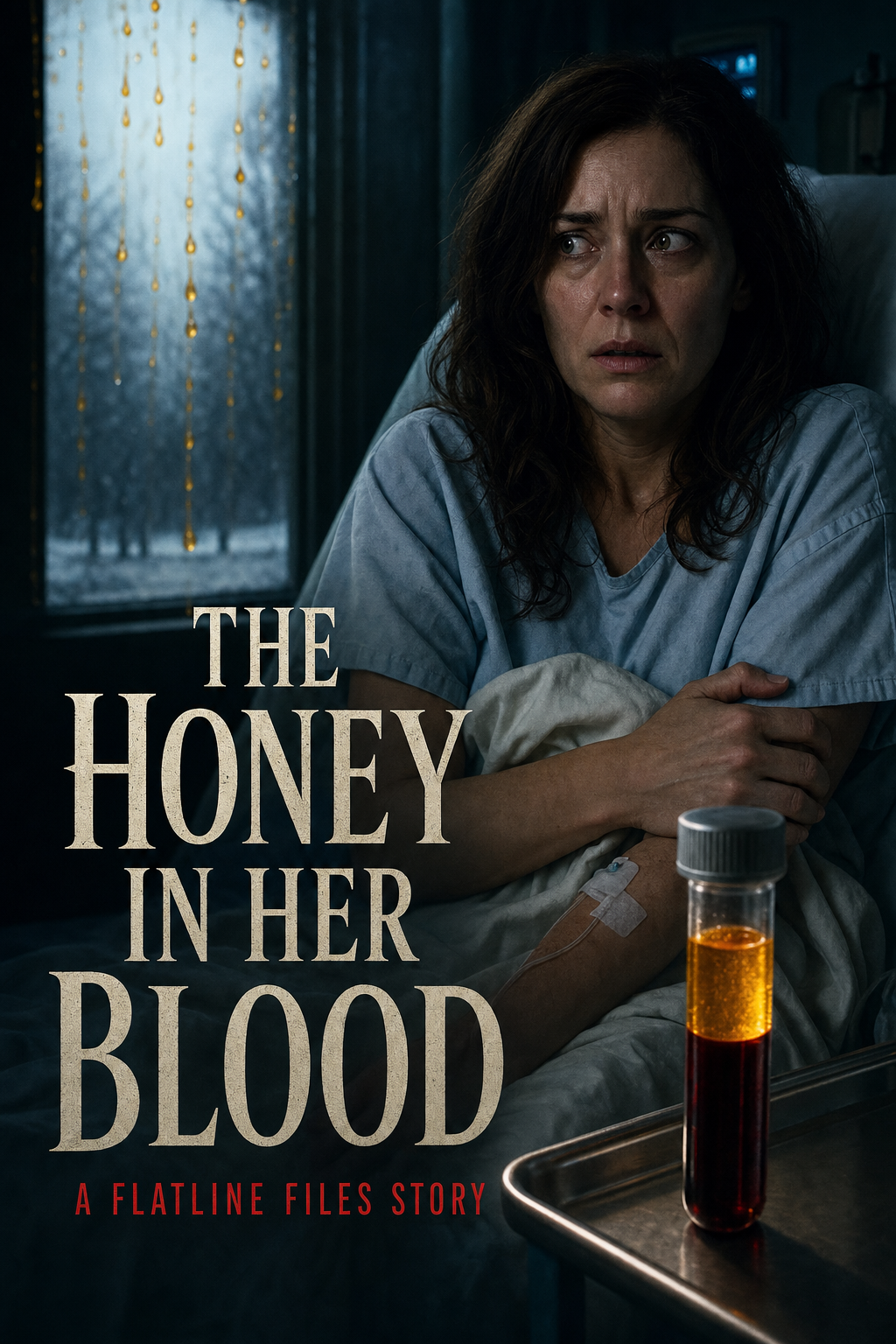
When thirty-five-year-old Mara Niles began fainting from dangerously low blood sugar and waking with a sweet taste in her throat, doctors considered diabetes medicine, liver trouble, a pancreas tumor, infection, and a lab mistake. Her tests showed that her body was making far too much insulin, yet scans found nothing wrong with the organs that should control it. Then a nurse drew Mara’s blood at midnight and watched the dark red sample separate into a clear golden layer that trembled against the glass like something alive.
The first time Mara woke on her kitchen floor, her cheek was stuck to a puddle of spilled orange juice.
Her dog, Pippin, was barking from the other side of the room. The little terrier did not come near her. He stood with his paws braced, his ears flat, staring at Mara as if she had become someone else while he slept.
Mara tried to sit up and found she could not make her right hand close. Her fingers shook above the tile. On the counter, she saw the cereal bowl she had dropped, the open carton of milk, and a grocery list in her own handwriting. The list said eggs, batteries, soap, and in dark circles beneath those words, sugar sugar sugar.
She did not remember writing that last part.
Her mouth tasted sweet. Not like candy. It was a thick, warm sweetness, like she had been licking a spoon left in a jar of honey. When she wiped her lips, her fingers came away dry.
Mara had worked in the billing office of a small dental clinic for eleven years. She was careful with dates, money, and details. She had never fainted before. She did not drink much. She did not take drugs. Her biggest bad habit was buying lemon cookies at the corner store when she was tired.
At the emergency room, a nurse checked her blood sugar with a finger-stick meter. The number was forty-one. A normal reading was usually much higher than that. The nurse gave Mara juice, crackers, and a small bag of sugar water through a tube in her arm.
By noon, Mara felt embarrassed more than sick. She wondered if she had skipped too many meals. The doctor wondered the same thing. He asked whether Mara had access to diabetes medicine, since too much insulin could make a person pass out.
Mara said no. Her father had diabetes before he died, but he had been gone seven years. She did not keep his old medicine. She did not even know where it had gone.
The doctor nodded, ordered blood work, and sent her home with a warning to eat regular meals and come back if she felt shaky again.
That evening, Mara ate two turkey sandwiches, a bowl of soup, and half a bag of pretzels. She felt silly doing it. By nine o’clock she was hungry again. By midnight, her hands were shaking so hard that she knocked a glass from the bathroom sink.
She drank apple juice straight from the bottle. She ate cereal without milk. She ate three spoonfuls of sugar from the canister, standing barefoot in her dark kitchen while Pippin watched from the doorway.
At two in the morning, she found six dead bees on the windowsill above the sink.
It was February. There was ice in the gutter outside. Mara stood looking at the bees for a long time before she swept them into her palm.
They were not frozen. Their bodies were soft and warm.
The next morning, the clinic called about her blood work. A woman with a calm voice said Mara needed to return to the hospital right away. Her insulin level was very high. Her body was making too much of the chemical that pulled sugar out of her blood.
There were ordinary reasons for that. A small growth in the pancreas could sometimes make extra insulin. Certain medicines could cause it. Severe liver disease could make it hard for the body to store sugar. Rare immune problems could confuse the body’s systems. The doctor said they would look carefully.
Mara heard the words, but she kept thinking about the bees.
At the hospital, they took more blood. A young nurse named Devon wrapped a blue band around Mara’s arm and frowned at the inside of her elbow.
“Do you work with plants?” he asked.
Mara looked down. There was a yellow smudge in the fold of her arm.
It looked like dried pollen.
She scrubbed at it with a wet paper towel. It did not smear. It lifted away in one dry piece, light as dust. Under it was a tiny red dot, no wider than a pinhead.
“Probably from outside,” Mara said, though she had not been outside except to walk from her apartment to her car.
Devon did not argue. He drew the blood, labeled the tubes, and sent them to the lab.
Mara spent two days in a hospital room with a window that faced a brick wall. Every few hours, someone checked her blood sugar. Every few hours, it dropped. Juice boxes and crackers piled up beside her bed. She ate until her stomach hurt, then watched the numbers slide down again.
Her sister, Lorna, came with clean clothes and a phone charger. Lorna was older by six years and had always been the person who knew what to do during a crisis. She spoke sharply to doctors and softly to Mara.
On the second night, Lorna opened Mara’s overnight bag and stopped.
“Why is there honey in here?” she asked.
Mara looked up.
At the bottom of the bag sat a small glass jar with a gold lid. It had no label. Thick amber honey filled it almost to the top.
Mara had never seen it before.
Lorna held the jar close to her face. “It smells strange.”
Mara smelled it too. Under the sweetness was something sour and metallic, like old pennies warmed in a fist.
They called Devon. He took the jar without touching the lid and placed it inside a clear evidence bag. He did not say why. His face had changed in a way Mara did not like.
Later, he returned alone. He stood by the door, keeping his voice low.
“Your blood sample did something unusual,” he said.
Mara gave a tired laugh. “That sounds like a bad way to begin a sentence.”
Devon did not smile. He explained that blood normally separated into layers after it was spun in a machine. Red cells went low in the tube. Clear yellow fluid, called plasma, rose above them. Mara’s sample had done that at first.
Then the yellow layer had thickened.
It had become cloudy and gold, almost like syrup. The lab worker thought the tube had been mixed up. They checked. It had Mara’s name, Mara’s date of birth, and Mara’s blood on the red cells at the bottom.
“Could it be something I ate?” Mara asked.
“Not like that,” Devon said.
He looked toward the hallway before adding, “The lab says there are grains in it. Tiny grains. They look a little like pollen.”
Mara remembered the yellow mark in her elbow. Her arm began to itch.
The doctors did not tell her the word impossible. They used better words. Contamination. Error. Rare reaction. They repeated the tests. They checked the medicine bags. They tested the air in her room. They scanned her abdomen, looking for a hidden tumor in the pancreas.
The scan was normal.
Her liver was normal. Her kidneys were normal. Her heart was normal. Her blood pressure dipped when her sugar fell, but rose again after she ate. The only clear problem was that Mara’s body seemed desperate to remove sugar from her blood as soon as it arrived.
On the third morning, a doctor suggested that Mara might be taking insulin without knowing it.
The words made her go cold.
He was careful. He asked about sleepwalking, depression, memory problems, and anybody who might want to hurt her. He asked if she had ever lost time.
Mara wanted to say no. Then she thought of the grocery list. She thought of waking on the floor. She thought of the jar in her bag.
“Sometimes,” she said. “Just little pieces.”
That night, they put a camera in the corner of her room, mostly to see whether she was getting out of bed and taking something. Mara agreed because she wanted an answer more than she wanted privacy.
She slept badly. She dreamed that she was standing in a dark field under a low summer sky. The field was full of white wooden boxes. Bees moved between them in great dark clouds, but their buzzing was deep and slow, like voices behind a wall.
In the dream, somebody called her name.
Not Mara.
Maribel.
She woke at 3:17 in the morning with both hands pressed hard against her ribs. Her skin was damp. Her throat hurt. The room smelled sweet enough to make her sick.
Devon was standing near the bed with the camera tablet in his hand.
“You need to see this,” he said.
The video showed Mara sleeping under a thin hospital blanket. For nearly an hour, nothing happened. Then she sat up without opening her eyes.
She walked to the bathroom. She stood at the sink with her head bent down. Her shoulders moved as if she were coughing, though there was no sound.
After seven minutes, she returned to bed.
The strange part came when Devon enlarged the picture.
On the bathroom mirror behind Mara’s sleeping face, small yellow shapes had gathered in a circle. They moved across the glass in a tight, turning pattern. There were too many to count.
When Mara opened the bathroom door after watching the video, there was nothing there. No insects. No pollen. Only a dark drip in the sink.
She leaned over it.
The drip was honey.
By then, Lorna had stopped telling Mara that everything would be all right. Instead, she brought a plastic storage box from their late mother’s house. It was filled with old papers, photographs, and things neither sister had looked at since the funeral.
“I found something,” Lorna said.
At the bottom was a newspaper clipping from thirty-five years earlier. The paper had yellowed around the edges. The headline was about a fire at an abandoned orchard outside town.
A beekeeper’s cottage had burned down. One woman had died. A baby had been found alive in a root cellar beneath the cottage.
Mara read the story twice. The baby had been unnamed. A hospital worker had called her Maribel in the report because that was the name written on a stained blanket beside her.
Lorna sat very still. “Mom and Dad never told us you were adopted until you were old enough to understand. But they told me you came from a bad place. I was little. I forgot most of it.”
Mara could barely breathe. “Why didn’t they tell me this?”
“They said the cottage was empty. They said your birth mother had died in the fire.”
Under the clipping was an old photograph. It showed a young couple standing outside a small white house with bee boxes behind it. In front of them was a woman holding a baby wrapped in a blanket.
The woman holding the baby was not Mara’s mother.
Her face was burned away by age and sunlight. But around her throat was a necklace made of small amber beads.
Mara touched the photograph. Her fingertips began to buzz.
Not metaphorically. Not in her head. The pads of her fingers vibrated against the paper, fast and faint.
She pulled her hand back. A dry yellow grain clung to the photograph where she had touched it.
The hospital brought in an infectious disease doctor, then a toxicology doctor. They asked about parasites, chemicals, mold, strange foods, old buildings, and insect stings. They tested the honey from Mara’s bag.
It was not honey from any flower they could name. It contained sugar, wax, and traces of Mara’s own blood.
It also contained human DNA from at least three people.
The doctors tried to keep Mara calm. They said a contaminated jar could explain that. They said the result did not prove anything. They said science sometimes began with results that did not make sense.
Mara understood what they were doing. They were building a fence around fear with careful words.
That afternoon, Pippin stopped eating at Lorna’s house. He sat beside Mara’s empty apartment door and scratched until his nails bled.
Lorna called to tell her. In the background, Mara could hear the dog whining.
Then she heard another sound through Lorna’s phone.
A low, crowded humming.
Mara asked Lorna what it was.
There was a pause.
“Nothing,” Lorna said too quickly. “Probably the refrigerator.”
Mara knew her sister was lying. Lorna had always been a poor liar. Mara made her turn on a video call.
At first, the apartment looked normal. The kitchen was dim. A few grocery bags sat by the door. Pippin crouched under the table, trembling.
Then Lorna aimed the phone at the ceiling vent.
Amber liquid was leaking through the metal slats.
It fell in slow bright drops onto the kitchen floor.
Mara asked Lorna to leave. Lorna said she had already called building maintenance. Mara begged her not to wait. At last, Lorna grabbed Pippin and ran out with the phone shaking in her hand.
As she reached the stairs, the humming inside the apartment grew louder.
It sounded almost pleased.
That evening, Mara’s sugar dropped so low that she lost track of the room again. Nurses gave her sugar water through her IV. Someone pressed a cold cloth to her forehead. She heard Lorna crying near the window.
In the dark behind her eyelids, Mara stood once more in the dream field.
This time she knew the white boxes were not empty.
They were breathing.
A woman stood between them with her back turned. Her dress was blackened. Her hair hung in long ropes. When she raised one hand, bees covered her skin from wrist to elbow, moving together like a sleeve.
“You were too small,” the woman said.
Mara tried to run, but her feet were stuck in the grass.
“We kept you warm.”
The woman turned around.
Her face was Mara’s face, only older and hollow-eyed.
“Now we need somewhere dry.”
Mara woke screaming and tore the IV from her arm.
A drop of blood struck the white blanket. Instead of soaking in, it sat on top like a red bead. Yellow wax spread around it in a perfect six-sided shape.
Devon saw it. So did Lorna. No one spoke for several seconds.
Mara understood then that the hunger was not hers. The fainting was not an illness trying to kill her. Something inside her had been lowering her blood sugar because it wanted sugar carried through her body. It wanted warmth. It wanted a place to grow.
She begged the doctors to cut it out.
They could not find anything to cut.
Before dawn, a fire alarm went off on Mara’s hospital floor. Later, the staff said there had been an electrical problem in a supply closet. Mara never saw flames. She only saw smoke drifting under her door and heard the building fill with alarms.
In the confusion, Lorna pushed Mara’s wheelchair toward the service elevator.
“We have to go,” she said.
Mara was too weak to argue. Her body felt empty, scraped clean from the inside. As the elevator doors closed, she looked down at her bandaged arm.
A single bee crawled slowly over the white tape where the IV had been.
It was small. It was wet. Its wings had not opened yet.
Mara watched it lift its head toward her pulse.
Then, from somewhere deep beneath the skin of her wrist, another tiny wing began to beat.