
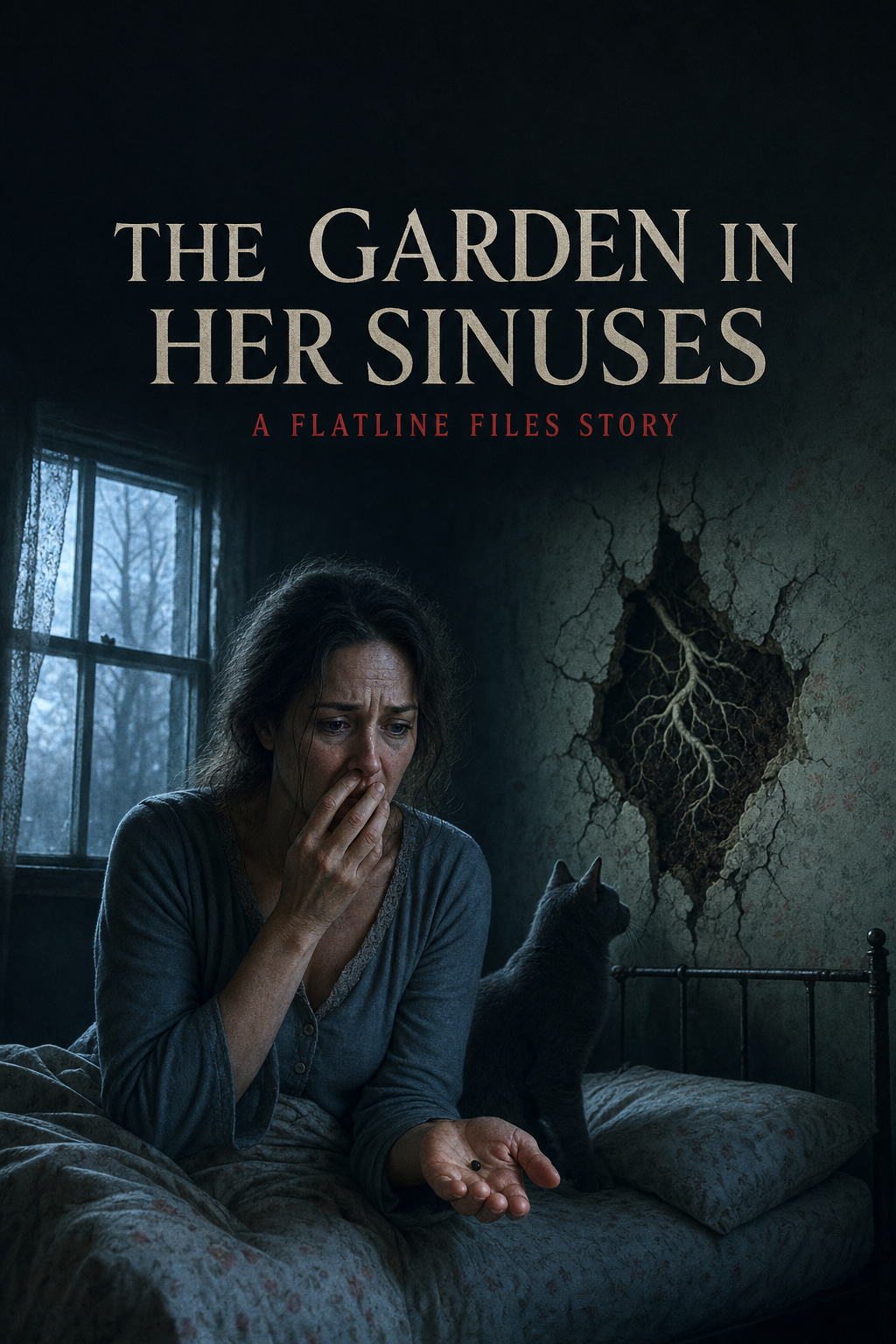
Thirty-seven-year-old Celia Voss began waking with pounding headaches, nosebleeds, and tiny black husks lodged inside her nostrils. Doctors considered allergies, a sinus infection, dry winter air, a bleeding problem, mold, and even the chance that Celia was putting something in her nose while asleep. Then a laboratory technician split open one of the husks and found a pale green root curling around a fresh red thread of Celia’s blood.
Celia woke before her alarm because something was scratching behind her eyes.
At first, she thought it was a dream. She lay still in the gray light of her bedroom, listening to rain tick against the window. The scratching came again. It was small and dry, like fingernails brushing the inside of a paper bag.
Then warm blood ran across her upper lip.
She sat up too fast. The room tipped sideways. Blood dripped onto the white sheet in bright, round drops. When Celia pinched her nose and leaned over the wastebasket, something hard fell out with the blood.
It was no bigger than a grain of rice. Black. Split down one side. It looked like an empty seed shell.
She told herself it had come from her blanket. Her cat, Moth, had dragged dirt through the house all week after tearing into a dead potted fern. Celia rinsed the little thing down the sink, changed the sheet, and went to work with a roll of tissue in her purse.
By lunchtime, the headache had settled behind her nose. It felt less like pain than pressure. She kept wanting to press two fingers against the bridge of her nose, as if she could hold something still inside her head.
That night, she dreamed she was standing in a greenhouse full of wet leaves. The glass walls were black with rain. Somewhere under the soil, something tapped three times.
Celia’s first nosebleed seemed ordinary until a black husk fell from her nostril, and the pain returned with a dream of a rain-dark greenhouse. She could still blame dry air, stress, or dirt in the house, but she saved the next husk instead of throwing it away.
Three mornings later, it happened again.
This time she was in the shower. Steam filled the bathroom. She bent to pick up the soap, and blood poured from her left nostril in a thin, steady stream. Two black husks landed on the shower floor and stuck beside the drain.
Celia stared at them until the water went cold.
She put both husks into a clean spice jar. Then she searched every room in the small house she had bought six months earlier. She checked the attic, the basement, the furnace closet, the old window frames, even the bags of potting soil in the garage.
She found nothing like them.
The house had belonged to an elderly woman named Mrs. Bell, who had died the year before. Celia knew almost nothing about her except that she had lived alone and kept a garden behind the house. The garden was gone now. The yard had been covered with winter weeds and a warped wooden shed.
At the urgent care clinic, a nurse took Celia’s blood pressure and asked whether she had been using any nasal spray, cocaine, cleaning chemicals, or new medicine.
Celia said no to all of it.
The doctor looked inside her nose with a bright little scope. He saw swollen tissue and a small raw place that could explain the bleeding. He said winter air and allergies could make the inside of the nose crack and bleed. He gave her saline spray, an allergy pill, and a paper bag for the lab sample.
“Bring in one of those things if it happens again,” he said, trying not to sound amused.
Celia wanted to be angry at him. Instead, she felt relieved. A dry nose was boring. A dry nose was fixable.
For two days, she used the spray exactly as directed. She ran a humidifier beside her bed. She washed every sheet and vacuumed the bedroom twice.
On the third night, Moth began growling at the wall behind Celia’s bed.
He was an old, quiet cat. He almost never made a sound. But at 2:11 in the morning, he stood with his back arched and his gray fur raised along his spine. He stared at the wallpaper behind the headboard.
Tap. Tap. Tap.
Celia held her breath.
The sound came from inside the wall.
The clinic found only irritated tissue, so allergies and dry air remained possible. But Celia’s cat heard tapping in the bedroom wall at the same hour as her nightmares, making her house seem tied to the strange husks.
She did not sleep after that.
At sunrise, Celia dragged the bed away from the wall. There was a thin crack in the yellow wallpaper near the baseboard. A line of dark dampness ran from the crack toward the carpet.
She touched it with one finger. It was not water. It was cool and oily, and it smelled like wet leaves left in a bucket.
Behind her, Moth hissed.
Celia called a handyman named Drew, who had repaired the back steps when she moved in. He came that afternoon with a flashlight and a tool belt. He peeled back a corner of the wallpaper, frowned, and tapped the wall with his knuckles.
“There could be a leak,” he said. “Maybe an old pipe.”
He cut a square opening between two wall studs.
There was no pipe.
There was only dirt.
Not insulation. Not rot. Actual dark garden dirt packed into the wall cavity. Thin white roots ran through it, each one no thicker than sewing thread.
Drew backed away so fast that he bumped the dresser.
“That should not be there,” he said.
He pulled out one of the roots with gloved fingers. It snapped. A clear liquid beaded from the broken end.
That night Celia developed a fever of 101 degrees. Her face hurt badly enough that she went to the emergency room. The doctor there ordered a CT scan, which is a special X-ray that shows the inside of the head in thin slices.
The scan showed swollen sinuses. The hollow spaces behind Celia’s nose and cheeks were full of fluid and inflamed tissue. That fit with a bad sinus infection. It explained the fever, the pressure, and maybe the bleeding.
But it did not explain the husks.
The emergency doctor admitted that part.
“We will treat the infection,” she said. “And we will send the samples to the lab.”
Celia spent the night in a hospital bed under a thin blanket. Every time she drifted off, she saw the greenhouse again. This time she saw shelves of clay pots. Each pot held a small black seed.
On every pot, someone had written a name in white paint.
One said CELIA VOSS.
A wall repair exposed damp soil and white roots where the house should have contained empty space, while Celia’s scan confirmed a real sinus infection. The infection explained her pain but not the seeds, and her fever dreams now placed her own name inside the greenhouse.
The antibiotic helped her fever by the second day. It did nothing for the pressure.
At home, Celia found a voicemail from the hospital laboratory. She called back during her lunch break and spoke to a technician named Priya.
Priya sounded careful. Too careful.
“The material is plant matter,” she said. “At least, mostly plant matter.”
Celia sat down at her kitchen table.
“Mostly?”
“There were cells from your nasal lining on it. That can happen if it scraped you. But one husk had a very small root inside. It was fresh.”
“Fresh as in alive?”
There was a pause.
“Yes.”
Celia looked through the kitchen window at her yard. Rain had stopped. The dead grass lay flat and silver under the clouds.
“What kind of plant?”
“We do not know yet.”
That answer frightened her more than if Priya had named something terrible.
That evening, Celia drove to the county records office. She told herself she was being sensible. Old houses had strange histories. Maybe Mrs. Bell had kept unusual plants. Maybe the soil in the wall came from a badly sealed old garden room. Maybe roots had reached an open vent, and Celia had somehow breathed in seeds while she slept.
The woman at the records desk found an old property map.
Celia’s house had been built in 1958. Before that, the lot had held a glass greenhouse owned by a plant seller named Arthur Bell. The greenhouse had burned down in 1949 after a lightning storm.
“Bell?” Celia asked.
The clerk nodded. “Same family, maybe. That name comes up a lot on that block.”
There was also an old newspaper article on microfilm. Arthur Bell had been known for rare climbing plants. After the fire, neighbors complained about a strange vine growing through cracked foundations and storm drains. The city ordered the site cleared.
Three workers dug out the roots.
Two became sick with severe nosebleeds and fever.
The third disappeared on his way home.
The laboratory confirmed that a living root had grown inside one husk, and property records linked Celia’s home to a burned greenhouse where workers once suffered the same bleeding illness. A normal infection no longer explained enough, so Celia began to believe something beneath the house had reached her.
She should have left that night.
She packed a bag. She put Moth in his carrier. She called her sister, Janine, and asked if she could stay over.
Then she walked into the bedroom and found the wall opening covered.
Drew had nailed a sheet of plywood over it before leaving. Now the plywood bulged outward as if someone had pressed a shoulder against it from behind.
Tap. Tap. Tap.
Moth began yowling inside his carrier.
Celia grabbed her bag and ran for the front door. Her keys were on the hook beside it. She reached for them and stopped.
There was soil beneath every fingernail on her right hand.
Her fingers ached. The nails were bent and packed with dark mud.
She had no memory of digging.
Outside, she found the back yard torn open.
A long trench crossed the grass from the bedroom wall to the old shed. It was not deep, only a few inches. It looked as if someone had scraped it with both hands. Roots filled the trench in a white tangled braid.
At the far end stood the shed door, open wide.
Celia had never been inside. The lock had been rusted shut when she bought the house.
Now the lock lay in the mud, split cleanly in two.
Inside the shed, beneath broken rakes and flowerpots, was a square wooden hatch set into the floor.
Someone had painted words on it in faded white letters.
DO NOT WATER.
Celia did not open it. Not yet. She called Janine with shaking hands and asked her to come immediately. Then she called the police.
The police officer who arrived was kind but plainly doubtful. He looked at the trench, the roots, and the broken lock. He wrote notes. He said kids sometimes broke into sheds. He said roots could spread in strange ways.
When Celia showed him the hatch, he did not touch it.
“You should let the city inspect this,” he said.
As he walked back to his car, he paused at the trench.
“Ma’am,” he said, “you might want to see a doctor again about your hands.”
Her right fingertips were bleeding where the skin had split.
Celia lost time and woke to evidence that she had dug a root-filled trench to the locked shed, where a hatch warned against water. She could no longer trust her own sleep, and she needed help before the thing beneath the yard made her open it.
Janine arrived after dark with coffee, a flashlight, and the hard look she wore whenever Celia was in trouble.
They had not been close since their mother died. Janine thought Celia worked too much and worried too quietly. Celia thought Janine treated every problem like a broken appliance.
But when Janine saw Celia’s swollen face and cracked fingertips, her anger vanished.
“You are coming with me,” she said.
“I need to know what is under there.”
“No. You need to get out.”
As if the house had heard them, the lights flickered.
A smell drifted through the open shed door. Wet leaves. Sweet rot. The same smell that had leaked from the wall.
Celia bent over suddenly and vomited into the grass. Something small clicked against a stone.
A black husk lay in the spit.
Janine saw it. Her face went blank.
That changed everything. Until then, Janine had been trying to explain Celia away. A panic attack. A bad infection. Sleepwalking. Mold. Anything that lived in a world with rules.
She picked up the hatch’s rusted ring with a gardening glove from the shed wall.
“We open it once,” Janine said. “Then we leave. Together.”
The hatch lifted with a groan.
Below was a narrow brick stairway leading down into darkness. Cool air rose from it. The air smelled green.
Celia switched on her flashlight and went first.
The stairs led to a low room under the shed. It had once been part of the greenhouse cellar. Broken clay pots lined the walls. Rusted pipes hung from the ceiling. In the center stood a stone basin filled with black water.
White roots covered everything.
They climbed the walls like veins. They threaded through the brick. They curled around old tools and cracked pots. In several places, the roots ended in black husks.
On the far wall hung a row of small wooden signs.
Each carried a name.
Arthur Bell. Elsie Bell. Thomas Bell. Ruth Bell.
Below them was one new sign, clean and pale.
CELIA VOSS.
Janine finally witnessed a husk emerge from Celia herself, and the sisters opened the shed hatch together. Beneath it they found the remains of the Bell greenhouse, a root-covered basin, and a fresh name marker showing that whatever grew there had chosen Celia.
Celia stepped closer to the basin despite Janine grabbing her sleeve.
The black water was still. It reflected the flashlight beam and nothing else.
Then a bubble broke the surface.
Inside the bubble was a tiny black seed.
Celia remembered something from the newspaper article. Arthur Bell had sold climbing plants. The article had called one of them a rare mourning vine, brought from somewhere overseas. It grew fast in warm wet places. It was said to flower only after a death.
But this was not a vine. Not exactly.
On the floor beside the basin, half buried in roots, lay a leather notebook. Celia pulled it free. The pages were swollen and stuck together, but a few lines could still be read.
Arthur Bell’s handwriting shook across the paper.
It drinks grief first. Then blood. It learns the shape of the house from the people inside it.
Farther down, another line had been scratched so hard that it nearly tore the page.
Never let it grow a sleeper.
Celia’s headache exploded.
She fell to her knees. The cellar vanished around her.
She was standing in the greenhouse from her dreams. Rain slammed against the glass ceiling. Clay pots stood on shelves in long rows. Every pot held a black seed. Every pot bore the name of someone dead.
At the end of the room, a woman in a dark dress stood with her back turned.
Mrs. Bell.
The old woman slowly lifted one hand and pointed down.
Celia looked at the soil around her feet.
White roots were winding around her ankles.
She woke with Janine slapping her cheek.
“Celia, get up!”
Roots were moving across the cellar floor. Not quickly. Not like snakes. They grew in small pale jumps, each one no longer than a breath. They reached for Celia’s hands.
Janine dragged her toward the stairs.
Behind them, the basin water began to rise.
The notebook revealed that Arthur Bell believed the plant fed on grief and blood and created sleeping people who carried it beyond the greenhouse. Celia understood that her missing hours were not simple sleepwalking, and she and Janine had to escape before the roots could anchor inside her for good.
They made it into the yard before the first roots reached the stairway.
Janine shoved Celia toward the car. Celia stumbled, coughing hard. Blood filled her mouth. A husk pressed against the back of her throat.
She spat it into the grass.
It split open at once.
A white root pushed into the wet soil.
Janine stared at it. Then she ran to the shed, grabbed the gas can for the lawn mower, and came back.
“Move,” she said.
“The house will catch.”
“Then we call the fire department from the road.”
Celia looked at her house. It was the first place she had ever owned. She had painted every room herself. Her mother’s yellow mixing bowl sat in the kitchen. Her books were stacked by the sofa. Moth was crying in his carrier on the passenger seat.
Then the bedroom window cracked from inside.
A thick pale root pressed against the glass.
Celia took the gas can from Janine.
“The shed first,” she said.
They poured gasoline across the open hatch, the broken floorboards, and the roots crawling through the trench. Celia used the lighter from her purse. Her hands shook so badly that Janine closed both hands over hers.
The flame caught with a soft blue pop.
For one second, nothing happened.
Then the fire raced along the roots beneath the grass.
The yard flashed with blue-white lines. The shed groaned. From below came a sound like hundreds of dry fingernails scratching at glass.
Celia and Janine ran to the car.
At the end of the driveway, Celia looked back.
The shed had become a square of orange fire. Smoke rolled from the yard in greenish waves. The house had not caught yet, but every bedroom window was fogged from the inside.
In the upper window, Celia saw a shape standing behind the glass.
It had her height.
It raised one muddy hand.
Celia chose to burn the shed and the roots despite the risk to her home, because each new husk could plant the thing elsewhere. As the fire spread underground, she saw a figure shaped like herself inside the house, suggesting the greenhouse had already made more than one version of her.
The fire department saved most of the house. The shed collapsed. The city dug up the back yard and removed truckloads of soil. A hazmat crew, called in because of the strange plant material, wore white suits and said very little.
Celia spent four days in the hospital. Doctors cleaned her sinuses and removed swollen tissue. The final scan showed no roots, no seeds, and no hidden growth. Her fever went away. The headaches slowly faded.
Priya from the laboratory visited once during her lunch break.
“The samples burned in the storage freezer,” she said quietly. “That does not make sense, but they are gone.”
“Was it a plant?” Celia asked.
Priya looked toward the door before answering.
“I do not know what it was.”
That was the closest thing to an answer Celia ever got.
By spring, the house had been repaired. Celia did not move back in. She stayed with Janine and began looking for a small apartment across town. Moth slept on Janine’s couch as if he had lived there forever.
Some nights Celia still dreamed of rain striking greenhouse glass. But the tapping was gone.
In April, a package arrived for her at Janine’s house. There was no return address. Inside was the leather notebook from the cellar, dried and wrapped in brown paper.
Celia almost threw it away without opening it.
Instead, she turned to the final page.
The last words were not Arthur Bell’s handwriting. The ink looked fresh. The letters were thin and green.
THE SLEEPER DOES NOT CARRY THE GARDEN.
Below that, another sentence had been added.
THE SLEEPER IS THE GARDEN.
Celia read it three times before she noticed the dark crescent under her left thumbnail.
She scraped at it with a pin.
A single black husk fell onto the table between her hands.
The fire destroyed the visible roots, and Celia’s medical tests finally became normal, but no one could identify what had grown beneath the house. Months later, the notebook gave her a worse answer: she had not merely carried the garden away, and a fresh husk beneath her nail proved that the fire had not ended anything.