
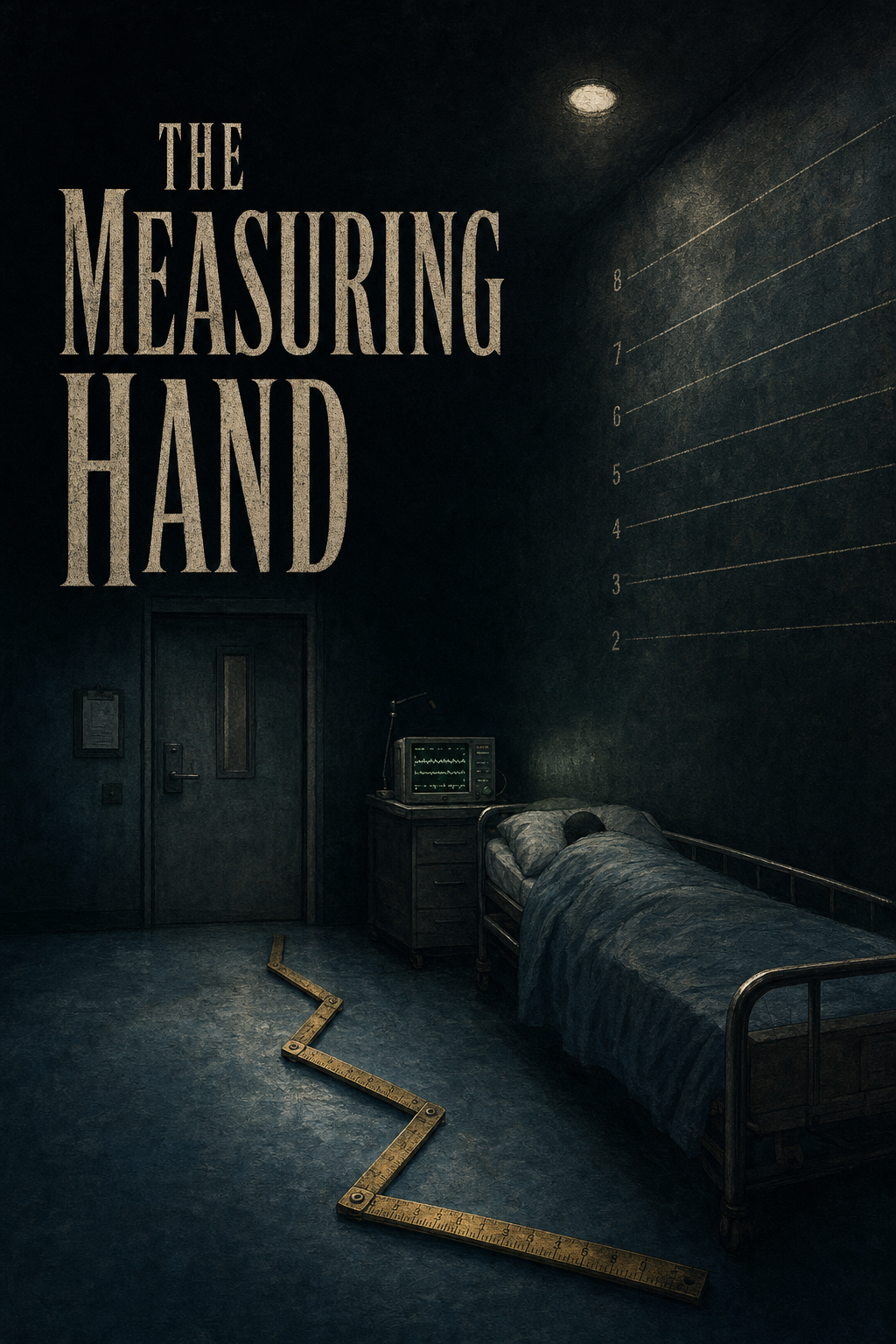
After thirty-nine-year-old Mara Venn began waking with stabbing shoulder pain and the sick feeling that her left arm was longer than it should be, doctors considered nerve damage, migraines, seizures, medicine reactions, anxiety, and a sleep disorder. Her strength tests and X-rays were normal, yet every morning she found fresh pencil marks on walls far beyond her reach. Then, during an overnight sleep study, a camera showed Mara lying perfectly still while a metal ruler slid across the floor toward her bed.
Chapter 1
Mara first noticed the trouble when she woke with her left hand resting against her bedroom window. Her bed stood on the other side of the room. She slept alone, with her door locked, and there was no way she could have reached the glass without getting up.
Her shoulder hurt so badly that morning she could not pull on a sweater. When she looked in the bathroom mirror, her left arm appeared normal. It was not longer. It was not bent. Still, when she closed her eyes, she felt it stretching through the wall behind her, feeling along pipes and wires inside the building.
She worked restoring old maps at the county records office. All day she used rulers, soft brushes, and tiny tools. By noon, her pain had eased. She told herself she had slept in a strange position.
The next morning, she found a thin pencil line across the wall above her bed. It ran straight from the ceiling corner to the closet door. At one end was a small mark like the side of a carpenter’s square. Mara stood on her mattress and reached as high as she could. Her fingertips stopped almost a foot below it.
She scrubbed the line away. That night she pushed a chair under her bedroom doorknob and wrapped a scarf around her left wrist before going to sleep. She woke with the scarf still tied in place, but another line crossed the wall. This one ended at the window, where someone had written a careful number: 18.
Mara’s pain and strange body feeling first seemed like a bad sleeping position, but the high pencil marks gave her proof that something was happening while she slept. She still believed there might be an ordinary cause, so she needed a doctor before fear made her believe the marks had come from somewhere else.
Chapter 2
The clinic doctor checked Mara’s reflexes by tapping below her knees. He asked her to squeeze his fingers, follow a light with her eyes, and lift both arms. Mara did everything normally. He ordered blood tests and an X-ray of her shoulder. The X-ray showed no broken bone, no joint problem, and no sign that anything had changed shape.
He explained that nerves could make a person feel things that were not there. A pinched nerve, a migraine, a small seizure, even stress could twist the brain’s picture of the body. Mara understood that. She was not angry at him. She only wished he had seen the marks.
Her blood tests were normal. A specialist gave her a test that measured the nerves in her arm. Small stickers sent gentle signals through her skin. The results were normal too.
At home, Mara placed her phone on a shelf and aimed it at the bed. In the morning, the video had stopped at 2:14 a.m. The screen showed gray blocks and a frozen picture of her sleeping face.
Her apartment wall had a new drawing. Four straight lines made a tall rectangle around the bedroom door. Beside it was another number: 18, 6, 3.
Mara carried the measurements to work. She laid a ruler across the old plans she was cleaning that day, plans for the Venn Foundry, a brick factory torn down before she was born. Her stomach tightened. The numbers matched the size of a narrow inspection room shown on the blueprint.
The room had been called the Gauge Chamber. Workers had measured machine parts there before they were sent into the factory floor.
Medical tests found no injury or nerve disease, but Mara’s overnight recording failed at the exact time a new set of measurements appeared. The marks matched a long-destroyed factory room, which made her fear that her sleeping body was being used to measure a place that should no longer exist.
Chapter 3
Mara did not want to return to her apartment. She spent the next night at a sleep center, where a nurse placed soft sensors on her chest, head, and legs. They watched brain waves, breathing, heart rhythm, and movement. Mara tried to joke about it, but her left shoulder had begun to throb before dark.
At 2:14, she woke to a hard click beneath the bed.
The room was dark except for the green light of the monitor. Mara could not move her left arm. It felt pulled straight beside her, longer and colder than the rest of her body. She tried to call for help. Only a thin breath came out.
A metal ruler lay on the floor between the bed and the wall. It had not been there earlier. Mara watched it creep forward one inch at a time. Click. Slide. Click. Slide.
The nurse came running when Mara’s heart rate jumped. The ruler stopped at once. Her arm snapped back into its normal place with such force that Mara cried out.
The next day, the sleep doctor showed her the video. Mara had not moved. Her legs stayed still. Her right arm stayed under the blanket. Yet the ruler had crossed the room by itself. The brain-wave record showed Mara was awake for most of it.
There was one more thing. At 2:14, the sensors on her left arm had recorded a sudden stretch between her wrist and shoulder. Not a possible stretch. Not an injured stretch. The distance had increased by nearly three feet for eleven seconds.
Mara went back to the records office and found the oldest file she could. In 1948, the factory had burned after an overnight shift. The report said the Gauge Chamber door had jammed. Three workers had been trapped inside while the building was measured for repairs the next morning.
The sleep study proved Mara was awake when an ordinary ruler moved toward her and her arm briefly measured far longer than human anatomy allows. The old factory report gave the pattern a darker meaning: the destroyed Gauge Chamber had once held trapped workers, and something connected to it was still taking measurements at 2:14.
Chapter 4
The old foundry lot was now a vacant field behind a discount store. Mara went there at dusk with the copied blueprint folded in her pocket. Rain had softened the ground. The place smelled of wet weeds and rust.
She found the former Gauge Chamber by counting from the cracked loading ramp. The blueprint said it should be beneath a patch of grass near a bent chain-link fence.
Her left shoulder began to burn.
Mara knelt and brushed away mud. A straight black line showed beneath the grass. Then another. They were not stones. They were narrow strips of old tile, making the same rectangle that had appeared around her bedroom door.
At the center lay a brass measuring rule, black with age. Numbers were stamped along its edge. The last number was 18.
Mara understood then that the marks in her home had not been random drawings. Something had been laying out the old room again and again, searching for its exact shape. It had used her arm because she had spent her days measuring old things, because she had carried the blueprints home in her mind.
She picked up the brass rule. The pain stopped.
For one warm second, Mara thought she had won. Then the ruler clicked open by itself. Its folded sections stretched across the wet ground, pointing past her shoes toward the discount store.
The store had been built over the rest of the factory foundation.
That night, Mara slept at her sister’s house with both arms held close beneath the blanket. At 2:14, she woke without pain. Across the dark bedroom, a long pale line appeared on the wall, starting near the floor and rising toward the ceiling.
At its end, in careful pencil, was a new number.
36.
Mara found the buried outline of the Gauge Chamber and learned that the measuring force had begun rebuilding its lost room through her. Taking the old ruler ended her pain for one night, but its new measurement pointed toward the store built over the factory, and the growing number showed that the room was no longer finished with her.