
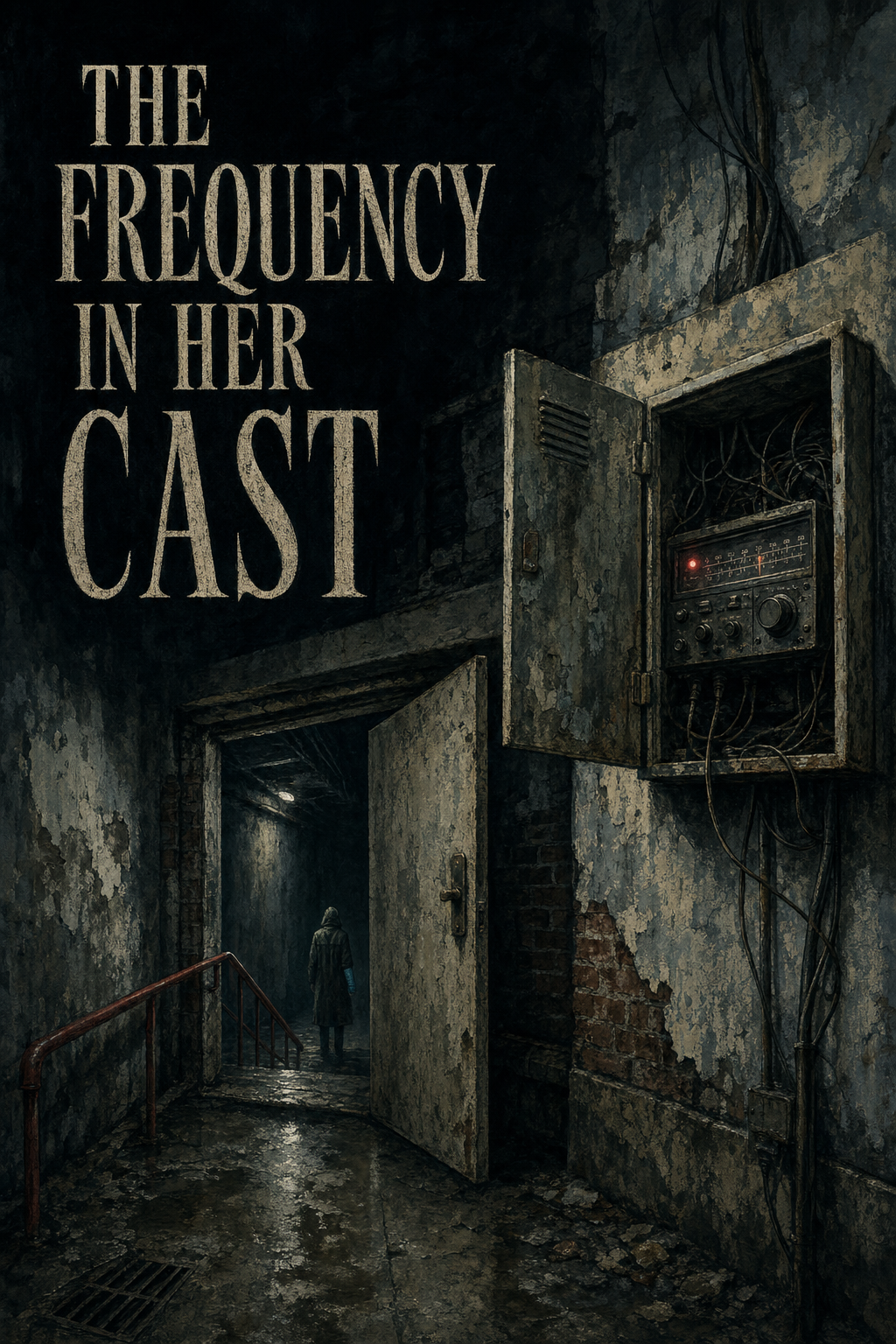
After Cass Reyes broke her wrist, she began hearing faint emergency broadcasts buzzing beneath her cast, and doctors considered nerve pain, medicine side effects, anxiety, a loose phone speaker, and a hidden piece of metal from the fall. Her X-rays looked clean, and the sound stopped whenever anyone else put an ear near her arm. Then Cass recorded the static overnight and heard a terrified dispatcher give the address of her own apartment building.
Cass first heard the voice at 2:11 in the morning, three days after she broke her wrist.
She was lying on her couch with her left arm raised on a pillow, trying not to think about the dull ache under her bright blue cast. Rain tapped the windows. The refrigerator hummed. Her phone was charging on the far side of the room.
Then a dry crackle came from inside the cast.
At first Cass thought it was the plaster shifting. She held still. The crackle came again, sharper this time, followed by a woman’s voice so faint that Cass had to press her good ear against her own forearm.
“Unit twelve, repeat your location.”
Cass sat up so fast that her wrist throbbed.
The voice vanished. In the quiet afterward, her apartment felt too small. She checked her phone. No calls. No radio app open. The television was dark. Even the little battery radio she kept for storms was in a kitchen drawer with dead batteries inside it.
She told herself it had been a dream. Pain medicine could do strange things, especially when a person was half asleep. Her doctor had warned her that the first week after a fracture could be rough.
Still, Cass did not go back to sleep until sunrise.
Cass has a fresh wrist fracture and a new cast, so pain, poor sleep, and medicine seem like reasonable explanations for the voice she hears. Yet the sound appears to come from inside her arm, and Cass cannot explain why it spoke like an emergency dispatcher. She decides to mention it at her follow-up appointment instead of frightening herself alone.
The next afternoon, Cass sat in an exam room at the orthopedic clinic while Dr. Mehta looked at her new X-rays.
“The break is lined up well,” he said. “That is good news. Keep the cast dry. No lifting. Come back in three weeks.”
Cass watched the black-and-white picture on his screen. Her wrist bones looked thin and strange, like small white stones beneath dark water.
“Could there be something else in there?” she asked.
“In your wrist?”
“Like a piece of metal. I fell near an old fence behind the warehouse.”
Dr. Mehta enlarged the image. “I don’t see anything. Why?”
Cass almost lied. The words sounded foolish even in her head. But she had spent the whole morning hearing a faint hiss whenever she bent her elbow.
“I keep hearing radio sounds in my cast.”
He did not laugh. Cass appreciated that.
He asked whether she had numb fingers, burning pain, weakness, fever, or a bad smell coming from the cast. She had none of those. He tapped the blue plaster gently and checked the color of her fingertips.
“Sometimes nerves send mixed-up signals after an injury,” he said. “The brain can turn pain into buzzing, clicking, even voices. Stress can make it stronger too.”
“I know what a radio sounds like.”
“I believe you hear something. I’m saying the source may not be outside your body.”
Cass nodded, though the answer left her cold.
On the bus home, she kept her cast tucked beneath her coat. She was embarrassed by how badly she wanted the sound to return. If it came back, then she had not imagined it. If it did not, she might have to accept that something in her own mind had made the voice.
That night, she put her phone on the coffee table and opened a sound-recording app.
At 2:11, the static returned.
This time it was louder.
“Unit twelve, repeat your location,” the woman said.
A man answered through heavy bursts of noise. “Basement level. Water coming through the east wall. We have two trapped.”
Cass stared at her cast. The sound seemed to tremble up through the bones of her arm and into her teeth.
Then the woman said, very clearly, “Address confirmed. Fourteen Bellwether Court.”
Cass lived at fourteen Bellwether Court.
The doctor finds no metal, infection, or dangerous pressure under Cass’s cast, leaving nerve pain and exhaustion as possible answers. But her phone captures a radio call that names her own building and describes people trapped below it. Cass now has proof that she heard something real, though she does not know whether it is current, old, or meant for her.
Bellwether Court was a narrow brick building with six apartments, a laundromat on the corner, and a basement nobody used.
Cass had lived there for four years. She knew its groaning pipes, its broken front step, and the smell of old cooking that drifted through the hallways every evening. She also knew that the basement door in the lobby was always locked.
Her landlord, Mr. Weller, called it storage.
“Nothing down there but pipes and old junk,” he had once said when Cass asked whether she could keep a bicycle inside.
That evening, Cass stood across the street under an umbrella and looked at the building. Every window glowed yellow except hers. Her apartment was on the third floor, near the back. It looked harmless. It looked exactly as it had every other rainy night.
Her cast buzzed beneath her sleeve.
“Water rising,” a man said. “Please send somebody.”
Cass walked into the lobby.
The basement door was at the end of the hall. Gray paint peeled from its lower half. A small brass padlock hung from the latch, but the lock was not closed. It rested open, as if someone had forgotten to snap it shut.
Cass stared at it for a long time.
She told herself there had to be a simple reason. Perhaps a neighbor was using a scanner. Perhaps the building had old wiring that picked up signals. Perhaps Mr. Weller was repairing something below.
Then she heard a bang from behind the door.
Not a loud bang. Just one hard knock.
Cass should have gone upstairs. She knew that. Her wrist hurt. Her phone battery was low. She was alone.
Instead, she pushed the door open.
The stairs went down farther than she expected. A weak bulb burned halfway below, throwing a yellow circle onto wet concrete. The air smelled of rust, wet cardboard, and something sour beneath it.
“Hello?” Cass called.
No answer came from the basement.
But from inside her cast, the dispatcher said, “Cass Reyes, can you hear me?”
Cass dropped her phone.
The recorded address leads Cass back to her own building, where the basement door has been left open and the voice now says her full name. Ordinary causes such as nearby radio traffic or old wiring still seem possible, but the sound has become personal. Cass enters the basement because someone may truly be trapped below.
Her phone hit the concrete steps and kept shining upward. Cass picked it up with shaking fingers.
“Who is this?” she whispered.
The cast answered with static.
She went down one step at a time. The basement was not a single open room. It was divided by old wooden walls into narrow storage spaces. Most doors had been removed. Inside were broken chairs, rolled rugs, paint cans, and boxes swollen from years of dampness.
Water dripped somewhere in the dark.
Cass moved her phone light across the walls. Near the far corner, she found a small metal cabinet bolted beside a rusted pipe. Its door stood open.
Inside was an old radio receiver the size of a toaster. Thick wires ran from it into the wall. Dust covered everything except the round tuning dial, which had been wiped clean by someone’s fingers.
A paper label was taped above it.
EMERGENCY RELAY — BELLWETHER CIVIL DEFENSE.
Cass had heard of civil defense only in old movies. It was the kind of thing people built during the Cold War, when they feared bombs and sirens.
She leaned closer. The receiver was dead. No lights. No power cord. The wires were cracked and green with age.
Her cast hissed.
“Do not touch the panel,” the dispatcher said.
Cass pulled back.
For one second, a bright squeal filled the basement. Her phone screen blinked. In that squeal, she heard another voice—a child’s voice—counting slowly.
“One. Two. Three. Four.”
Then silence.
Behind the receiver cabinet, Cass noticed a patch of wall where the paint was newer. A thin line of water ran from beneath it and crossed the floor toward a drain.
She touched the wall with her good hand. It was cold.
“Is anyone there?” she called.
Something knocked from the other side.
Three times.
Cass ran upstairs.
She did not stop until she reached the sidewalk. Rain soaked her hair and ran down her face. She called the city’s non-emergency line, then hung up before anyone answered. What was she supposed to say? My broken wrist is receiving messages from an old radio in my basement?
Instead, she called her older brother, Luis.
Luis arrived twenty minutes later in his work truck. He listened without interrupting, which was worse than disbelief. When Cass showed him the open basement door, he grew serious.
“You should not be down here alone,” he said.
“I know.”
“No. I mean ever.”
They went down together. The radio cabinet was still there. The old receiver was still dead. But the patch of newer paint had changed.
A dark wet line ran down its center.
It looked like the wall had begun to crack open.
Cass discovers that her building once held an emergency radio relay, although the equipment appears too old and powerless to work. A hidden wall behind it seems wet and unstable, and something knocks from beyond it. Luis believes the basement itself may be unsafe, so Cass must decide whether to report the danger or learn why the radio knows her name.
Luis wanted to call the fire department at once. Cass agreed until her cast began talking again.
“Do not let them seal the door,” the dispatcher said.
Luis froze. “What was that?”
Cass looked at him.
“You heard it?”
He nodded slowly.
The relief that flooded her lasted only a second. She was not losing her mind. That meant something else was happening.
Luis held his ear near her cast. The voice faded into a low hiss. When he pulled away, it became clear again.
“Cass Reyes,” the dispatcher said. “You need to remember the stairs.”
Cass felt the basement tilt beneath her feet.
She remembered the stairs.
Not the basement stairs. Another set. Concrete steps. A red handrail. Her mother pulling her by the arm while rain hammered the ground above them.
The memory was not new, exactly. It had always been there in pieces. Cass had been six years old when her family left Bellwether Court. Her mother had said there had been a flood in the building. Luis had been ten. Their father had been working nights.
After the flood, they moved across town. They never spoke about the old apartment again.
“Mom said there was a pipe burst,” Cass said.
Luis did not answer.
“Luis.”
He rubbed both hands over his face. “It was more than a pipe.”
He told her that heavy rain had filled the basement after a storm drain collapsed behind the building. Water had forced its way through an old tunnel beneath the property. Their mother had taken Cass and Luis downstairs because the lobby had begun filling with smoke from an electrical fire.
“Why would she take us down there?” Cass asked.
“Because there was another exit.”
There had been a civil defense shelter under the basement, Luis said. A small concrete room from the 1950s. The emergency relay had been connected to a phone line and a roof antenna. Their mother knew about it because she had once worked for Mr. Weller’s father.
“We got out through the tunnel,” Luis said. “Mom carried you most of the way.”
“And Dad?”
Luis looked toward the wet wall.
“Dad came back for someone.”
Cass had always been told her father died in a highway accident two years later.
“That was a lie,” she said.
Luis’s eyes filled. “Mom thought it would be easier.”
The cast crackled so loudly that both of them flinched.
A man’s voice came through it now. Weak. Distant.
“I’m still down here.”
Cass knew the voice before he said another word.
It belonged to her father.
Luis confirms that Cass lived through a basement flood as a child and that an old shelter lies behind the damaged wall. Cass learns that her father did not die in the accident she was told about; he disappeared after returning underground during the flood. The radio is no longer only a strange signal, because it carries a voice Cass recognizes, and the hidden space must be opened before the growing water destroys it.
The fire department came after all.
Luis called them while Cass stood in the lobby, wrapped in a blanket from a neighbor’s apartment. She did not tell the firefighters about the voices. She told them about the crack, the water, and the old room beneath the basement.
That was enough.
They brought lights, helmets, and a small camera on a long cable. Cass watched from behind the yellow tape while they examined the wall. One firefighter said the crack might lead to an old service tunnel. Another said the building should be emptied until they knew whether the foundation was shifting.
Mr. Weller arrived in a robe and slippers, furious that people were being sent outside in the rain. He stopped being angry when he saw the radio cabinet.
“That was supposed to be removed,” he said.
“When?” Cass asked.
He looked at her cast, then at Luis. “A long time ago.”
“My father went down there.”
Mr. Weller’s face lost its color.
“Your father was told not to,” he said.
“Was he trapped?”
The old man did not answer.
One of the firefighters called from the basement. “We found an opening.”
A low rumble passed beneath the floor.
Everyone in the lobby went quiet.
Then Cass heard her father’s voice in the cast again, louder than before.
“The water is back.”
She pushed past Luis and the tape before anyone could stop her.
At the basement door, a firefighter caught her good arm. “Ma’am, you cannot go in there.”
“My father is in there.”
“There is no one in there.”
“You don’t know that.”
He looked at the cast, perhaps thinking she was in shock. Cass did not blame him. She would have thought the same thing yesterday.
Her cast began to tremble. Fine white dust drifted from the edge near her thumb.
Under the plaster, her wrist burned.
The dispatcher returned. “Cass, listen carefully. The east stair is gone. Use the red rail.”
“There is no red rail,” Cass said.
Luis, standing behind her, made a strangled sound.
“There used to be,” he whispered.
Emergency crews find the hidden opening and begin evacuating the building, while Mr. Weller’s reaction suggests that the old flood was covered up. Cass believes her father may still be calling from the shelter, even though no one else thinks survival is possible. When the signal gives directions known only from her childhood, Cass understands that it is leading her somewhere beneath the basement.
The crack in the wall widened before the firefighters could brace it.
A sheet of wet plaster fell away, exposing a low concrete doorway behind it. Brown water pushed through the gap. Beyond it, Cass saw a narrow stairwell dropping into darkness.
On the wall beside the stairs was a red metal handrail.
Luis grabbed Cass’s shoulder. “No.”
But a firefighter was already stepping through with a light. Another followed behind him. Cass slipped free and went after them.
“Cass!” Luis shouted.
The stairwell smelled like wet stone and old pennies. Her cast kept buzzing. The air grew colder with every step.
At the bottom was a concrete room with rusted shelves, a broken desk, and a radio antenna box bolted to the wall. Water covered the floor to Cass’s ankles.
On the far side stood a second door.
It had been blocked by fallen boards and a collapsed cabinet. A firefighter shone his light across it.
“There’s a void behind that,” he said. “Could be another room.”
Cass stared at the door. Her father’s voice came from the cast, but now it sounded close enough to touch.
“I tried to get back,” he said.
For years Cass had imagined her father leaving. She had imagined him choosing a road, a truck, another life. It had been easier than imagining him lost beneath her childhood home.
“I know,” she whispered.
The radio box on the wall clicked on by itself.
A red light glowed behind its cloudy plastic cover.
The dispatcher spoke through the room’s speaker and Cass’s cast at the same time.
“Evacuate immediately. Structural failure is expected.”
The firefighters began backing toward the stairs.
Cass did not move.
From behind the blocked door came three hard knocks.
Not a ghostly sound. Not a distant echo.
Wood struck wood.
Three times.
One firefighter stepped toward the door. “Is somebody back there?”
A man answered, muffled by the boards.
“Please.”
Cass’s knees nearly gave out.
The firefighter called for tools. Luis came down despite orders and held Cass upright while the others pulled away the fallen cabinet. The ceiling groaned. Water rushed faster around their boots.
Behind the door was not another room.
It was a narrow tunnel, half filled with mud.
And in the mud, caught beneath a rusted metal support, lay an old emergency radio handset.
Its cord disappeared into the darkness.
There was no person there.
But the handset was still warm.
Cass reaches the buried shelter and follows the signal to a sealed tunnel where a voice seems to knock from behind a blocked door. The rescue team finds no trapped survivor, only an old radio handset still warm in the floodwater. As the structure begins to fail, Cass must leave without knowing whether her father’s voice was a recording, a memory, or something still waiting below.
The building was condemned before sunrise.
Cass and Luis watched from the back of his truck as workers carried boxes from the apartments. Rainwater shone in the street. The firefighters had shut off power and blocked the basement entrance with boards, but everyone knew the boards would not hold for long.
Mr. Weller sat under the awning of the laundromat with a blanket around his shoulders. He looked smaller than Cass had ever seen him.
Before he left, he gave Cass a yellowed envelope.
“Your mother asked me to keep this,” he said. “I should have mailed it after she died.”
Inside was a letter in her father’s handwriting.
It was dated the night of the flood.
Cass read it sitting in Luis’s truck while dawn pressed gray light across the windshield.
He wrote that the tunnel had collapsed behind him. He wrote that he could hear the rescue workers above but could not reach them. He wrote that the emergency radio still worked for a few minutes at a time. He had asked the dispatcher to tell his family he loved them.
The last line was written in a shaky hand.
I can hear Cass crying upstairs. Tell her not to be afraid of the dark.
Cass folded the letter against her chest.
“Why didn’t they get him out?” she asked.
Luis stared ahead. “The building was filling with smoke. The tunnel was falling in. They said there was no safe way.”
“Did Mom know he was alive?”
“I think she knew enough.”
For a while they said nothing.
The cast on Cass’s arm had gone quiet. Its silence hurt more than the static ever had.
Later that morning, a nurse at the clinic removed it because the swelling in Cass’s wrist had gotten worse. Beneath the blue plaster, her skin was pale and wrinkled from dampness. There was no wound, no metal, no burn.
But near the inside of her wrist was a faint red mark.
It looked like a thin cord had been pressed into her skin.
The nurse frowned. “Did something get inside the cast?”
Cass did not answer.
That night, Luis drove her to his house across town. He made up the guest bed and left a glass of water beside her lamp. Cass lay awake with her bare wrist resting on the blanket.
At 2:11, the lamp flickered.
From the kitchen, far away from any radio, a woman’s voice spoke through a burst of dry static.
“Unit twelve,” the dispatcher said. “We have another caller below Bellwether Court.”
The shelter is sealed and Cass finally learns that her father died trapped in the tunnel after trying to return to his children. The radio may have carried his final calls across time, grief, or the flooded wires beneath the building. Cass leaves with proof that the signal has followed her, because at the same hour the dispatcher reports that someone is still calling from below the condemned home.