
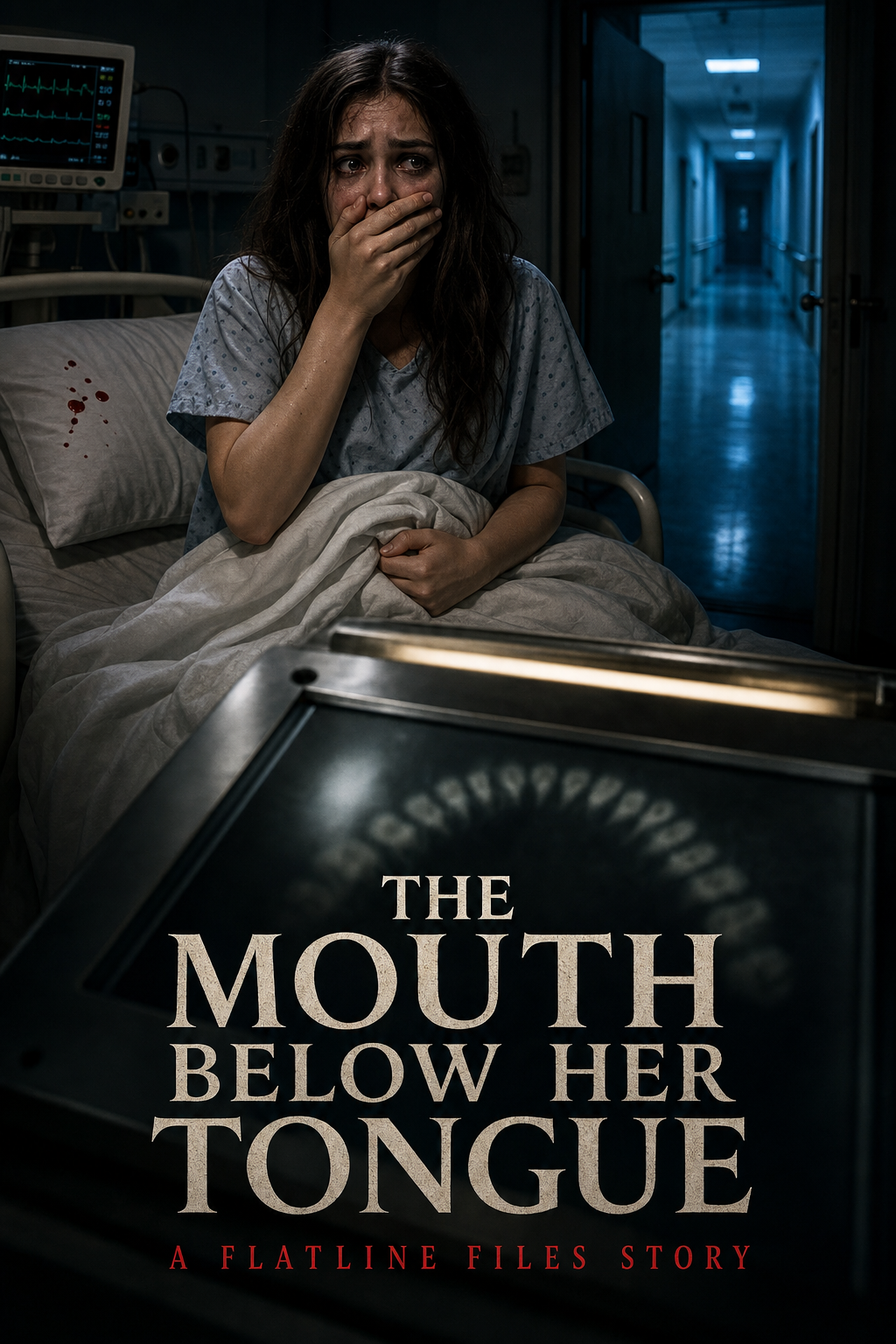
After Claire Wren began waking with blood on her pillow and a painful lump beneath her tongue, doctors considered an infected salivary gland, an allergy, a dental problem, stress, and a small harmless cyst. The lump vanished whenever anyone examined her, yet Claire kept hearing a child softly clicking its teeth inside her mouth. Then a scan showed a perfect row of tiny teeth buried where no teeth could possibly grow.
Claire woke with the taste of pennies in her mouth.
At first, she thought she had bitten her tongue in her sleep. That happened sometimes. She ground her teeth when she worried, and lately she had worried about everything: rent, her mother’s bad knees, the broken heater in her apartment, the fact that she was twenty-nine and still working double shifts at a grocery store.
But when she touched her tongue, her fingers came away red.
There was blood on the pillowcase too. Not much. Three dark drops near her cheek.
Claire sat up quickly. Her bedroom was still dark except for the orange streetlight pushing through the blinds. She went to the bathroom, switched on the light, and opened her mouth.
At first she saw nothing.
Then she lifted her tongue with two fingers.
A pale bump had risen from the soft skin beneath it. It was round, wet, and about the size of a grape. A thin red line ran across it.
Claire stared at the bump.
Click.
The sound came from inside her mouth.
She froze.
Click. Click.
It was a small sound. Like someone tapping a fingernail against a glass. Or like tiny teeth touching together.
Claire slammed her mouth shut so hard that pain shot through her jaw.
For several seconds, she stood over the sink with both hands gripping the counter. Her own face looked frightened in the mirror. Her eyes were wide. Blood had marked one corner of her lips.
She told herself it was her jaw joint. People got clicking jaws. Her cousin had one. Sometimes it popped when he chewed gum.
But Claire did not chew gum.
And the sound had come from below her tongue.
By daylight, the swelling was gone.
Claire almost talked herself out of going to urgent care. She had no health insurance through work, and missing a shift meant losing money. But when she drank coffee, a hot sting ran across the bottom of her mouth. She also found a second spot of blood on her collar.
The doctor at the clinic was a tired-looking woman named Dr. Patel. She listened while Claire explained the lump, the bleeding, and the clicking sound.
Claire left out the part about teeth.
Dr. Patel looked under her tongue with a small light. She pressed gently beneath Claire’s jaw. Then she checked her ears, throat, and neck.
“I do not see a lump now,” she said. “But there are little scratches under your tongue. You may have irritated a salivary gland.”
“Can salivary glands make a clicking sound?” Claire asked.
Dr. Patel smiled in the careful way doctors smiled when they did not want to embarrass someone. “Your jaw can click. Your ears can make strange sounds when you are congested. Stress can make those things seem louder.”
She suggested warm salt-water rinses, more fluids, and a dental visit if the pain continued. She also told Claire to return right away if she had fever, trouble breathing, or swelling in her neck.
For two days, Claire felt foolish.
Then she woke at 3:17 in the morning with someone whispering her name.
“Claire.”
The voice was soft and wet.
She bolted upright in bed. Her room was empty. The closet door was closed. Her cat, Miso, sat on the windowsill with its back arched and fur standing high along its spine.
“Claire,” the voice said again.
It came from her own mouth.
She clamped both hands over her lips.
Miso hissed at her.
Claire stumbled to the bathroom. Under the bright light, she saw the bump again. It was larger than before. It pushed the floor of her mouth upward. A thread of clear fluid shone along one side.
Click. Click. Click.
Claire grabbed her phone and took a picture.
On the screen, the picture showed her open mouth, her tongue, and darkness beneath it.
No bump.
She took six more pictures. Every one showed smooth skin.
When she looked in the mirror, the lump was still there.
Claire did not sleep again that night.
The next morning, she called in sick and made an emergency appointment with a dentist. The dentist was a young man named Evan Moore, who spoke too fast and wore bright blue shoes.
He checked every tooth. He tapped them with a metal tool. He took X-rays.
“No infection,” he said. “No cracked tooth. Your gums look good.”
Claire watched him studying the black-and-white image on his computer.
His smile faded.
“What?” she asked.
“There may be something on the image,” he said. “It could be a shadow from the machine.”
“What kind of something?”
He turned the screen toward her.
Claire did not understand the X-ray at first. She saw the white roots of her teeth and the curved shape of her jaw. Then she saw a second curved line below the roots of her lower teeth.
There were small white shapes along it.
Twenty, maybe more.
They looked like teeth.
Not adult teeth. Tiny teeth. Pointed teeth, crowded together in a neat half-circle beneath her tongue.
Claire felt her stomach turn.
“Could that be another person’s X-ray?” she asked.
Evan looked offended for half a second. Then he looked scared.
“No,” he said. “This is yours.”
He took another image.
The row was gone.
He checked the machine. He checked Claire’s name. He took a third image.
This time there was only one small white mark beneath her jaw, no bigger than a grain of rice.
“I want you to see an ear, nose, and throat specialist,” Evan said. “Today, if possible.”
Claire left with copies of the first image in a brown envelope. She did not look at them again until she was sitting in her car.
When she opened the envelope, the strange row of teeth was missing from the print.
Only the grain-sized white mark remained.
That afternoon, Claire began to wonder if she was losing her mind.
Her father had lost his mind near the end, or that was what her mother used to say. He had started hearing someone in the walls of their old house. He would stand in the hallway at night with one ear pressed to the plaster.
“Your sister is crying,” he once told Claire when she was eight.
Claire had no sister.
Her father died when she was eleven. A heart attack, her mother said. Quick and sad and ordinary.
Claire had spent years trying not to remember him standing in the dark hallway.
At the specialist’s office, a nurse asked Claire if she had been under unusual stress. Claire said yes. The nurse asked if she had ever heard voices before. Claire said no.
That was almost true.
While she waited alone in the exam room, the clicking started.
Click. Click.
Then the soft wet voice said, “Mama lied.”
Claire screamed.
The specialist hurried in with the nurse behind him. Dr. Harlan was an older man with silver hair and kind eyes. Claire tried to explain, but the words came out tangled.
“There is something under my tongue,” she said. “It talks. It said my mother lied.”
Dr. Harlan did not laugh. He examined her carefully. This time the swelling did not disappear.
He went quiet.
“There is a mass there,” he said at last. “We need imaging.”
“A mass?”
“A lump. That word sounds frightening, but there are many kinds. A blocked gland can make one. So can a cyst, which is a pocket of fluid. We need to see it more clearly.”
Claire was sent for a CT scan. The machine was a large white ring that hummed around her head. She lay still with her arms tight against her sides.
Halfway through the scan, she heard breathing.
Not the machine. Not her own breath.
It was a small, shallow breath, coming from beneath her tongue.
“Do not let them cut me,” the voice whispered.
Claire jerked so hard that the technician stopped the scan.
When Dr. Harlan came back, he looked pale.
“The scan shows a growth in the floor of your mouth,” he said. “It has bone-like material inside it.”
“Teeth,” Claire said.
He did not answer right away.
“Sometimes a rare kind of growth can contain hair, skin, or even tooth-like tissue,” he said carefully. “It can happen when cells grow in the wrong place before birth. It does not mean what you think it means.”
“What do I think it means?”
Dr. Harlan looked at the floor.
Claire began to cry.
She called her mother from the parking lot.
Her mother answered on the fourth ring. “Claire? Honey, are you all right?”
“Did I have a twin?”
There was silence.
Cars hissed past on the wet road. Claire could hear the clinic doors opening and closing behind her.
“Why would you ask that?” her mother said.
“Because there is something in my mouth. They found teeth under my tongue. It said you lied.”
Her mother made a sound Claire had never heard before. It was not quite a sob. It was like someone choking on a memory.
“Come home,” her mother said.
Claire had not been to her childhood home in almost two years. It was a narrow brick house at the end of a quiet street, with plastic flowers in the front window and a porch that sagged in the middle.
Her mother sat at the kitchen table holding an old cardboard box.
She looked smaller than Claire remembered.
“Your father made me promise,” she said.
Claire stayed standing. “Promise what?”
Her mother opened the box.
Inside were hospital papers, old photographs, and a tiny knitted cap yellowed with age.
“You were not twins,” her mother said. “Not exactly.”
Claire laughed once. It came out sharp and ugly. “That does not explain anything.”
“The doctor said there had been two babies at first. Very early. Then one stopped growing.”
Claire stared at her.
“They said it was absorbed,” her mother whispered. “That means your body took it in. They told us it happens. They said there was nothing left.”
“Nothing left,” Claire repeated.
Her mother’s hands shook over the box. “After you were born, you would not nurse. You screamed all night. Your father said he heard another baby crying when he held you.”
Claire felt the lump move beneath her tongue.
Click.
“He wanted doctors to look again,” her mother said. “But they told him he was grieving something that never lived. He got worse after that. He started hearing things. He thought the house was full of children.”
“Was it?” Claire asked.
Her mother looked at her, and Claire knew the answer.
“I do not know,” she said.
That night, Claire slept in her old bedroom because she was too afraid to drive home.
She pushed a chair under the doorknob. She put on every light. She lay awake beneath the faded quilt and listened to the old house settle around her.
At 2:13 in the morning, her mouth began to hurt.
The pain was terrible. It ran from her tongue down her throat and deep into her chest. Claire rushed to the bathroom and looked in the mirror.
The swelling below her tongue had split open.
There was no blood at first.
There was a small mouth.
It was no larger than a walnut. Its lips were pale and smooth. Inside were tiny white teeth, close and sharp. A little tongue moved behind them.
Claire made a broken sound and fell against the sink.
The mouth opened.
“I was cold,” it said.
The voice was not a child’s voice now. It was Claire’s voice, but thinner. Younger. As if it had been waiting many years to grow strong enough to speak.
Claire ran from the bathroom. Her mother found her crouched in the hallway, spitting blood into her hands.
By the time they reached the emergency room, the mouth had closed. The doctors saw only a torn swelling under her tongue.
Claire was admitted to the hospital before dawn. Dr. Harlan came in later that morning. He said a surgeon should remove the growth. He said the scans suggested a rare tissue mass. He said it could become infected or block her airway if it kept growing.
Claire wanted it gone.
She wanted it gone more than she had ever wanted anything.
But when she tried to sign the surgery form, something moved under her tongue.
“Please,” it whispered.
Claire dropped the pen.
For the next two days, she lived in a private room under bright lights. Nurses checked her temperature and blood pressure. They gave her pain medicine and soft food. The swelling came and went.
Sometimes it was only a sore place.
Sometimes she could feel the little teeth pressing upward.
Her mother sat beside the bed and cried quietly when she thought Claire was asleep.
On the second night, Claire heard her father’s voice from the corner of the room.
“Do not leave her alone,” he said.
Claire opened her eyes.
No one stood there.
But the hospital monitor beside her bed gave one long, steady beep.
Then a second heartbeat appeared beneath her own.
The nurses came running. They checked the wires and changed the pads on her chest. The second line vanished.
One nurse said the monitor had made a mistake.
Claire did not argue.
Before surgery, Dr. Harlan asked if she wanted to talk to someone from the hospital mental health team. He spoke gently. He said fear, lack of sleep, and pain medicine could make a person hear things.
Claire almost said yes.
Then the mouth below her tongue said, “Tell him about the blue dress.”
Claire looked at Dr. Harlan.
“My father used to keep a blue dress in the attic,” she said.
Her mother gasped from the chair by the window.
“How did you know that?” Claire asked her.
Her mother covered her face.
“It was for a girl,” she whispered. “Before we knew.”
Claire understood then that whatever lived inside her had not learned things by magic. It had been there. It had heard every argument, every bedtime story, every whispered confession through the years.
It knew her father’s voice because it had heard him from inside her.
It knew loneliness because it had never known anything else.
That made Claire feel worse, not better.
On the morning of surgery, she was rolled toward the operating room. The ceiling lights passed above her in white squares. Her mother walked beside the bed until the doors marked SURGERY stopped her.
“I am sorry,” her mother said.
Claire wanted to say she forgave her.
Instead, her jaw locked.
The pain below her tongue became unbearable.
The orderly stopped the bed. “Claire?”
She could not answer.
Her tongue lifted by itself.
The small mouth opened beneath it.
Everyone saw it.
The orderly screamed. A nurse stumbled backward into the wall. Dr. Harlan stood frozen at the double doors with his surgical cap already on.
The mouth was larger now. Its teeth were no longer tiny. They were the size of baby teeth, wet and bright beneath Claire’s tongue.
“I do not want to be cut out,” it said.
Claire could feel its fear moving through her own body. It was not separate from her. Not completely. Its panic made her heart race. Its grief filled her throat.
Then it said something else.
“There are more.”
Claire stopped struggling.
“What?” Dr. Harlan asked.
The mouth closed.
On the floor beneath the hospital bed, a drop of blood fell from Claire’s lips.
It spread across the pale tile in a thin red line.
Then another line joined it.
And another.
The blood moved in a circle around the bed, making the shape of a small open mouth.
From somewhere inside the walls, far beyond Claire’s room, came the soft sound of children clicking their teeth.
Click.
Click.
Click.