
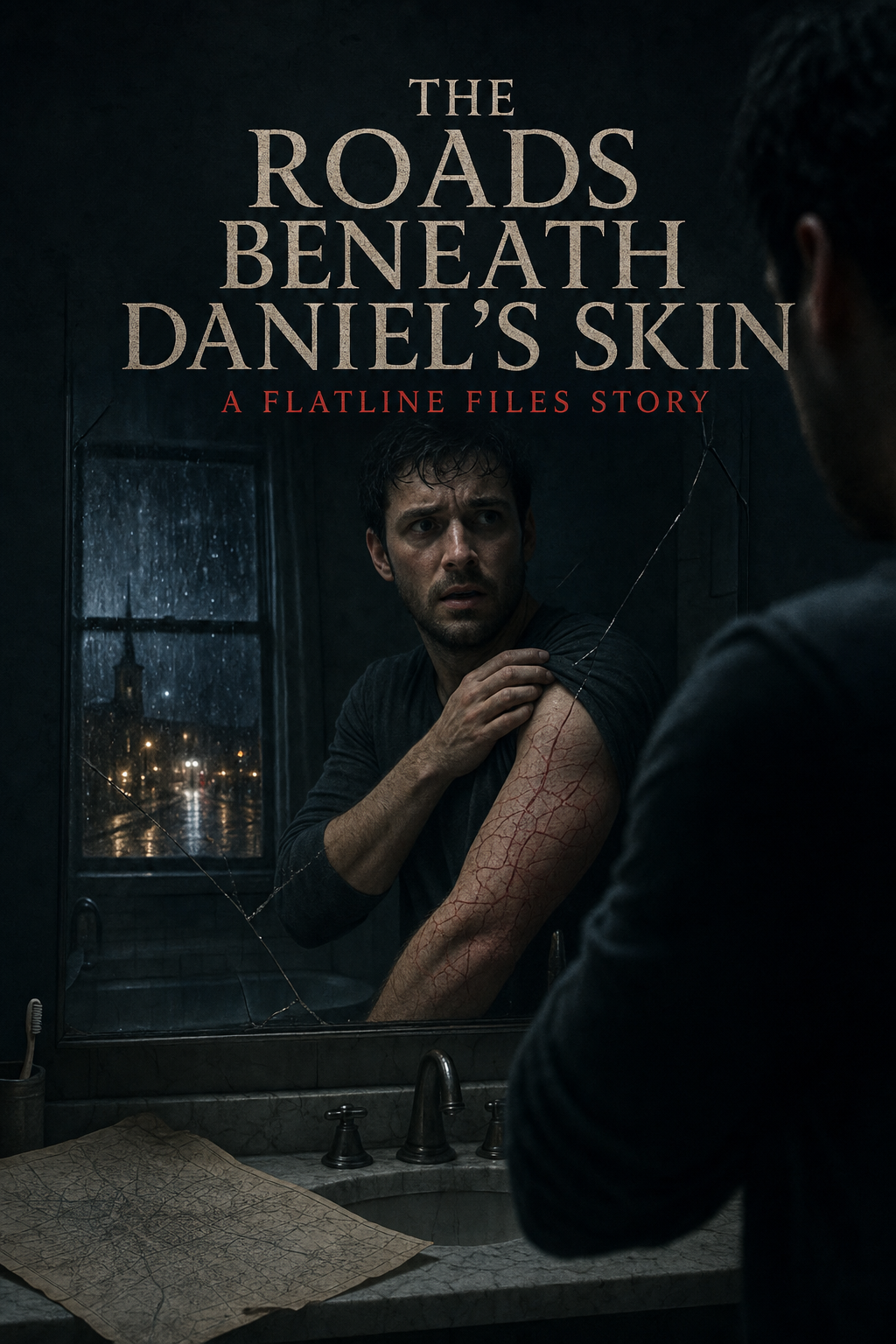
When Daniel Price woke with thin red lines crawling across his arms and chest, doctors considered hives, an allergic reaction, a blood vessel problem, stress, and even marks caused by sleepwalking. The lines faded before most tests could be completed, but each morning they returned in a different pattern, and Daniel noticed they matched streets, alleys, and footpaths in his hometown. Then one night, the map beneath his skin showed a road that had been buried for more than sixty years—and it was leading straight toward his house.
Daniel Price woke at 4:18 in the morning because his arm hurt.
At first, he thought he had slept on it wrong. His left arm was numb from the shoulder down, heavy as wet laundry. He rolled onto his back and rubbed at it in the dark.
Then he felt the raised lines.
They ran from his wrist to the inside of his elbow. There were three of them, thin and hot beneath his fingertips. One bent sharply near his thumb. Another crossed it. A third ended in a small round mark in the center of his palm.
Daniel switched on the lamp.
The marks were red, but not like scratches. They looked like something had pressed a map into the skin of his arm from below. The lines were too straight in some places and too neat at the corners. He stared at them until his eyes began to water.
He lived alone, and he had no pets. His bedroom door was locked. His windows were shut.
Still, he got out of bed and checked the whole apartment.
Nothing was out of place. No broken glass. No wet footprints. No sign that anyone had come inside.
When he returned to the bathroom, the lines had spread. A red path now crossed his ribs beneath his T-shirt. Another ran up the side of his neck.
Daniel took pictures with his phone. His hand shook so badly that the first few came out blurry.
By sunrise, the lines were gone.
Daniel was thirty-two and worked at a hardware store on the edge of Bellwether, a small town with an old mill downtown and new houses spreading across the hills. He was not the kind of man who rushed to a doctor over a rash. He had spent two winters with a sore shoulder before finally learning he had torn something lifting boxes of tile.
But he showed the photographs to a doctor at an urgent care clinic that afternoon.
The doctor, a tired woman named Dr. Arlen, looked closely at the screen. She asked whether Daniel had changed soap, laundry detergent, sheets, food, or medicine. She asked if he had been hiking, working with chemicals, or sleeping somewhere else.
Daniel said no to all of it.
She examined his arms. His skin looked normal now, except for a few pale spots where the redness had been.
“It may be hives,” she said. “Hives can appear suddenly and vanish fast. Stress can bring them on. So can allergies, heat, cold, pressure, sometimes nothing we ever find.”
“Do hives make little street corners?” Daniel asked.
Dr. Arlen gave him a careful look. “They can make strange shapes.”
She suggested an allergy pill and told him to return if he had trouble breathing, swelling in his throat, fever, chest pain, or marks that did not fade.
Daniel nodded. He felt foolish before he even left the clinic.
That feeling lasted until the next morning.
He woke at 4:18 again.
This time the lines covered his stomach.
He stood before the bathroom mirror in his underwear, holding his breath. There were dozens of red paths across him. Some were thin as threads. Others were wider, made of tiny red dots close together. They crossed his belly, curved around his hip, and climbed toward his chest.
He took photographs from every angle.
Then, because he could not stop himself, he opened the map app on his phone.
Daniel had grown up in Bellwether. He knew the streets well. He knew where every pothole was on his drive to work. He knew the shortcut past the old mill. He knew which back road flooded when it rained.
The shape on his stomach looked like the road behind the grocery store.
He zoomed in on the map.
His breath caught.
The red line across his ribs bent at the same sharp turn as Cinder Lane. A small round blotch near his navel sat exactly where the town fountain stood. Two tiny branching lines near his left side matched the narrow walking paths through Harlow Park.
He told himself it was only his mind finding pictures in random shapes. People saw faces in clouds. They saw animals in stains on walls.
Still, he went to work with his shirt buttoned all the way to his neck.
At lunch, he showed the pictures to his coworker, Marcy. She was older than Daniel by twenty years and had known him since he was a teenager. She leaned over his phone near the break-room vending machine.
“That looks painful,” she said.
“It is. Not awful. It burns.”
“You should go back.”
“I did. They think it is hives.”
Marcy studied one picture longer than the others. “Why did you draw on it?”
“I didn’t.”
“That square. Right there.”
Daniel looked.
Near the center of his chest was a red square with four lines leading away from it. He had not noticed it before. It did not match the current town map.
But it felt familiar.
That afternoon, Daniel printed an old street map from a history website. Bellwether had once been larger around the mill. Before the river changed course, there had been worker homes, a church, a market, and a whole row of brick buildings near the water.
The square on his chest matched a place called Market Cross.
Market Cross had been torn down in 1962.
The next day, Daniel went to his regular doctor. Dr. Singh listened without laughing. She looked at the pictures, checked his pulse and blood pressure, and examined his skin with a bright magnifying lamp.
“The pattern is unusual,” she said.
Daniel was grateful for the word unusual. It was better than crazy.
She ordered blood tests. She explained that some illnesses could cause rashes or marks on the skin. A problem with blood vessels could leave red or purple lines. An immune problem, where the body attacked itself by mistake, could cause strange skin changes. Some infections could do it too.
“Could it be in my head?” Daniel asked.
Dr. Singh paused before answering. “Stress can cause real symptoms. That does not mean you are making them up.”
“But could I be doing it in my sleep?”
“Maybe. We will start with what we can test.”
His blood work came back almost normal. No fever. No clear infection. No sign of a major immune illness. His liver and kidneys were fine. His blood cells looked healthy.
Dr. Singh sent him to a skin specialist anyway.
For four nights, Daniel slept badly. He set alarms for 3:45, 4:00, and 4:15. He drank coffee before bed. He taped a small camera to a shelf facing his bed.
On the first night, he woke at 4:18 with the lines burning beneath his shoulder blades. On the second, he woke at 4:18 with them across both thighs.
On the third, he did not wake at all.
The camera showed him sitting upright at 4:17.
Daniel watched the recording at his kitchen table, his coffee growing cold beside him. On screen, he sat perfectly still in bed. His eyes were open. His face was empty.
Then he stood.
He walked to the front door, unlocked it, and stepped outside.
The camera could not show where he went.
At 5:06, he returned. His bare feet were muddy. He stood in the hallway for nearly a minute, staring at the wall. Then he went back to bed.
Daniel looked down at his own feet.
There was dried brown mud beneath his toenails.
He did not remember leaving.
The skin specialist took a small sample from one of the red marks the following morning. She numbed his side and removed a tiny round piece of skin. Daniel barely felt it.
“The marks could be a kind of physical hives,” she said. “Sometimes skin reacts to pressure or rubbing. We call it dermatographia. It means skin writing.”
“My skin is writing maps,” Daniel said.
She gave a tight smile. “It may look that way to you because you have been looking at maps.”
Daniel wanted to argue, but he was tired. He had dark half-moons under his eyes. He had started leaving every light on in the apartment. He wore socks to bed because the thought of waking with mud on his feet made him feel sick.
The biopsy showed mild swelling and irritation. Nothing dangerous. Nothing that explained why his body seemed to know roads that no longer existed.
Dr. Singh suggested a sleep study, a night in a clinic where people could watch his breathing, heart rhythm, brain activity, and movements. Daniel agreed at once.
He wanted someone else to see it happen.
The sleep room was small but clean. Wires ran from little sticky pads on his chest and head to a machine beside the bed. A nurse named Luis explained each one in plain words. The head wires watched for unusual brain activity. The chest pads watched his heart. A clip on his finger measured oxygen in his blood.
“You may not sleep well,” Luis said. “Most people don’t the first night.”
“I haven’t slept well in weeks.”
Luis looked sorry for him. “We’ll keep an eye on you.”
Daniel lay awake until after midnight. The room had no clock he could see, but he knew when 4:18 was getting close. His skin began to prickle. The lights were off. The wires tugged when he moved.
At some point, he fell asleep.
He woke with a cry.
The pain was worse than before. It felt as if hot strings were being pulled under his skin from every direction.
He looked down.
The front of his hospital gown was open.
Red lines covered his chest and arms.
But that was not what made him scream again.
The lines were moving.
Not quickly. Not like worms. They slid in slow, steady shifts, a corner stretching across his ribs, a path joining another path on his shoulder. Daniel watched a red circle form over his heart.
Luis and another nurse rushed in. They saw Daniel clutching at himself. They saw the marks.
“Don’t touch them,” Daniel said. “Please. They’re changing.”
Luis did not touch him. He stared at the pattern, then looked toward the monitor outside the room.
“Your heart rate is up,” he said. “You’re safe. You’re here with us.”
Daniel grabbed his phone from the bedside table and took pictures.
By the time Dr. Singh arrived, the lines had faded to pale pink.
The sleep test did not show a seizure. It did not show Daniel walking. His oxygen stayed normal. His heart raced during the pain, but otherwise his body behaved as if he were having a nightmare.
There was one strange thing.
At 4:18, the microphone in Daniel’s room picked up a sound below the floor.
It was faint. A long scraping noise. Then three dull knocks.
The clinic building had a basement, but no one was down there. Security checked it before sunrise. The basement door had been locked all night.
Daniel listened to the recording again and again.
Scrape.
Knock. Knock. Knock.
His father had made the same sound on Daniel’s bedroom wall when he came home late from the night shift. Three gentle knocks, so Daniel would know it was him and not a stranger.
Daniel had not heard that sound since he was eleven years old.
His father had died in a car crash on Old Quarry Road.
Daniel did not tell Dr. Singh about the memory. He was afraid of what she would say. More than that, he was afraid she would be right.
Instead, he went home and searched old records at the public library.
Bellwether had been built in layers. First came the mill and its worker houses. Then the flood of 1962 tore through the low part of town. Afterward, the town filled in damaged roads, knocked down homes, and built over pieces of the old neighborhood.
Daniel found a black-and-white map from 1958.
His hands went cold.
Every red mark from the night at the clinic was there.
The circle over his heart was Market Cross. A heavy line down his left arm was the old river road. A crooked mark across his collarbone was called Willow Cut, a narrow lane that once led from the mill district to the quarry.
Daniel copied the map and spread it over a current map of Bellwether.
Most of the old roads were gone.
But one red line from his newest photograph did not appear on either map.
It began beneath the old quarry, crossed the river, passed through the mill district, and stopped at his apartment building.
It did not end there.
It curved around the building and pointed directly at his bedroom window.
That evening, Daniel drove to the quarry.
Rain had fallen all day, and the roads were shining black. The quarry had closed before Daniel was born. A chain-link fence ran around the entrance, rusted and bent in places. Beyond it stood trees, broken stone walls, and a dark slope leading down.
He parked on the shoulder and stood in the rain, holding the old map beneath his jacket.
His skin began to burn.
Daniel lifted his sleeve.
A fresh red line was appearing on his forearm.
It pointed through a gap in the fence.
He should have left. He knew that. He had no flashlight except the one on his phone. The rain was cold. The quarry was private land, and the ground could give way without warning.
But for weeks, something had been happening to his body while he slept. Now, for the first time, he had a direction.
He climbed through the gap.
The path below the fence was nearly hidden by weeds. Daniel slipped twice in the mud. He followed the red mark on his arm as it grew darker, line by line.
At the bottom of the slope, he found an old concrete drainpipe half buried beneath leaves. It was wide enough for a person to crawl into. A shallow stream of rainwater ran from its mouth.
Three knocks came from inside.
Daniel froze.
“Hello?” he called.
Nothing answered.
His phone light shook across the wet concrete. Far inside, maybe thirty feet away, he saw something pale caught in the mud.
It was a child’s shoe.
Daniel went in.
The pipe smelled of wet earth and old metal. He crawled on his hands and knees, trying not to think about the stone pressing down above him. The red lines on his arm throbbed with each beat of his heart.
The shoe belonged to a small boy. It was old, not fresh. The leather had cracked. A faded blue marble sat inside it.
Beyond the shoe, the pipe opened into a low brick chamber.
Daniel swept the light around.
There were names written on the walls.
Some were scratched into the brick. Some were written in pencil. Some had faded almost away. Daniel saw dates beside them, most from the early 1960s.
Then he saw one that was new.
DANIEL PRICE.
Under it was tomorrow’s date.
He scrambled backward so fast that he hit his head on the pipe. His phone flew from his hand and landed in the water. The light spun across the tunnel walls.
For one second, Daniel saw a figure standing in the chamber.
It was only a shape. Thin. Wet. Head lowered.
Then the phone light went out.
Daniel ran blind until he saw the gray mouth of the drainpipe ahead. He burst into the rain, climbed the hill, and did not stop until he reached his car.
For the first time since the marks began, he called the police.
They searched the quarry the next morning. Daniel went with them, though he wanted nothing more than to stay under his blankets and never look at his skin again.
The drainpipe was there.
The chamber was there too.
But the wall was clean brick.
No names. No shoe. No marble. No writing with his name on it.
The officers found an old bicycle frame and a few beer cans. They found no person. They found no sign that anyone had been living underground.
One officer asked if Daniel had taken any drugs. Another asked whether he had been sleeping.
Daniel showed them the pictures of his skin. Neither officer knew what to say.
That night, Marcy came over with soup and a bag of groceries. Daniel had not asked her to. She simply appeared at his door, took one look at him, and walked inside.
“You look terrible,” she said.
“Thank you.”
“Eat something.”
He tried to laugh, but it came out wrong.
Marcy sat at his kitchen table while he told her everything. Not all the medical details. Not every fear. But enough.
When he finished, she was quiet.
“My mother grew up near the mill,” she said at last. “She used to tell stories about the flood.”
Daniel looked up.
“People got trapped below ground,” Marcy said. “Old storm tunnels. Storage rooms. Things nobody knew were connected. The town said everyone was counted. But my mother never believed it.”
“Why would it be happening to me?”
Marcy looked toward the window. Rain tapped the glass.
“Your dad worked for the road crew, didn’t he?”
Daniel nodded slowly.
His father had spent years repairing streets, clearing drains, and patching broken pavement. In Daniel’s childhood, he always came home with mud on his boots and orange safety paint on his hands.
“After the flood,” Marcy said, “some roads were covered over. Maybe your father knew things.”
Daniel thought of the three knocks in the sleep clinic. He thought of the shape in the tunnel. He thought of his father tapping softly on the wall.
“He died when I was eleven,” Daniel said.
“I know.”
“He used to tell me never to play near the quarry.”
Marcy did not answer.
At 4:18, Daniel woke screaming.
Every light in his apartment was on.
His bedroom window stood open.
Rain blew across the floor.
The marks covered him from throat to ankle. They were no longer red. They were dark blue, raised high beneath his skin like veins. The map was larger than it had ever been, too large to understand all at once.
Daniel ran to the bathroom mirror.
The old streets were there.
But there were new ones too.
They spread beyond Bellwether. They crossed hills, fields, and roads he had never seen. Hundreds of tiny paths branched from a black circle over his stomach.
At the center of the circle was a single pale mark.
It looked like a door.
Then someone knocked three times from inside Daniel’s chest.
He dropped to the floor.
The knocking came again. Not from his heart. Lower. Deeper. Like a fist striking a wall under his ribs.
Daniel crawled to the phone and called Dr. Singh. He did not care that it was the middle of the night. He did not care if she thought he was losing his mind.
She told him to unlock the door and call an ambulance. She stayed on the line until the sirens came.
At the emergency room, nurses took his blood pressure, his temperature, and an electrocardiogram, a test that traced the beat of his heart. Everything was nearly normal except for his racing pulse.
The dark lines began to fade before anyone could photograph them properly. Daniel fought to keep his eyes open.
“You need to look,” he told Dr. Singh when she arrived. “There is something under me. It is trying to get out.”
She ordered a scan of his chest and stomach.
Daniel lay inside the machine, listening to its hard banging sounds. He imagined dark tunnels beneath the hospital. He imagined roads folding through his body like roots.
When the scan ended, Dr. Singh stood beside him with a face Daniel could not read.
“What is it?” he asked.
“There is nothing in your chest,” she said softly.
Daniel laughed once, sharp and scared. “That is good, right?”
“Yes.”
“Then why are you looking at me like that?”
Dr. Singh turned the screen toward him.
The scan showed his body in gray layers. Ribs. Lungs. Heart. Stomach. Normal things.
But behind the image of Daniel’s back was another shape.
It was not inside him.
It was beneath the hospital floor.
A long black tunnel ran under the building, even though the hospital plans showed only packed earth below that wing. The tunnel stretched away beneath Bellwether in thin branching lines.
At the far end, directly below Daniel’s apartment, was a small bright square.
Like a door.
Daniel stared at it until the screen blurred.
Then, from somewhere deep below the emergency room, three gentle knocks sounded through the floor.
Dr. Singh heard them too.
Everyone in the room did.
Daniel looked down at his bare arm.
A single red line had returned at his wrist.
It was moving slowly toward his palm.