
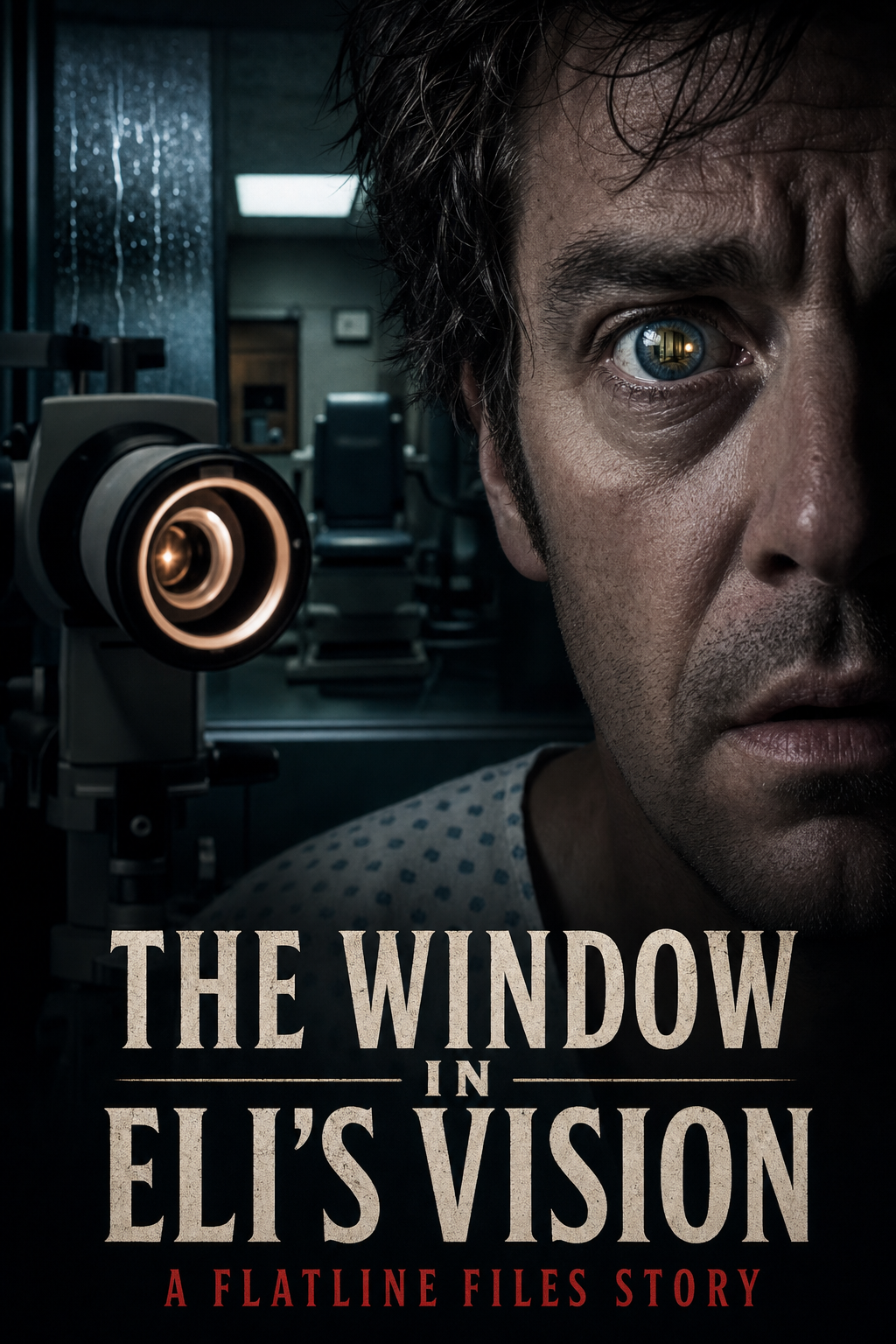
After Eli Mercer began seeing a small bright window floating in the left side of his vision, doctors considered migraines, a damaged retina, seizures, stress, and a side effect from his blood pressure medicine. The window showed the same empty little room no matter where Eli looked, but every eye test said his vision was almost perfect. Then a camera meant to photograph the inside of his eye captured a pale hand resting against the far side of the glass.
The first time Eli saw the window, he was driving a school bus full of sleeping children through rain.
It was nearly midnight. The bus smelled like wet coats, cracker crumbs, and the rubber floor mats he had cleaned that afternoon. Eli had spent twenty years driving buses for the county school district. He knew every bump in every road. He knew which turns made children wake up and which ones made them sleep harder.
That night, on the long road past the soybean fields, a square of yellow light appeared beside the stop sign ahead.
At first Eli thought it was a house window. Then he realized the square was moving with his eyes.
He looked right. It slid right.
He looked left. It slid left.
He blinked hard. It stayed.
The square was no bigger than a postage stamp. Inside it was a room with faded green walls, a crooked lamp, and a wooden chair facing away from him. The room did not shake with the bus. It did not blur in the rain. It sat there in his vision, calm and bright, like somebody had cut a hole through the world.
Eli gripped the wheel until his hands hurt.
He did not pull over. There were sixteen children behind him, all coming home from a late band competition. He kept his eyes on the wet road and tried to ignore the little room floating near the left edge of his sight.
But when the bus passed the old water tower, the chair inside the window slowly turned around.
There was nobody sitting in it.
Eli made it safely to the school lot. He waited until every child had been collected by a tired parent before he shut off the bus. Then he sat in the driver’s seat for almost an hour.
The window was gone by then.
He told himself it had been a migraine. His sister, June, got migraines that made bright zigzags flash in her eyes. Eli had never had one, but he was forty-three, overworked, and sleeping badly since his divorce. Strange things happened when a person was tired.
That explanation lasted two days.
The window came back while he was brushing his teeth.
This time the room was darker. The lamp was off. Rain tapped against a window inside the room, though the sky outside Eli’s bathroom was clear. He leaned close to the mirror and lifted his left eyelid with one finger.
His eye looked normal. Blue iris. White around it. A small red vein near the corner, nothing else.
Then, in the tiny bright room, somebody knocked three times.
Eli dropped his toothbrush into the sink.
He went to an urgent care clinic that same night. The nurse checked his blood pressure, which was a little high, and tested his vision by having him read letters off a wall. Eli could read nearly all of them.
“Any headache?” the doctor asked.
“Not really.”
“Flashing lights?”
“No.”
“Any weakness in your arms or face?”
“No.”
Eli almost told him about the room. He had the words ready. There is a window inside my left eye. But the doctor looked tired, and Eli already knew how it would sound.
So he said, “It’s like a little blind spot, except I can see something in it.”
The doctor paused. “See what?”
“Just shapes.”
They sent him home with a referral to an eye doctor and instructions to return right away if he got a bad headache, chest pain, weakness, or sudden loss of sight.
The eye doctor was named Dr. Bell. She had silver hair, red glasses, and a calm voice that made Eli feel foolish for being scared. She put drops in his eyes that made everything bright and soft. Then she shined lights into them, took pictures, and looked through a machine that showed a close-up image of the back of his eye.
“Your retina looks healthy,” she said.
Eli knew what a retina was because she explained it. It was the thin layer at the back of the eye that caught light, almost like film in an old camera.
“Could there be something behind it?” he asked.
Dr. Bell smiled gently. “Not a room, if that’s what you mean.”
Eli stared at her.
“You said shapes,” she added. “People often mean familiar things when they describe vision changes. A migraine can make the brain turn light and shadow into something that feels very real.”
He had not told her about the room.
“Maybe,” Eli said.
She ordered more tests anyway. One was a scan that made a map of the layers inside his eye. Another checked the pressure in his eye. A third had him sit in a dark room and press a button whenever a small light appeared.
Everything was normal.
For one week, Eli tried to believe that was good news.
Then the window began appearing every evening at 8:17.
It did not matter where he was. He saw it while warming soup. He saw it while standing in the grocery store, staring at canned beans. He saw it while watching a baseball game alone in his apartment.
The room inside it was always the same. Green walls. One chair. One lamp. A narrow window with rain sliding down the glass.
At 8:17, the lamp came on.
At 8:23, it went off.
After that, the little window vanished.
Eli began writing everything down in a notebook. He wrote the date, the time, what he had eaten, how much coffee he had drunk, whether he had taken his medicine. He wrote down his sleep. He wrote down the weather.
On the ninth night, he added a new note.
8:19. Chair moved closer to window.
On the tenth night, he wrote:
8:20. Heard knocking. Not in apartment. Inside left side of head.
On the eleventh night, he was sitting at his kitchen table when someone spoke from the room.
Not loudly. Not clearly.
Just a child’s voice, muffled behind glass.
“Dad?”
Eli stood so fast his chair fell over.
His daughter, Mae, was eleven. She was spending the week with her mother in another town, three hours away. Eli had talked to her on the phone that afternoon. She had complained about a spelling test and asked if he would come to her school play next month.
He called her mother at once.
“Is Mae okay?” he asked.
“She’s asleep,” his ex-wife said. “Eli, what’s wrong?”
“Nothing. I just wanted to hear her.”
“At eight-thirty at night?”
He could hear the old anger in her voice. The worry behind it was worse.
“Sorry,” he said. “I’m sorry. I’ve been having eye trouble.”
He hung up before she could ask more.
The next day, he told Dr. Bell the truth.
She did not laugh. She did not tell him he was crazy. Instead, she asked many quiet questions. Did he hear voices at other times? Did he smell things that were not there? Had he passed out? Did he lose time? Did anyone in his family have seizures?
“My father had them after his stroke,” Eli said.
“That does not mean you have them,” she said. “But I want a brain doctor to see you.”
The brain doctor ordered an MRI, a machine that used magnets to take pictures inside Eli’s head. He also ordered an EEG, which measured the small electrical signals in Eli’s brain through wires taped to his scalp.
Eli wanted one of the tests to show something simple. A swollen nerve. A hidden infection. A medicine problem. Anything with a name, a treatment, and an ending.
The MRI was normal.
The EEG was normal.
“That is good,” the doctor said.
Eli nodded because that was what people did when doctors said good.
But when he got home, he sat in his truck outside his apartment building and cried until his chest hurt.
Normal was starting to feel like a locked door.
June came over that Friday with pizza and a bottle of ginger ale. She was younger than Eli by five years, but she had always been the one who acted older. Their mother used to say June came into the world already tired of everybody’s nonsense.
“Show me the notebook,” she said.
Eli handed it to her.
She read every page. She did not make a joke until she reached the part about the voice.
“Maybe it was Mae on television,” she said.
“My television was off.”
“Maybe a neighbor’s kid.”
“It came from the room.”
June stopped smiling.
“You need to stop being alone,” she said.
“I am not sick in the head.”
“I did not say you were.”
“You were thinking it.”
“I was thinking you’re scared.”
That made him angry because it was true.
At 8:16, June sat across from him at the kitchen table. Eli placed his phone between them with the camera recording. He wanted proof for himself more than for any doctor.
At 8:17, the window appeared.
“It’s here,” he whispered.
June watched his face. “What do you see?”
“The room.”
“Describe it.”
He did.
Then the chair turned toward him.
Eli stopped talking.
Something was in the chair.
It was a boy, maybe ten years old. He wore a yellow raincoat. His dark hair was plastered flat against his forehead, as if he had walked through a storm. He had his back to Eli.
“Who is that?” June asked.
“I don’t know.”
The boy raised one hand and pressed it against what looked like the glass of the window.
June grabbed Eli’s wrist. “Your eye is bleeding.”
Eli touched his cheek. His fingertip came away wet and red.
The room vanished at 8:23.
His phone video showed Eli sitting still at the table, staring ahead with one eye wide open. At 8:20, a thin line of blood ran from his left eye.
Nothing else appeared in the video.
No window. No room. No boy.
Dr. Bell saw him first thing Monday morning. She found a tiny scratch on the clear front surface of his eye. It was not deep, but it was real.
“Have you rubbed your eye?” she asked.
“Not that I know of.”
“Do you sleepwalk?”
“No.”
“Has anyone been in your apartment?”
“No.”
She gave him ointment and told him to avoid touching the eye. Then she repeated the retinal photographs.
Eli sat at the machine with his chin on a rest. A bright flash filled his vision. He heard the camera click.
Dr. Bell looked at the first image.
Her face changed.
“Take another,” she told the technician.
The technician took another.
“Again.”
“What is it?” Eli asked.
Dr. Bell did not answer.
She turned the computer screen toward him.
The picture showed the back of his left eye in red and gold colors. Blood vessels spread from the center like branches. Eli did not understand most of it.
But near the middle was a pale square.
It looked like a reflection.
Inside the square was a green wall and the corner of a wooden chair.
On the third picture, a small white hand rested against the square.
Eli could see five narrow fingers.
He made a sound that did not feel like it came from him.
Dr. Bell called the hospital. She said she wanted him admitted for observation, which meant they would keep him overnight and watch him closely. Eli wanted to refuse. He hated hospitals. His father had died in one, and the smell of floor cleaner always made his stomach turn.
But June came, and she took his keys from him.
“You’re going,” she said.
At the hospital, they checked his blood, his heart, his blood sugar, and his temperature. They asked him the same questions again. A young doctor suggested that his brain might be making a false image because of stress or an unusual kind of seizure. Another said the strange shape in the photograph could be a camera error.
“Can a camera error make a hand?” June asked.
No one answered her.
They gave Eli a private room on the sixth floor. He hated that it had one chair, one lamp, and pale green walls.
“No,” he said when the nurse switched on the lamp.
“Sorry?”
“Turn it off.”
She did.
At 8:16, a nurse attached a small monitor to his finger. It measured the oxygen in his blood. Another nurse checked the wires on his chest. June sat beside the bed with her coat still on, like she was ready to run.
“We’ll get through this,” she said.
“What if it isn’t in my head?” Eli asked.
June looked toward the dark window. “Then we’ll still get through it.”
At 8:17, the room in his vision opened.
It was closer than before.
The green walls filled nearly half of his left eye. The wooden chair was empty. Rain struck the inner window in hard silver lines.
Then the boy in the yellow raincoat stepped into view.
He turned around.
Eli knew him.
Not because he had seen him recently. Not because he had ever met him as an adult.
He knew him from an old photograph kept in a box at June’s house.
The boy was Eli.
He was ten years old, thin and solemn, with dark hair falling into his eyes.
Young Eli pressed both palms against the glass. His mouth moved.
“Dad?”
Eli’s father had been alive then. He had been driving the family home through a thunderstorm when their truck slid off a bridge and rolled into a ditch. Eli had survived with broken ribs and a cut over his eye. His father had pulled him from the truck before the water rose too high.
His father had not made it out.
For thirty-three years, Eli had remembered almost nothing after the crash. A cold hand. Mud in his mouth. Rain. A bright light swinging over him.
Now he remembered more.
He remembered waking in a little room with green walls. He remembered sitting in a wooden chair while rain struck the window. He remembered waiting for his father to come through the door.
He remembered a doctor telling someone outside, very softly, that the man had died.
“Eli?” June said.
He was crying. He had not noticed.
“That’s me,” he said.
The monitor on his finger began to beep faster.
Young Eli pulled one hand from the glass. In his fist was something small and dark.
He held it up.
It was a child’s shoe.
Not Eli’s shoe.
A red shoe with a white buckle.
Then somebody moved behind the boy.
A tall shape crossed the green wall. It had no clear face. Its head bent too low beneath the ceiling. One long hand came down onto young Eli’s shoulder.
Eli screamed.
The hospital lights flickered. June shouted for the nurse. Eli clawed at his left eye before someone caught his wrist.
For one second, the window widened.
He did not see the old room anymore.
He saw the hospital room from the other side.
He saw himself on the bed, June standing beside him, nurses rushing through the door.
And in the dark corner behind them, near the real window, stood the tall shape.
It was watching through Eli’s eye.
Then everything went black.
He woke the next morning with a patch over his left eye and a pounding headache. June was asleep in the chair beside him. Dr. Bell stood by the window, holding a paper cup of coffee.
“You scratched your eye badly,” she said. “But it should heal.”
“What happened?” Eli asked.
“You had a brief seizure-like event,” she said carefully. “Your brain showed unusual activity for less than a minute. It may explain some of what you have been seeing.”
“May?”
Dr. Bell looked tired.
“The camera in the room recorded a problem,” she said.
She handed him a printed still image.
The picture showed Eli in bed, with June beside him. It was dark but clear enough to see their faces. Behind them was the corner near the window.
There was nothing there.
“The strange part,” Dr. Bell said, “is that the recording has twenty-three seconds missing. Not blurry. Not damaged. Just missing.”
Eli stared at the paper.
“And the retinal images?” he asked.
“We repeated them this morning. They are normal.”
“You saw the hand.”
“I did.”
Her voice was quiet now. “I saved the files in three places. By morning, they were gone from all three.”
For two weeks after he left the hospital, Eli wore the patch, used the ointment, took the new seizure medicine, and slept at June’s house. He did not drive the school bus. He did not stay alone. Every night at 8:17, June watched him closely.
The window never came back.
Little by little, Eli began to breathe normally again. He went back to work, first cleaning buses in the garage, then driving short daytime routes. He called Mae every night. He even told her he loved her before hanging up, which was something he had too often assumed she already knew.
Three months passed.
On a rainy Saturday, Mae came to stay with him.
They made pancakes, watched a silly movie, and built a blanket fort in the living room. Eli let her choose the music in the truck when they went to buy groceries. For the first time in a long while, he felt like he had climbed out of a deep hole.
That evening, Mae was drawing at the kitchen table while Eli washed dishes.
“Dad?” she said.
“Yeah?”
“What was Grandma’s house like when you were little?”
Eli turned off the faucet.
“Why?”
“I don’t know. I had a dream about it.”
His mother’s old house had been torn down years ago. Mae had never seen it.
“What did you dream?” he asked.
Mae kept coloring.
“There was a room with green walls. And a chair.”
The dish towel slipped from Eli’s hand.
Mae looked up at him. Her face had gone pale.
“Dad,” she whispered, “why is that little boy looking at me through the window?”