
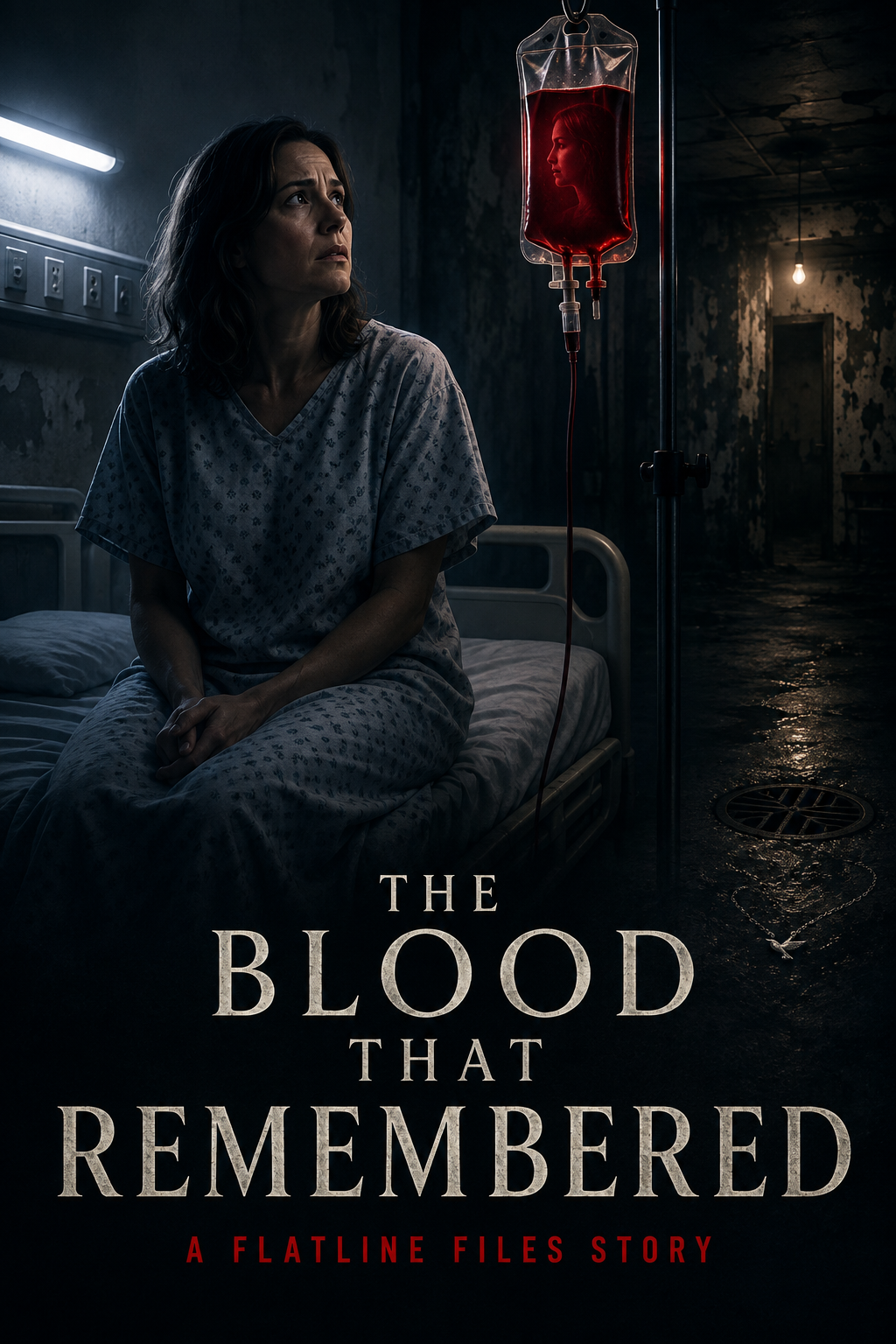
After an emergency blood transfusion, thirty-six-year-old Lena Ortiz began dreaming of a locked basement room she had never seen and a woman begging her not to turn off the light. Her doctors first blamed the concussion from her crash, pain medicine, stress, or a rare reaction to the transfusion, but Lena could describe the room in greater detail each night. Then she drew a rusted drain hidden beneath the floor, and police found it exactly where she said it would be—with fresh blood around it and her name scratched into the concrete.
Lena woke with dirt under her fingernails.
That was the first thing she noticed.
Not the ache in her ribs. Not the white bandage around her head. Not the machine blinking beside the hospital bed.
Dirt.
Dark soil filled the half-moons beneath every nail. One nail was torn low enough to sting. A thin brown line ran across her palm.
She lifted her hand toward the light.
“Where did this come from?”
Her husband, Daniel, jerked awake in the chair by the window. He had been sleeping with his chin against his chest.
“What?”
“The dirt.”
He stood too fast and caught the bed rail. His face looked gray. “There isn’t any dirt.”
Lena looked again.
Her nails were clean.
The torn one was whole.
Only the brown line remained, and when she rubbed it with her thumb, it came away like dried blood.
Daniel called the nurse.
The nurse checked Lena’s eyes, asked her name, and asked if she knew where she was.
“Mercy Valley Hospital,” Lena said. “I was in a car crash.”
She remembered rain on the highway. A truck sliding sideways. Daniel shouting her name. Then glass flew through the air like bright ice.
After that, nothing.
The nurse told her she had lost a lot of blood from a cut in her leg. The doctors had given her four bags of donated blood during surgery. She also had a concussion, which meant her brain had been shaken hard inside her skull.
“A concussion can make things feel strange,” the nurse said. “And the pain medicine can cause vivid dreams.”
“I wasn’t dreaming.”
The nurse gave her a kind smile. “It can feel that way.”
Lena wanted to argue.
Then she heard the woman crying.
It came from beneath the bed.
Soft at first. One wet breath. Then another.
Please don’t turn off the light.
Lena grabbed Daniel’s wrist.
“Did you hear that?”
The crying stopped.
No one else had heard a thing.
They kept Lena in the hospital for two more nights.
Her scans were normal. The doctors said there was no bleeding in her brain. Her blood count was rising, which meant she was replacing the blood she had lost. The wound in her leg looked clean.
Everything was getting better.
Except for the dreams.
Each time Lena closed her eyes, she woke somewhere else.
She stood in a basement with no windows. A bare bulb hung from a black cord. Water ticked inside the walls.
There was a metal chair in the center of the room.
Leather straps hung from its arms.
A woman sat on the floor behind it. Lena could never see her face. Long black hair covered it.
“Help me,” the woman whispered.
Lena tried to move closer, but her body would not obey.
The woman raised one shaking hand and pointed at the floor.
“He keeps it under the drain.”
Lena woke with a scream trapped in her throat.
On the morning she went home, a young doctor named Patel came to speak with her. He explained that strange dreams were common after trauma. Some patients also filled missing hours with false memories. The brain hated empty spaces, he said. Sometimes it made a story to cover them.
“So my brain made a basement?” Lena asked.
“Possibly.”
“And the woman?”
“She may stand for fear. Or helplessness.”
Lena looked at the blood moving through the clear tube in her arm.
“Could it come from the transfusion?”
Dr. Patel paused.
“Blood carries oxygen,” he said. “It does not carry memory.”
He said it gently, but the words closed the door.
At home, Lena tried to return to normal.
Daniel took two weeks off work. He cooked soup, changed the bandage on her leg, and helped her into the shower. Their small house filled with flowers from family and friends.
Lena should have felt safe.
Instead, every room seemed to have another room beneath it.
At night she heard water moving under the floor.
She woke with the taste of pennies in her mouth.
Once, she found herself standing in the kitchen at 3:12 in the morning. She held a screwdriver in one hand. All the cabinet doors were open.
Daniel found her before she pulled up the floor vent.
“What are you doing?” he asked.
“Looking for the drain.”
She did not remember leaving the bed.
Daniel hid the tools after that.
The dreams became clearer.
Lena saw white paint peeling from the basement walls. She saw a red handprint above the light switch. She saw six short lines carved into the metal chair.
She saw the drain.
It was round and rusted, but it was not fixed to the floor. One side had been lifted with a screwdriver. Beneath it was a hollow space.
Something silver rested in the dark.
A necklace.
It had a small bird hanging from it.
The woman on the floor finally lifted her head.
Her face remained hidden in shadow, but Lena saw her lips.
They formed one word.
Marrow.
Lena woke sitting at the dining table.
A pencil lay between her fingers.
The basement covered nine sheets of paper.
She had drawn the walls, chair, light, drain, and necklace. The pictures were simple, but the details matched from page to page.
On the last sheet, she had drawn a road.
At the end stood a white farmhouse with a broken windmill.
Across the bottom of the page, she had written:
MALLOW ROAD. LAST HOUSE.
Daniel stared at it.
“Do you know that place?” Lena asked.
“No.”
“Have I ever been there?”
“Not with me.”
They searched the name online.
Mallow Road was real.
It ran through empty farmland forty miles north of the city.
Lena began to shake.
Daniel wanted to call Dr. Patel. Lena called the police.
The officer who came to the house was polite until she mentioned the transfusion. Then his face changed. He asked whether she had taken her pain medicine that morning.
Lena showed him the drawings.
“Please,” she said. “Just see if the house is real.”
The officer took photos of the pages. He promised to pass them along.
Two days went by.
No one called.
On the third night, Lena dreamed she was no longer standing in the basement.
She was lying on its floor.
Her cheek pressed against cold concrete. Her hands were tied behind her. The bare bulb swung above her.
A man moved near the stairs.
She could not see his face, only a dark work jacket and muddy boots.
The woman with black hair lay beside Lena now.
No. Not beside her.
Lena was inside her.
She felt the woman’s cracked lips. She felt her empty stomach. She felt a deep pain in her hip where a needle had gone into the bone again and again.
The man crouched near them.
“You always come back,” he said.
Then he held up a clear blood bag.
Lena saw her own name printed on its label.
She woke with Daniel pinning her arms against the mattress.
“Lena! Wake up!”
Her teeth hurt.
Blood covered her tongue.
She had bitten through the inside of her cheek.
On the bedroom wall, written in blood, were three words:
HE FOUND YOU.
Daniel drove her back to the hospital.
This time, the doctors called a brain specialist and a mental health counselor. They asked about stress, old trauma, drugs, and family history. They tested her blood for infection. They checked the salts and sugar in her body. They repeated the brain scan.
Everything was normal.
Dr. Patel visited after his shift.
He stood in the doorway holding Lena’s chart.
“There is one thing,” he said.
Daniel sat forward.
“What?”
“The blood bank had trouble matching part of your transfusion record.”
Lena felt cold.
Dr. Patel explained that every donated bag had a number. The number let the hospital trace it back to the donation center. Three of Lena’s bags had normal records.
The fourth did not.
“The number belongs to a bag that was used six years ago,” he said.
“Used on who?” Lena asked.
“A woman named Evelyn Marrow.”
The room went silent.
Marrow.
The word from the dream.
“Is she alive?” Daniel asked.
Dr. Patel looked at the chart again.
“She disappeared from this hospital the night she received it.”
Lena’s mouth went dry.
“How did her blood get into me?”
“It didn’t,” Dr. Patel said. “At least, it could not have. The bag was empty and destroyed after use. The number must have been entered by mistake.”
“Then why did I know her name?”
He had no answer.
The police returned that evening.
This time there were two detectives.
Evelyn Marrow had been twenty-nine when she vanished. She had come to the hospital after being found unconscious beside Mallow Road. She had severe blood loss and small round wounds over both hip bones.
The doctors thought someone had pushed thick needles into her bones.
Bone marrow is the soft center inside bones where the body makes blood.
Evelyn woke after the transfusion. She told a nurse that a man had kept her in a basement and taken her marrow.
Before police arrived, she vanished.
No one ever found her.
“There is a farmhouse at the end of Mallow Road,” one detective said. “But it burned down five years ago.”
Lena pushed the drawings across the table.
“The basement didn’t burn.”
The detectives went that night.
They called at 2:40 in the morning.
The basement was still there.
So was the chair.
The red handprint.
The six carved lines.
And the rusted drain.
Under it, police found a silver necklace with a bird charm.
They also found blood around the drain.
Fresh blood.
Someone had scratched a name into the concrete beside it.
LENA ORTIZ.
One detective showed Lena a photograph of Evelyn.
She had dark hair, a narrow face, and a small scar through her left eyebrow. She wore the silver bird necklace found under the drain.
Lena knew that face.
Not from the dreams. From a memory she had carried since childhood.
She saw herself at eight years old, sitting in the back seat of her father’s car. Rain crossed the window. A young woman stood beside the road with blood on her dress. Lena’s father drove past without stopping.
She remembered turning around to watch the woman disappear into the rain.
“That’s impossible,” Lena said.
Evelyn had vanished when Lena was thirty.
The childhood memory could not be hers.
Daniel took the photograph away, but the memory stayed. More came behind it. Evelyn buying the necklace at a street fair. Evelyn singing badly in a yellow kitchen. Evelyn holding her mother’s hand at a funeral.
They did not feel like pictures in Lena’s mind. They felt worn and lived in, like rooms she had walked through for years.
Then other memories pushed through.
A man remembering a fishing boat.
An older woman remembering the smell of a newborn’s hair.
A teenage boy remembering the last page of a book he never got to finish.
Lena pressed both hands to her head.
“How many people were in that basement?”
The detective did not answer.
That night, Lena stood before the bathroom mirror and said Evelyn’s name.
Her reflection smiled.
Lena had not.
The reflection touched two fingers to its left hip. Then it opened its mouth.
Six voices spoke together.
“He made a door in the bone.”
The bathroom light burst.
When Daniel forced the door open, Lena was alone in the dark. Every mirror in the house had cracked in the same place: one thin line running through the reflected image of her hips.
The police put a car outside Lena’s home.
Daniel locked every window. He moved a dresser in front of the back door. Neither of them slept.
At dawn, Lena heard the woman again.
Not beneath the floor this time.
Inside her chest.
He isn’t coming for you, the voice whispered.
“Then what does he want?” Lena asked.
Daniel looked up from the couch.
The voice answered.
He wants what came through with me.
Pain struck Lena’s hips.
She fell to the floor.
It felt as if two hot nails had been driven into the bones on either side of her body. Daniel called an ambulance.
At the hospital, scans showed nothing broken. There were no wounds on her skin.
But her blood count had fallen.
Then it fell again.
Lena was losing blood somewhere, yet the doctors could not find any bleeding. Her belly was clear. Her stool had no blood. The surgery wound remained closed.
Her body was simply becoming empty.
Dr. Patel ordered another transfusion.
The moment the new blood entered Lena’s arm, every light in the room went out.
The monitor kept running on its battery.
In its green glow, Lena saw a man standing behind Daniel.
Dark work jacket.
Muddy boots.
His face looked wrong. It shifted like a face seen through moving water.
He held a clear bag in one hand.
“Turn it off,” Lena whispered.
Daniel looked at the blood tube. “What?”
“The transfusion. Turn it off.”
The man smiled.
The blood in the tube stopped moving.
Then it began flowing backward.
Out of Lena.
The bag above her filled with dark red blood.
Daniel shouted for help. Nurses rushed in. One clamped the tube. Another pulled it from Lena’s arm.
The lights came back.
The man was gone.
The new blood bag hung swollen and warm.
Across its label, someone had written one word in black ink.
RETURN.
Hospital security searched the room and hallway. No one found the man.
The blood bag was taken to the laboratory.
The result made no sense.
The blood inside was not the blood they had started giving Lena.
It was Lena’s blood.
Mixed through it were cells belonging to another woman.
Evelyn Marrow.
The detectives searched old hospital records. They learned that Evelyn had not been the first missing patient tied to Mallow Road.
Over twenty years, six people had been found near that farmhouse. All had tiny wounds over the hip bones. All had lost dangerous amounts of blood. Three vanished after reaching a hospital.
The other three died.
Their bodies were buried.
But tissue samples taken from all six showed the same thing.
Their marrow had begun making blood that did not belong to them.
The unknown blood came from one man.
No name. No match in any police record.
Just the same blood, appearing year after year, never aging.
Lena understood before anyone said it.
He had not been taking marrow from the women.
He had been planting his own.
“Why?” Daniel asked.
The answer came from Lena’s mouth in Evelyn’s voice.
“So he can come back.”
Lena’s body went still.
The room disappeared.
She stood in the basement again.
This time the light was bright.
Evelyn stood before her. She was thin and pale, but Lena could see her face at last. She looked tired more than frightened.
“I’m sorry,” Evelyn said.
“Did you do this to me?”
“I tried to hide in the blood.”
“Whose blood?”
“Mine. Yours. Everyone he touched. We mixed together.”
Footsteps sounded on the stairs.
Evelyn looked up.
“He needs a living body,” she said. “But he cannot take one while someone else is inside.”
Lena heard the man coming closer.
“What do we do?”
Evelyn took her hand.
“We make sure he is never alone in you.”
The basement filled with voices.
Five more people stepped from the dark. Three women. Two men. All pale. All watching the stairs.
The man reached the bottom.
His face became clear.
It was Lena’s face.
Then Daniel’s.
Then Dr. Patel’s.
Then the face of every person whose blood he had touched.
“You are only blood,” he said.
Evelyn squeezed Lena’s hand.
“So are you.”
They rushed him together.
Lena woke in the hospital three days later.
Her blood count was normal.
The strange cells were gone.
The pain had ended.
Police found no one at the farmhouse basement. The fresh blood around the drain matched Lena, though she had never been there. The name scratched into the floor remained unexplained.
Daniel took her home.
For several weeks, Lena slept without dreams.
She returned to work. Her leg healed. The bruises faded. She stopped hearing water beneath the floor.
Dr. Patel called once a week. He said her blood tests looked perfect.
Then, one cold morning, Lena cut her finger while slicing an apple.
A red drop formed on her skin.
It did not fall.
It crawled.
The drop moved across her fingertip against gravity. It stretched into a thin line and wrote one tiny word on her nail.
LIGHT.
Lena stared at it.
From somewhere deep inside her bones, six voices began to whisper.
They were not afraid.
They were counting.
One.
Two.
Three.
Then a seventh voice joined them.
It sounded exactly like Lena.
“Open the door,” it said.