Thirteen-year-old Owen Vale began hearing a second heartbeat inside his chest, one that slowed when he was awake and raced whenever he fell asleep. His mother and doctors first blamed anxiety, an unusual heart rhythm, muscle spasms, or the medicine he used for asthma, but every exam showed that Owen’s own heart was healthy. Then a nurse placed a monitor on his chest and recorded two separate heartbeats—one belonging to Owen, and one that stopped the moment he said, “I know you’re in there.”
The first time Owen heard it, he was lying in bed with his ear pressed against his pillow.
Thump-thump.
He thought it was his own heart.
Then his heart beat again.
Thump-thump.
The other sound came a moment later.
Thump.
Owen held his breath.
His heart raced because he was scared. The beat in his chest became quick and hard.
Thump-thump. Thump-thump. Thump-thump.
But the second beat stayed slow.
Thump.
Pause.
Thump.
It seemed to come from deep beneath his left ribs.
Owen sat up and pressed both hands against his chest. The room was dark except for the green light from his alarm clock. It was 1:17 in the morning.
He counted his pulse at his wrist, the way the school nurse had taught him.
One, two, three, four.
The slow beat did not match.
Thump.
Owen jumped out of bed and ran to his mother’s room.
“Mom.”
Rachel Vale opened one eye. “What happened?”
“There are two hearts in me.”
She stared at him for a second, then pulled back the blanket.
“Come here.”
Owen climbed beside her. Rachel placed her palm over the center of his chest. His heart was pounding fast.
“I only feel one,” she said.
“The other one is lower.”
She moved her hand toward his ribs.
They waited.
Nothing happened.
“Maybe it was your stomach,” she said. “Bodies make all kinds of sounds.”
“Stomachs don’t beat.”
“Sometimes muscles twitch.”
Owen knew what a twitch felt like. This was not a twitch.
Still, he stayed in his mother’s bed until morning.
At breakfast, the second heartbeat was gone. Owen almost believed he had dreamed it.
Then he reached for his cereal.
Thump.
His spoon slipped from his hand.
Rachel looked up from her coffee. “What?”
“It did it again.”
She came around the table and pressed her fingers under his ribs. She could not feel anything.
“Does it hurt?”
“No.”
“Are you having trouble breathing?”
Owen shook his head.
He had asthma, but this did not feel like an asthma attack. There was no tightness in his chest. He was not coughing or wheezing. Air moved in and out without trouble.
Rachel still called his doctor.
The doctor’s office had no open visits, so they went to urgent care after school.
A nurse checked Owen’s temperature, blood pressure, and oxygen level. Everything was normal. She clipped a small device to his finger to measure the oxygen in his blood. It read 99 percent.
“That’s good,” she said.
The doctor listened to Owen’s heart and lungs. She moved the stethoscope, a listening tool with a round metal end, across his chest and back.
“Take a deep breath.”
Owen breathed in.
“Again.”
He breathed out.
The doctor smiled. “Your lungs sound clear. Your heart sounds steady.”
“There’s another one,” Owen said.
“Another heartbeat?”
“Under here.”
He pointed to the bottom of his left ribs.
The doctor listened there for a long time.
“I hear your heartbeat passing through your chest,” she said. “Sounds can travel inside the body.”
“This one is slower.”
Rachel explained that Owen had been under stress. His father had died in a car crash eleven months earlier. Owen had changed schools soon after. He had also been sleeping badly.
The doctor did not say the sound was imaginary. She said fear could make a person notice normal feelings that had always been there.
She ordered a heart tracing to be safe.
The test was called an ECG. Small sticky pads were placed on Owen’s chest, arms, and legs. Wires carried his heart’s electrical signals to a machine. The paper showed a clean, even rhythm.
“Your heart looks normal,” the doctor said.
Owen wanted to feel relieved.
Instead, the slow beat came again while the doctor was talking.
Thump.
Owen looked down.
The paper from the machine jumped.
A single crooked line appeared between two of his normal beats.
The nurse frowned. “Did he move?”
“I didn’t,” Owen said.
The doctor tore off the strip and studied it.
“Machines sometimes catch noise,” she said. “A loose wire. A muscle moving. Even nearby equipment.”
Owen watched her fold the paper and place it in his chart.
On the ride home, Rachel told him the test was normal.
“Then why did she keep the strange part?” he asked.
Rachel did not answer.
That night, Owen slept with the light on.
At 1:17, he woke to the sound again.
This time it was faster.
Thump. Thump. Thump. Thump.
It beat beneath his ribs like a fist knocking on a locked door.
Owen pulled up his shirt.
The skin over his left side moved.
Not much. Just a small rise and fall.
He touched it with one finger.
Something tapped back.
Owen screamed.
Rachel rushed in and turned on the ceiling light. By the time she reached him, the movement had stopped.
“It touched me,” he cried.
“What touched you?”
“The thing inside.”
Rachel checked his skin. There was no swelling or mark. She called the advice nurse, who told her to take Owen to the emergency room if he had pain, trouble breathing, fainting, blue lips, or a very fast heartbeat that would not slow down.
Owen had none of those things.
Rachel sat beside him until sunrise.
Neither of them slept.
The next day, Owen began keeping a notebook.
He wrote down every time he felt the second heartbeat.
1:17 a.m. — fast.
6:40 a.m. — slow.
12:03 p.m. — three beats during math.
3:25 p.m. — stopped when I held my breath.
7:11 p.m. — beat when Mom said Dad’s name.
That last one bothered him most.
He tested it.
“Dad,” Owen whispered in his room.
Thump.
“Daniel Vale.”
Thump. Thump.
Owen opened the closet and took down a box of his father’s things. Inside were a wallet, a watch, old photos, and a small recorder his father had used for work notes.
Owen pressed the play button.
His father’s voice filled the room.
“Pick up milk. Call Rachel. Owen’s game Saturday at ten.”
The second heart began to race.
Thump-thump-thump-thump-thump.
Owen dropped the recorder.
The closet door slammed shut on its own.
For a few seconds, the light in his room grew weak. The corners seemed to stretch away from him.
Then a boy spoke from inside the closet.
“He was mine first.”
Owen ran downstairs.
Rachel found the recorder on his bedroom floor. The closet was empty. She checked the window and under the bed.
“What did the voice sound like?” she asked.
“Like me.”
Rachel’s face changed.
“What?” Owen asked.
She sat on the edge of his bed.
“When I was pregnant with you, the first picture showed two babies.”
Owen stopped breathing for a moment.
Rachel explained slowly. Early in the pregnancy, the doctor had seen two tiny shapes. At the next visit, only Owen remained. The doctor said the other baby had stopped growing very early. Sometimes the body takes in the tissue, and the pregnancy continues with one baby.
“I had a twin?” Owen asked.
“For a few weeks.”
“Was it a boy?”
“We never knew.”
The second heart beat so hard that Rachel saw Owen’s shirt move.
This time she did not tell him it was a muscle.
They went to the emergency room.
The hospital ran more tests. Blood work showed no infection or other clear problem. A chest picture showed normal lungs and normal bones. An ultrasound used sound waves to make a picture beneath Owen’s skin. The worker moved a smooth probe over the place where he felt the beating.
At first, the screen showed only muscle, ribs, and the upper part of his stomach.
Then the image changed.
A small dark space appeared behind his lowest rib.
Inside it, something opened and closed.
The worker stopped moving the probe.
“What is that?” Rachel asked.
“I need the doctor.”
Before she could leave, the dark space vanished.
The worker moved the probe back and forth. She changed the angle. She pressed harder.
Nothing returned.
The doctor ordered a CT scan, a machine that takes detailed pictures inside the body. Owen lay on a narrow table that moved through a large ring.
“Hold still,” a voice said through a speaker.
The ring began to hum.
Halfway through the scan, the second heartbeat stopped.
Owen felt a cold pressure climb from his ribs to his throat.
The speaker crackled.
His own voice said, “Don’t let them cut me out.”
Owen tried to sit up, but a strap held him in place.
“Mom!”
The worker stopped the scan and ran into the room.
“Who said that?” Owen asked.
“Said what?”
The CT pictures looked normal.
There was no extra organ, no growth, and no hidden space beneath his ribs.
The doctor admitted Owen overnight to watch his heart.
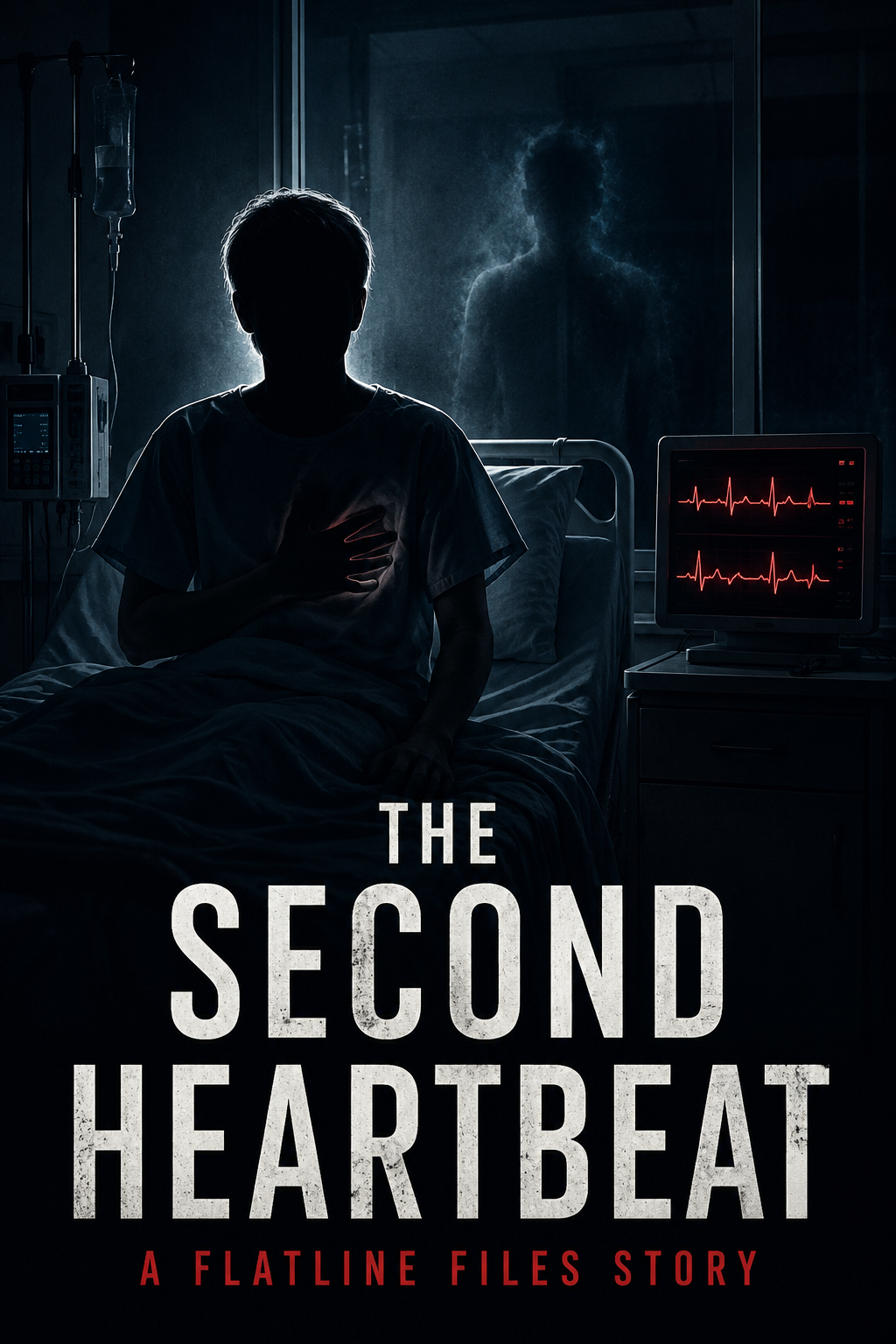
Sticky pads connected him to a monitor beside the bed. A green line moved with every heartbeat. A nurse could see the same line from a desk in the hall.
At 12:50, Rachel fell asleep in a chair.
Owen stayed awake.
At 1:16, the room became cold.
The second heartbeat began.
Thump.
A new line appeared on the monitor beneath Owen’s own rhythm. It moved slowly, like another person was connected to the machine.
The nurse entered.
“Owen, do you feel okay?”
“It’s here.”
She checked the wires. None were loose.
The second line continued.
Thump.
“There are two,” the nurse whispered.
Rachel woke.
The nurse called the doctor.
Owen stared at the monitor. The second line rose and fell. It did not match his pulse. It did not match his breathing.
He felt anger push through his fear.
“I know you’re in there,” he said.
The second line went flat.
The heartbeat stopped.
Every light on the hospital floor went out.
In the darkness, a child began crying beneath Owen’s bed.
Rachel grabbed his hand.
The nurse turned on her phone light and looked under the bed.
No one was there.
The power returned.
Written backward across the dark monitor were four words.
YOU TOOK MY LIFE.
The words faded before the doctor arrived.
The nurse swore she had seen them. She also saved the heart recording before it could disappear.
A heart specialist reviewed it in the morning. He said the second signal could not have come from Owen’s heart. The timing was too slow, and the shape of the wave was different.
“Could another person’s heartbeat reach his monitor?” Rachel asked.
“Not with the wires attached this way.”
The doctor ordered a special scan of Owen’s heart. It showed a healthy heart with four normal chambers. There was no second heart.
They were sent home with a small monitor Owen could wear for a week.
For two days, the second heartbeat stayed quiet.
Owen returned to school. He tried to act normal. He ate lunch with his friends. He played a video game after homework.
On the third night, Rachel found something in the box of Daniel’s belongings.
It was an old folded paper from the hospital where Owen had been born.
Across the top, Daniel had written, “Ask again about Baby B.”
Beneath that were notes in his handwriting.
Heartbeat seen at six weeks.
Gone at nine weeks.
Owen touched the paper.
The room disappeared.
He was standing in a hospital hallway. His father sat alone in a chair, much younger than Owen remembered him. Daniel held the same folded paper in his hands.
A doctor sat beside him.
“Your wife is still asleep,” the doctor said. “The surgery went well.”
“And the other tissue?” Daniel asked.
“Removed.”
“Was it part of the twin?”
The doctor looked toward a closed door.
“We cannot be sure.”
The hallway changed.
Daniel stood in a dark room holding a metal tray. On the tray rested a small lump of red tissue.
It beat once.
Daniel dropped it.
Something beneath the tray whispered, “Dad.”
Owen snapped back into his bedroom.
He was lying on the floor. Rachel knelt beside him.
The heart monitor on his chest beeped wildly.
“What did you see?” she asked.
Owen told her.
Rachel began to cry.
After Owen was born, she had suffered heavy bleeding. Doctors had performed emergency surgery to stop it. Daniel had never told her that anything else had been removed.
They called the hospital, but records from thirteen years earlier gave no clear answer. The notes mentioned an “unusual mass” near the placenta, the organ that feeds a baby before birth. A lab had examined it.
The final report was missing.
That night, the wearable monitor sent an emergency warning to Rachel’s phone.
Owen’s heart rate was falling.
She ran to his room.
Owen stood in front of the mirror.
His reflection was smiling.
Owen was not.
The reflection lifted its shirt. Beneath its left ribs, a small hand pressed outward from under the skin.
Owen backed away.
The reflection stayed close to the glass.
“He heard me,” it said.
“Who?” Owen whispered.
“Dad.”
The reflection struck the inside of the mirror.
A crack split the glass.
Owen fell to the floor.
His monitor showed that his heart had stopped.
Yet Owen was still awake.
Rachel called 911. She pressed her fingers to his neck and felt no pulse. Owen looked up at her and tried to speak.
The only sound from his mouth was a slow beat.
Thump.
The paramedics arrived. Their machine found one heartbeat, deep and slow. It came from beneath Owen’s left ribs.
They rushed him to the hospital.
Doctors prepared to open his chest. Owen heard them say his true heart was no longer moving. A machine pushed air into his lungs. Medicine flowed through a tube in his arm.
He could not move, but he could still see.
The operating room lights burned above him.
Then someone took his hand.
A boy stood beside the table.
He looked exactly like Owen.
His skin was gray. A deep hollow filled the left side of his chest.
“It’s my turn,” the boy said.
Owen tried to pull away.
“You had thirteen years.”
The boy leaned close.
“I only had nine weeks.”
The room went black.
Owen woke the next morning.
His mother sat beside him, holding his hand. She cried when his eyes opened.
The doctors called it a miracle. Owen’s heart had started again before the first cut was made. They could not explain why the machines had shown no heartbeat for almost four minutes while he remained awake.
The slow beat beneath his ribs was gone.
For the first time in days, Owen felt alone inside his own body.
He went home three days later.
He slept through the night. He returned to school the following week. The monitor never found another strange rhythm.
Rachel began to believe it was over.
Then she noticed small things.
Owen now wrote with his left hand instead of his right.
He no longer liked chocolate, but asked for foods he had always hated.
He stopped calling Daniel “Dad.”
He called him “my father.”
One evening, Rachel found Owen listening to the old recorder in his room.
Daniel’s voice said, “Owen’s game Saturday at ten.”
The boy smiled.
“He remembered you,” Rachel said from the doorway.
Owen turned.
For a moment, he seemed confused by her face.
Then he smiled wider.
“He remembered one of us.”
Rachel’s blood went cold.
From inside the bedroom mirror came a frantic pounding.
Thump-thump. Thump-thump. Thump-thump.
Owen looked toward the glass.
His reflection was not smiling.
It pressed both hands against the other side and silently screamed.