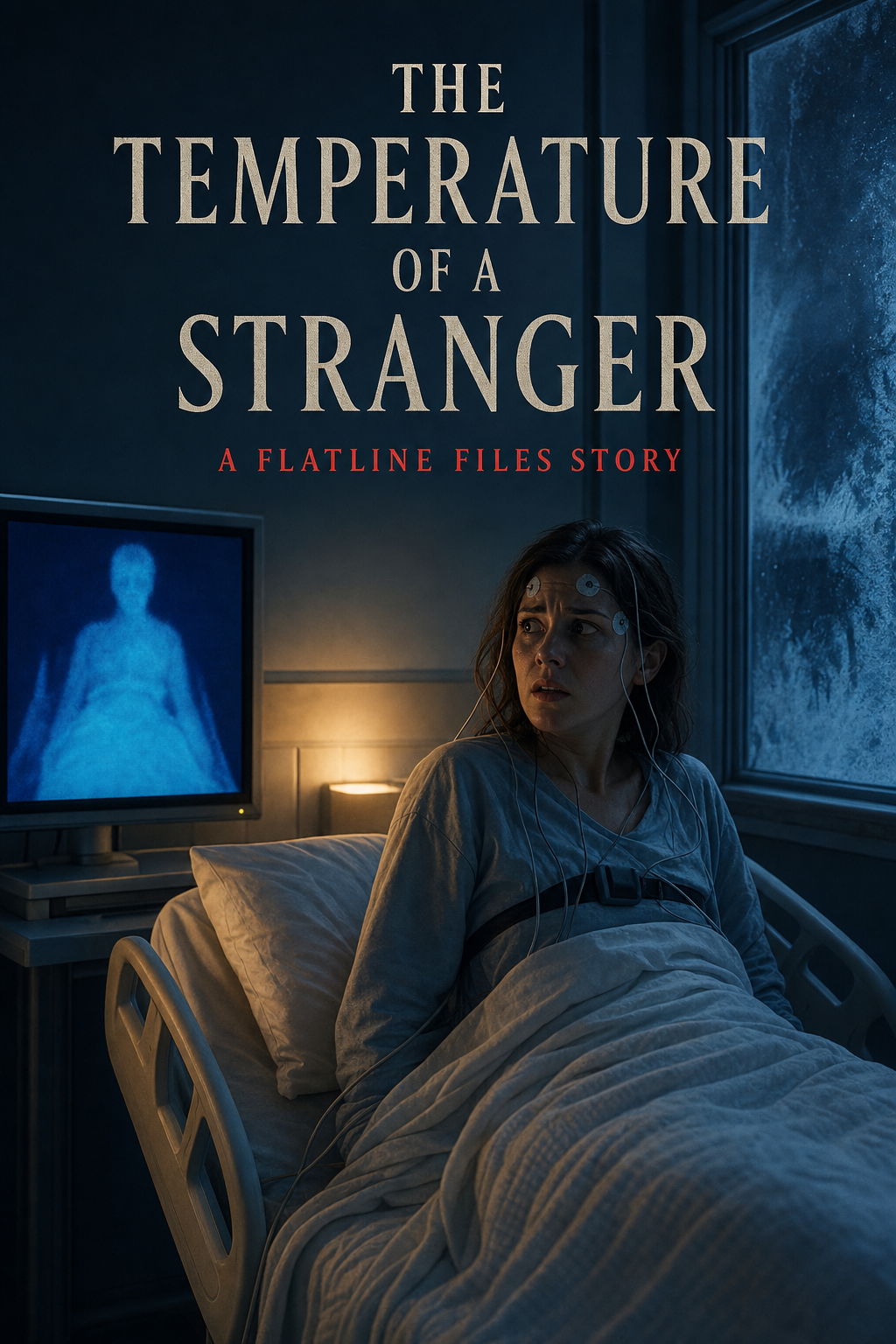
Thirty-four-year-old Miriam Cole began waking in a warm apartment with blue lips, shaking hands, and a body temperature low enough to kill her. Doctors considered a thyroid problem, infection, bad medicine, a broken thermometer, sleepwalking, and even hidden drug use, but no test explained why her body turned cold at exactly 2:13 every morning. Then a hospital thermal camera showed a second human-shaped patch of cold curled beneath Miriam’s blanket, although no one else was in the bed.
The first time Miriam woke cold, she thought she was dead.
She was standing barefoot in her kitchen at two in the morning. The floor tiles felt like ice. Her hands were pressed against the dark window over the sink. Outside, rain moved across the parking lot in silver sheets. Inside, the heat was running hard enough to make the vents rattle.
Still, Miriam could see her own breath on the glass.
Her lips were numb. Her teeth knocked together so hard that her jaw hurt. When she looked down, her nightshirt was damp with sweat, but her skin had the gray-blue color of old milk.
“Mom?” came a small voice from the hallway.
Miriam turned too fast. The room rolled sideways. Her daughter, Josie, stood holding a stuffed rabbit by one ear.
“Why are you outside?” Josie asked.
“I am not outside.”
Josie looked toward the window. “You were. I heard the door. I saw you standing by the tree.”
Miriam looked at the locked apartment door. Rainwater shone in a thin trail across the kitchen floor. It ran from the door to her bare feet.
She did not remember going anywhere.
At the emergency room, a nurse pushed a thermometer under Miriam’s tongue, frowned, and tried another one. Then she used a special thermometer that measured deep body temperature in Miriam’s ear.
“Ninety-two point eight,” she said.
Miriam knew enough to understand that was bad. Normal was close to ninety-eight. Ninety-two meant her body was colder than it should ever be in a heated apartment.
A doctor named Patel asked calm questions while warm air blew over Miriam from a thick blanket. Had she been drinking? Taking pills not prescribed to her? Had someone left her outside? Did she have diabetes? Did she have thyroid trouble? Was she trying to hurt herself?
Miriam answered no until the word meant nothing.
Dr. Patel checked her eyes, her chest, and her belly. Blood was drawn. An electrocardiogram, the test that watches the heart’s electrical signals, showed that her heartbeat was slow but steady. Her blood sugar was normal. There was no alcohol in her system. No sign of a serious infection. No dangerous poison.
By sunrise, after warm fluids through an IV and three heated blankets, Miriam’s temperature had climbed back to normal.
Dr. Patel sat beside her bed with a tired, kind face. “Sometimes we do not find the reason right away,” he said. “Cold exposure can happen during sleepwalking. Certain medicines can affect temperature. So can hormone problems. We will test your thyroid. I want you to follow up with your regular doctor.”
Miriam stared at the rain streaking down the window. “My daughter says I was outside.”
“Do you remember leaving?”
“No.”
He was quiet for a moment. “Then do not be alone tonight if you can help it.”
Her older sister, Beth, took Josie for two nights. Miriam slept with every lamp on, wearing socks, sweatpants, and a heavy sweatshirt. She wedged a chair under the apartment door. She set her phone on the bedside table and turned on a recording app.
Nothing happened the first night.
The second night, she woke at 2:14 with her face pressed against the bedroom wall.
Her phone was on the floor. The recording had stopped at 2:13.
Her body temperature was ninety-four.
This time she had not gone outside. The chair still blocked the front door. The windows were locked. Yet the wall in front of her was wet. Not damp from a leak. Wet in the shape of a narrow shoulder and a round head, as if someone had stood there dripping rainwater.
Miriam called Beth before she called the hospital.
“You need sleep,” Beth said. Her voice was careful. “You work late. You are raising a kid alone. You have been worried about money for months. Maybe you had a nightmare.”
“My temperature was ninety-four.”
That stopped her.
“Come get us,” Miriam said. “Please. Just come get us.”
Beth arrived twenty minutes later. She found Miriam sitting on the bed with Josie wrapped in her arms. The wet shape on the wall had already dried, leaving only a faint brown stain.
Josie would not look at it.
“There was a lady,” she whispered.
Miriam held her tighter. “What lady?”
“The lady under your blanket.”
Beth gave Miriam a quick look, the kind people give when they are trying not to show fear.
“She was cold,” Josie said. “She wanted to get in mine.”
That afternoon, Miriam’s regular doctor ordered more tests. Her thyroid was normal. Her blood tests were normal. A scan of her head found no tumor, no bleeding, and no sign of a stroke. A sleep doctor asked about nightmares, panic attacks, and strange behavior at night.
Miriam felt foolish answering him.
“I do not see things,” she said. “I know how that sounds, but I do not. I clean offices at night. I get tired. That is all. I am not losing my mind.”
The sleep doctor, Dr. Leung, did not laugh. “I believe that you are frightened,” she said. “And I believe something is happening to your body. Those are different things.”
She scheduled Miriam for an overnight sleep study. Miriam would sleep in a small hospital room while cameras watched her breathing, movement, heart rate, and brain activity.
Miriam did not want to go. She hated the idea of strangers watching her sleep. But Beth had taken Josie home, and Miriam could not bear the thought of the cold woman coming near her daughter again.
The sleep room looked almost cheerful. It had a narrow bed, pale blue walls, and a painted picture of mountains over the sink. A technician placed small sticky circles on Miriam’s scalp and chest. Wires ran from them to a box beside the bed.
“The wires will not hurt,” the technician said. “Try to sleep normally.”
“That is the problem,” Miriam said.
At 1:50, she was still awake.
At 2:08, she felt the room change.
It was not the air conditioner. That was Miriam’s first thought, because it was a sensible thought. The vent above the door had stopped making noise. Then the skin on her arms tightened. Her breath came out in a white cloud.
Miriam reached for the call button.
Her fingers would not move.
Something touched the side of the mattress.
The bed dipped beside her.
Miriam could not turn her head. She could only stare at the painted mountains on the wall while the cold spread beneath the blanket. It climbed from her feet to her knees, then higher. She felt a weight settle against her back, light as a child and terribly still.
She tried to scream. What came out was a weak clicking sound.
Then the room lights burst on.
Two technicians and Dr. Leung rushed inside. One pulled the blanket away.
The bed was empty except for Miriam.
But nobody spoke for several seconds.
Miriam saw why when she looked toward the monitor by the door.
The regular camera showed her lying alone on the bed, curled on her side. The thermal camera, which showed heat as bright colors and cold as dark ones, showed something else.
Miriam was a long orange shape under the blanket.
Pressed against her back was another shape.
It was dark blue, almost black. Human-sized, but smaller than Miriam. Its knees were drawn to its chest. Its head rested between Miriam’s shoulder blades.
On the screen, it lifted one hand.
Miriam felt fingers close around her wrist.
She screamed then. The sound came back all at once.
Dr. Leung grabbed the monitor and turned it away, but Miriam had already seen enough. The dark hand on the screen had five fingers. It had touched her exactly where a pale mark was now rising on her skin.
Her temperature had dropped to ninety-one point nine.
They admitted her to the hospital for observation. The staff spoke softly around her after that. Nobody said ghost. Nobody said monster. They said camera error, electrical interference, a strange reflection from the blanket. They said they would repeat the test.
Miriam listened because she needed their explanations. A camera could fail. A machine could lie. A frightened person could mistake one thing for another.
But the bruise on her wrist did not lie.
It looked like five tiny gray fingerprints.
In the morning, Beth brought Josie to the hospital. Josie ran into Miriam’s arms, then stopped.
“It came here too,” she said.
Miriam felt all the warmth leave her face.
“What came here?”
Josie pointed at the empty chair in the corner.
“The lady.”
Beth knelt beside her. “Sweetie, there is nobody there.”
“She is under the chair,” Josie said. “She is waiting for Mom to sleep.”
Miriam looked at the chair. A thin puddle had formed beneath it. The room was dry everywhere else.
That evening, she asked Beth to bring a plastic box from their mother’s attic. Their mother had died three years earlier, and Beth had never wanted to talk about the things she left behind. But Miriam remembered an old box marked HOSPITAL PAPERS in faded marker.
Inside were baby pictures, bills, and a yellowed folder from St. Agnes Women’s Hospital, the place where Miriam had been born. The building had closed before Josie was born. Miriam had not thought of it in years.
She found a note written in her mother’s small, slanted handwriting.
Miriam was born February 11, 2:13 a.m. Snowstorm. Power failed for nine minutes. Nurses said she stopped crying and went cold. I told them there was another baby in her blanket. They said I was confused from the medicine.
Miriam read it three times.
At the bottom, her mother had added one more line.
When they brought her back, she had a wet handprint on her chest.
Beth stood at the foot of the bed, holding the paper with both hands. “Mom was sick after you were born,” she said. “She had bad dreams. She said things that did not make sense.”
“Did she ever tell you this?”
“No.”
“Did she tell you why she kept the heat so high in the house? Why she never let me sleep without socks?”
Beth’s face changed. “I thought she was just strange.”
That night, Miriam did not sleep.
She sat upright beneath warming blankets and watched the chair. Nurses came in every hour. One checked her temperature. One brought tea. At 2:10, Miriam was still fully awake.
At 2:12, frost crept over the inside of the window.
At 2:13, the chair scraped across the floor by itself.
The nurse on duty heard it. Her name was Carmen, and she did not run. She stared at the chair, then looked at Miriam.
“Call Dr. Leung,” Miriam said.
Carmen pressed the button at the wall.
The overhead lights dimmed. The room became so cold that the plastic cup beside Miriam’s bed cracked with a sharp little pop.
Then Josie cried out from the couch.
She had fallen asleep beside Beth.
A dark shape covered the child on the thermal monitor above Miriam’s bed.
Miriam tore the wires from her chest. Alarms began to shriek. She stumbled from the bed, dragging her IV line behind her, and crossed the room before anyone could stop her.
Josie’s skin felt cold through her pajamas.
“No,” Miriam said. “No, not her.”
The cold was around Josie like a person crouching over her. Miriam could not see it with her eyes. She could only see the empty couch and her daughter’s frightened face. But she could feel something between them, something with a grip like frozen water.
Miriam wrapped both arms around Josie and pulled her close.
For one awful moment, the cold thing pulled back.
It did not pull Josie.
It pulled Miriam.
The hospital room vanished behind a wash of white pain. Miriam was somewhere else, somewhere dark and loud. Wind battered a window. A woman sobbed nearby. Miriam smelled blood, disinfectant, and snow melting on wool coats.
She was tiny. She knew that without seeing herself. She was wrapped in a blanket. Something cold was pressed against her chest.
Not another baby.
A little girl.
The girl had wet hair stuck to her face. Her eyes were open, but they did not blink. She was shaking so hard that the blanket trembled around them both.
“Please,” the girl whispered.
Then Miriam was back in the hospital room, on her knees beside the couch.
Dr. Leung was holding Josie’s hand. Carmen stood near the monitor, crying without making a sound.
The dark shape had returned to Miriam’s body on the screen.
Miriam knew what it wanted then. Not her daughter. Not even her warmth.
It wanted the place it had been trying to reach for thirty-four years.
It wanted the blanket.
Miriam looked at the empty space beside her daughter. “You were there that night,” she whispered. “You were alive.”
The room seemed to hold its breath.
“They left you,” Miriam said. “They thought you were gone, and they left you there.”
A soft sound came from beneath the couch. Not a voice. More like a child breathing through chattering teeth.
Miriam remembered her mother’s note. Another baby in the blanket. A snowstorm. A power failure. Confusion. Perhaps a child had been brought in from somewhere else. Perhaps a nurse had set her down for one moment and never understood what happened next.
Perhaps Miriam had been born warm, and the stranger had found her.
“I cannot be your bed anymore,” Miriam said.
Her teeth were chattering now. The cold had reached her bones. “You cannot have my daughter.”
The thermal monitor flickered. The dark shape slowly unfolded from Miriam’s outline.
For the first time, it looked almost clear.
A small girl sat at the edge of the couch, knees against her chest. She was no more than seven or eight. Her hair hung wet around her face. Her mouth was blue.
Josie lifted her head from Miriam’s shoulder.
“She is scared,” she whispered.
Miriam could barely breathe. Still, she reached toward the empty space.
“I know,” she said.
The girl-shaped cold lifted one hand.
Miriam felt the frozen fingertips brush her cheek.
Then the monitor went black.
Every light in the room flashed at once. The cold broke apart so suddenly that Miriam fell forward, gasping. Warm air rushed back through the vent overhead. The frost on the window melted into long, clear tears.
Josie’s skin was warm.
For the next two days, Miriam’s temperature stayed normal. The bruise on her wrist faded. Hospital staff repeated the thermal test twice, but the second shape never returned. Dr. Leung gave Miriam copies of the recordings, though she warned her not to expect anyone else to understand them.
St. Agnes Hospital had no records of an unknown little girl during the storm on the night Miriam was born. The old files were incomplete. The hospital had changed owners, then closed. Paper records had been lost in a basement flood years ago.
But Beth found one thing in their mother’s attic.
It was a photograph Miriam had never seen. In it, their mother sat in a hospital bed, exhausted and pale, holding newborn Miriam against her chest. The picture was blurry, taken in poor light.
At first, Miriam saw only herself and her mother.
Then she noticed the small hand curled around the edge of Miriam’s blanket.
It was too old to be a newborn’s hand.
Its fingers were long and blue-gray.
Miriam kept the photograph in a drawer and bought an electric heater for Josie’s room anyway. She checked the locks every night. She checked Josie’s forehead before bed and again before dawn.
Winter passed. Spring came. Miriam started believing that the cold girl had finally gone wherever she had meant to go.
Then, in July, Josie brought home her school picture.
She stood in the front row with a bright smile, wearing a yellow shirt. Behind her was the painted classroom wall, a row of backpacks, and the edge of a window full of summer sunlight.
There was one other thing in the picture.
Pressed close behind Josie’s shoulder was a dark, blurry shape with the outline of a small hand.