
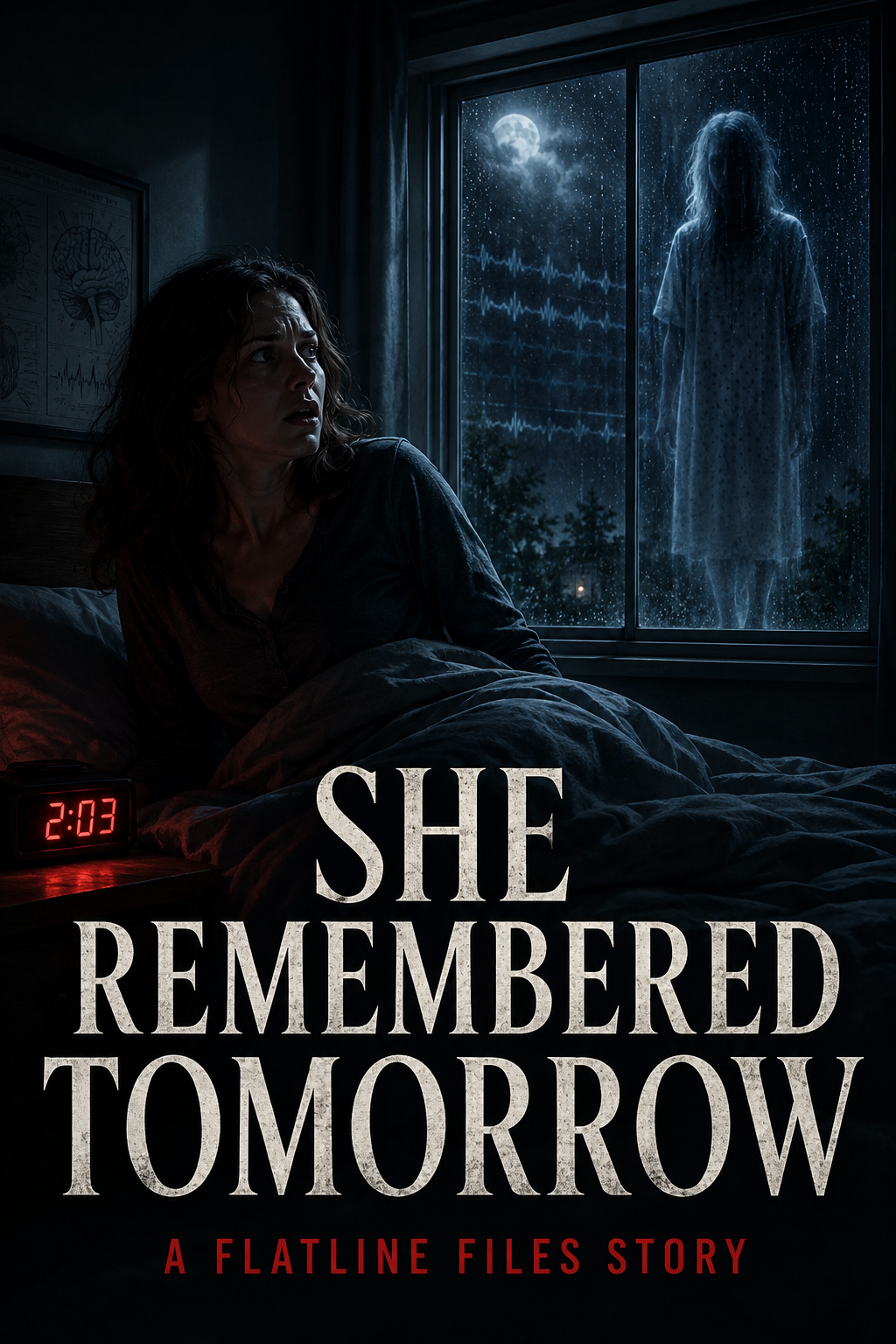
Lena Brooks began waking with clear memories of things that had not happened yet, including conversations, small accidents, and a stranger’s face pressed against her bedroom window. Doctors first blamed stress, unusual seizures, a sleep disorder, or a new medicine, but each memory came true the next day in exact detail. Then a test that measured her brain waves recorded Lena answering a question seven seconds before the nurse asked it—and the voice on the recording did not sound like hers.
On Monday morning, Lena remembered breaking a blue cup.
She did not dream about it. Dreams were soft around the edges. This felt sharp and complete, like something that had already happened.
She remembered standing in her kitchen at 6:42 in the evening. She remembered reaching for a jar of sugar. Her elbow struck the cup beside it. The cup hit the floor and broke into three large pieces.
She even remembered the tiny cut on her right thumb.
Lena opened her eyes.
Gray morning light filled her bedroom. Her alarm clock said 6:11. Her husband, Noah, was still asleep beside her.
She checked her thumb.
There was no cut.
The blue cup sat in the kitchen cabinet where it always did. Lena took it down and turned it in her hands. Her daughter June had painted a crooked yellow sun on it during a school art day. Lena used it every evening for tea.
She placed the cup on the highest shelf.
All day, the memory bothered her. She worked from home, answered emails, and tried to laugh at herself. By dinner, she had almost forgotten it.
At 6:41 that evening, Noah asked where they kept the sugar.
“Top cabinet,” Lena said.
He opened the door. The sugar jar sat behind the blue cup. When he reached for it, his elbow struck the cup.
It fell.
Lena lunged forward and caught one side, but the handle hit the counter. The cup slipped from her fingers and broke into three large pieces.
One piece cut her right thumb.
For several seconds, Lena could only stare at the blood.
“Are you okay?” Noah asked.
“I remember this.”
“You remember what?”
“This happened this morning.”
Noah thought she meant she had dreamed it. Lena let him believe that because she did not know how to explain the difference.
The next morning, she remembered a red balloon caught in a tree.
In the memory, she was walking June to school. A little boy stood under an old pine tree and cried while his father tried to reach the string. A city bus drove past and sprayed muddy water onto Lena’s shoes.
Lena did not want to test it, but she also did not want to hide at home.
She wore old shoes.
At 7:55, she and June turned the corner near the school. A red balloon floated above the sidewalk. Its string was tangled in the pine branches. A little boy cried beneath it.
“Mom, look,” June said.
Lena pulled her daughter away from the curb just before the bus passed. Muddy water splashed across the empty place where they had been standing.
The father thanked her for moving so fast.
Lena smiled, but her stomach felt cold.
On Wednesday morning, she remembered a phone call from her sister.
Her sister would say their mother had fallen in the grocery store. She would be frightened but not badly hurt. The hospital would find a sprained wrist and a bruise on her hip.
At 2:16 that afternoon, Lena’s phone rang.
She answered with, “Mom fell, but she’s okay.”
There was a long silence.
“How did you know?” her sister asked.
Lena did not have an answer.
That night, she told Noah everything.
He listened as she described the cup, the balloon, and the phone call. He asked if she had seen messages about any of those things before falling asleep. He wondered if she was remembering dreams and joining them to real events afterward.
“You think I’m making the details fit,” Lena said.
“I think the brain can play strange tricks.”
“Then write something down. Anything. Seal it in an envelope. Tomorrow, I’ll tell you if I remember opening it.”
Noah did not like the idea, but he agreed.
He went into the garage and locked the door. Ten minutes later, he returned with a sealed envelope. He signed his name across the flap and placed it inside his locked desk drawer.
On Thursday morning, Lena woke crying.
She remembered the paper inside the envelope.
Noah had drawn a black bird with a key in its beak. Under it, he had written, “June’s first word was moon.”
But that was not why Lena cried.
In the memory, someone had been standing behind Noah while he made the drawing.
It was a woman in a white hospital gown.
Her hair hung across her face. Her bare feet were gray with dirt. She stood so close that her chest almost touched Noah’s back.
Noah could not see her.
The woman looked straight at Lena, even though Lena was only remembering the scene.
Then the woman lifted one finger to her lips.
Lena woke with the same finger pressed against her own mouth.
She ran to Noah’s desk and made him unlock it. The paper showed the black bird. The sentence below it was exactly right.
Noah turned pale.
“Did you come into the garage?” he asked.
“No.”
“Did you watch through the window?”
“The blind was closed.”
“Then how?”
Lena told him about the woman.
That was when Noah asked her to see a doctor.
Lena’s family doctor gave her a careful exam. Her strength was normal. Her balance was normal. She knew the date, the place, and everyone’s name. Her speech was clear.
The doctor asked about headaches, fainting, lost time, new medicines, alcohol, and drug use. Lena had started a medicine for migraines three weeks earlier, but she had no other changes.
“Some kinds of seizures can cause a sudden feeling that something has happened before,” the doctor said. “A seizure is a burst of unusual electrical activity in the brain. It does not always make a person fall or shake.”
He told her to stop driving until they knew more. He also ordered a picture of her brain and a test of its electrical signals.
“Could a seizure show me tomorrow?” Lena asked.
The doctor paused.
“It could make a memory feel real,” he said. “That does not mean the event came from the future.”
Lena wanted to believe him.
The picture of her brain was normal. There was no tumor, bleeding, or sign of a recent stroke. Her blood tests were normal too.
The brain-wave test was scheduled for Friday.
A nurse placed small metal disks across Lena’s scalp. Thin wires ran from the disks to a computer. The test was called an EEG. It watched the tiny electrical signals made by the brain.
Lena lay on a narrow bed while the nurse sat behind a window.
“Try to relax,” the nurse said through a speaker.
Lena closed her eyes.
For several minutes, nothing happened.
Then she remembered the nurse asking, “Do you smell anything strange?”
Lena remembered answering, “Burnt oranges.”
Her eyes opened.
The room was quiet.
“Burnt oranges,” Lena said.
Seven seconds later, the speaker clicked.
“Do you smell anything strange?” the nurse asked.
Lena sat up so fast that two wires pulled loose.
The nurse entered the room. “What’s wrong?”
“I answered before you asked.”
“Answered what?”
Lena pointed at the speaker. “You asked if I smelled anything strange.”
The nurse frowned. “I was about to ask that.”
They reviewed the recording.
At 10:23 and fourteen seconds, Lena’s lips did not move. She was lying still with her eyes closed.
Yet a voice on the room microphone said, “Burnt oranges.”
At 10:23 and twenty-one seconds, the nurse asked the question.
This time Lena’s lips moved as the recording captured her frightened reply.
The first voice was lower than Lena’s. It sounded wet and tired.
The nurse played it again.
Under the words, they heard a slow clicking sound.
Three clicks. A pause. Three more.
“Is something wrong with the machine?” Lena asked.
The nurse shut off the recording.
“Machines can pick up other signals,” she said, but she would not meet Lena’s eyes.
The doctor who read the test found a few brief changes near the part of Lena’s brain that helps make memories. The changes were not enough to prove she had seizures. He wanted a longer test at the hospital.
Lena went home with more questions than answers.
That night, she and Noah moved June’s mattress into their room. Noah checked every lock and window. He also placed a camera in the garage.
“If the woman comes back, we’ll see her,” he said.
Lena did not tell him what she remembered that morning.
She had seen the woman standing outside their bedroom window at 2:03 at night.
Their bedroom was on the second floor.
At 2:00, Lena sat awake with all the lights on. Noah held a baseball bat. Rain tapped against the glass.
At 2:03, three soft knocks came from the window.
Noah raised the bat.
The woman stood on the other side of the glass.
Her hospital gown moved in the wind. Her feet rested on nothing. Her hair covered most of her face, but Lena could see one eye looking in.
Noah whispered, “Who is that?”
The woman smiled.
Then every light in the room went out.
June screamed.
Noah swung the bat at the window. The glass did not break, but the woman vanished.
When the lights returned, wet footprints crossed the ceiling above their bed.
They followed the prints into the hallway.
The last print stopped above June’s bedroom door.
Noah called the police. Two officers searched the house and yard. They found no one. One officer climbed into the attic but saw only dust and insulation.
He also found something else.
Above June’s room, someone had written a date on a wooden beam.
It was Saturday’s date.
Tomorrow.
Noah wanted to leave the house at once. They packed a bag and drove to Lena’s sister’s home across town.
Lena fell asleep near dawn.
She remembered Saturday.
She saw herself in a hospital room. Wires ran from her head to a machine. Noah sat beside her. June colored a picture near the window.
At 4:10 in the afternoon, the woman in the hospital gown walked into the room.
No one but Lena noticed her.
The woman leaned down and whispered, “You have one day left.”
Then she placed both hands around June’s head.
Lena woke screaming.
She refused to take June to the hospital. Noah argued that Lena needed the longer brain test. He said the doctors might finally find an answer. Lena told him the hospital was where the woman wanted them.
In the end, they left June with Lena’s sister. Noah drove Lena to the hospital alone.
“If anything feels wrong, we leave,” he promised.
The hospital room looked exactly as Lena remembered, except June was not there. Lena felt a small hope. They had changed the future.
More metal disks were placed on her head. A camera watched the bed. The doctors hoped to record one of her strange spells and see what her brain was doing at that moment.
For hours, nothing happened.
At 4:09, Lena’s phone rang.
It was her sister.
June had started vomiting and complained of a terrible headache. She was sleepy and hard to wake. An ambulance was bringing her to the same hospital.
Lena tore the wires from her head.
“We have to go,” she told Noah.
Before they reached the door, the clock changed to 4:10.
The woman in the hospital gown walked through the wall.
Noah froze. This time he could see her too.
The woman’s skin was pale. Water dripped from her hair, though the floor stayed dry. A faded name band circled her wrist.
LENA BROOKS.
“That’s my name,” Lena whispered.
The woman lifted her head.
Lena saw her own face.
It was older and thinner. A long scar crossed one side of the scalp. The eyes looked empty from too many nights without sleep.
“You have one day left,” the older Lena said.
“Until what?”
“Until you become me.”
The room stretched around them. The walls seemed to move farther away. The monitor beside the bed began showing dates instead of heartbeats.
Sunday.
Monday.
Tuesday.
Each date flashed faster than the one before it.
The older Lena stepped closer.
“I tried to stop it,” she said. “Every warning changed one small thing. But each change brought us closer to this room.”
“What happened to June?”
The older Lena began to cry.
“She saw tomorrow too.”
The door burst open. Two nurses rushed in because Lena’s wires had come loose. The older woman disappeared.
At that same moment, an emergency call sounded over the hospital speaker. A child had stopped breathing in the ambulance entrance.
Lena ran.
She reached the entrance as the paramedics pushed June through the doors. Her daughter’s face was white. A mask covered her mouth. One paramedic squeezed a bag to push air into her lungs.
Then June’s eyes opened.
She looked straight at Lena.
“Duck,” June whispered.
Lena dropped to the floor.
A heavy light fixture broke loose above her and crashed against the wall. Glass flew across the hall. If Lena had remained standing, it would have struck her head.
June began breathing on her own seconds later.
Her tests showed no clear cause for the sudden illness. The doctor thought it might have been a severe migraine. A migraine could cause intense head pain, vomiting, confusion, and strange changes in vision. But it did not explain why June knew the light would fall.
They stayed in the hospital overnight.
By morning, June seemed normal. She ate toast and asked to go home.
Lena sat beside her bed and held her hand.
“What did you see?” she asked.
June looked toward the empty corner.
“A lady told me to make you duck.”
“What lady?”
“The old one who looks like me.”
Lena’s grip tightened.
June pulled her hand away and touched the side of her head.
“She has a scar right here,” she said.
On Sunday morning, Lena woke without a future memory for the first time all week.
She laughed with relief. She woke Noah, hugged June, and opened every curtain in the house. Sunlight filled the rooms. The wet footprints on the ceiling were gone. The date in the attic had faded until only a dark smudge remained.
For two weeks, life returned to normal.
Then one morning, Lena found June sitting at the kitchen table before sunrise.
The girl had covered dozens of sheets of paper with the same drawing.
Each picture showed Lena lying in a hospital bed. A light fixture had crushed the pillow beside her head. An older woman stood in the corner.
At the bottom of every page, June had written a different date.
Lena flipped through them.
There were hundreds.
Some dates were only days away. Others were years in the future.
“Why did you draw all these?” Lena asked.
June looked up with dark circles beneath her eyes.
“I didn’t draw them yet,” she said.
From the hallway came three slow clicks.
Lena turned.
The older version of June stood at the foot of the stairs, wearing a white hospital gown and holding tomorrow’s picture in her hand.