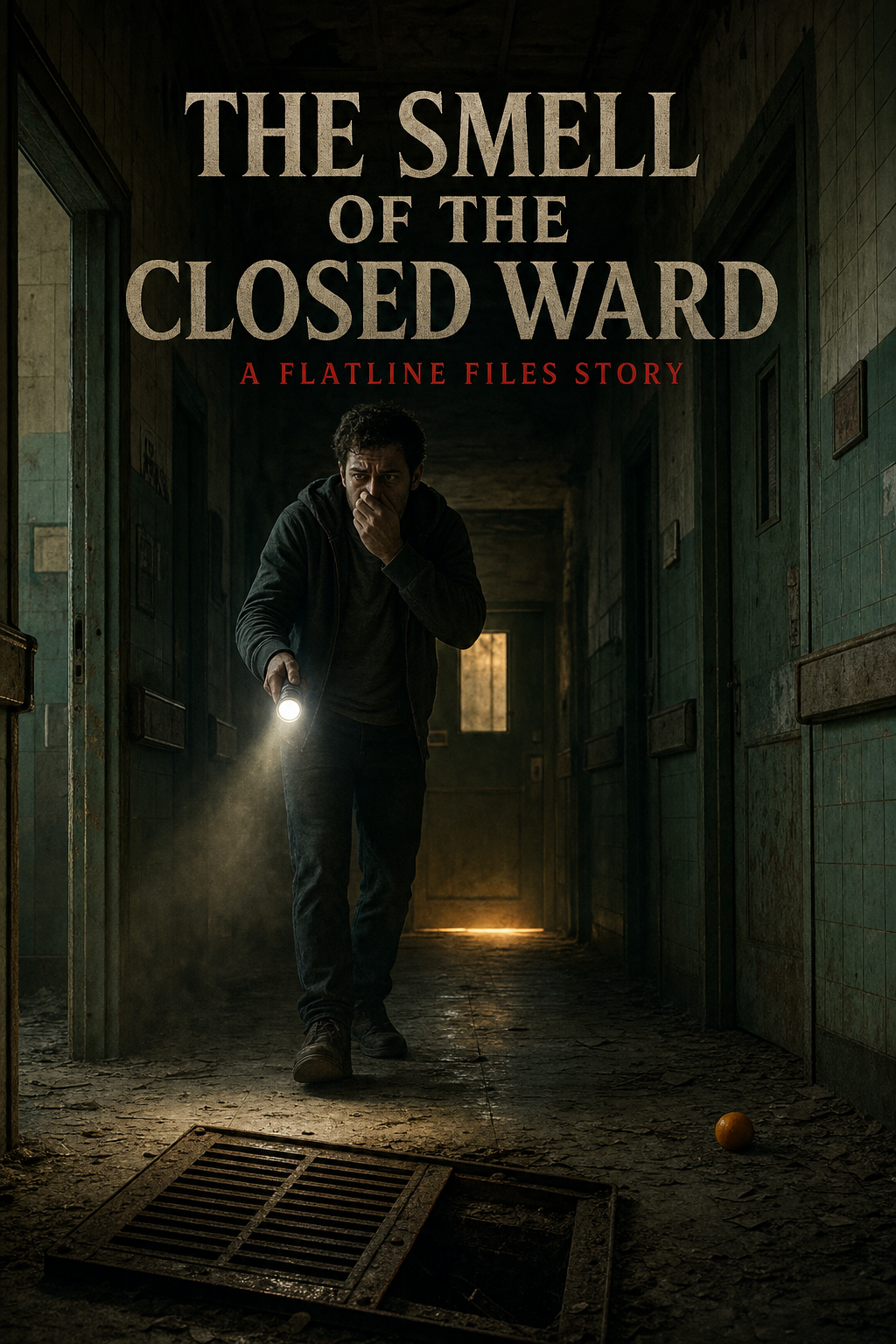
Thirty-one-year-old Rowan Bell began smelling sickly odors that nobody else could detect, followed by vomiting, shaking spells, and short gaps in his memory. Doctors considered sinus disease, migraines, seizures, poisoned air, anxiety, medication reactions, and a problem in the part of his brain that handles smell. Then Rowan found a hospital wristband in his coat pocket with his own name on it, dated seventeen years before he was born.
Rowan first smelled the oranges while he was driving home from work.
Not fresh oranges. Not the bright smell of juice or a peeled snack. These smelled rotten and hot, like somebody had left a bag of fruit on a radiator for a year. The stink filled his little gray car so fast that he gagged.
He rolled down both windows. Cold March air rushed in. The road beside him was empty except for a school bus and a man walking a dog.
The orange smell did not leave.
It sat behind Rowan’s eyes. It seemed to come from the back of his throat. He pulled into a gas station, bent over beside the air pump, and threw up until his stomach hurt.
When he looked up, a nurse in old-fashioned white clothes was standing beside his car.
Her dress was yellow around the hem. Her face was hidden by a paper mask. She held one finger over her mouth.
Rowan blinked.
The woman was gone. In her place was a trash can with a peeling advertisement for windshield cleaner.
He told himself he was tired. He had been working long shifts at the warehouse since Christmas, loading boxes and fixing broken scanners. He slept badly. He ate too much gas-station food. His mother had always said his body complained when he pushed it too hard.
But when he got home, he found orange-colored vomit dried on the front of his shirt.
He did not remember driving the last six miles.
Rowan’s first attack could have been food poisoning, exhaustion, or a panic spell, but the missing drive home and the masked nurse made him afraid that his senses were lying to him. He decided to watch for the smell if it came back, because he needed proof before he told anyone.
It came back three nights later while Rowan was brushing his teeth.
This time it was bleach.
Not the clean, sharp smell from his bathroom bottle. This bleach smelled old and wet, mixed with sweat, medicine, and something sweet underneath. Rowan dropped his toothbrush. His knees folded before he understood he was falling.
He woke on the tile floor with water running over one hand.
The sink had overflowed. The bathroom clock said 2:41 in the morning. His phone, which had been charging in the bedroom, showed 3:28.
Forty-seven minutes were gone.
There was a bruise on his left shoulder, dark enough to show through his skin. Rowan stared at it until the room began to tilt again.
He called his older sister, Leah, because he did not know who else to call.
Leah arrived in sweatpants and a coat thrown over her pajamas. She checked his pupils with her phone light, touched his forehead, and looked around the apartment as if she expected someone to be hiding behind the shower curtain.
“You need an emergency room,” she said.
“I smelled bleach.”
“There is bleach in your bathroom.”
“No. It was different.”
Leah looked at him carefully. She was a school counselor. She knew how to make her voice soft without making it sound fake.
“Okay,” she said. “Then we tell them exactly that.”
The emergency room was bright, crowded, and warm. Rowan sat under a thin blanket while a doctor asked about drugs, alcohol, head injuries, new medicine, and stress. Blood tests showed he was dehydrated from vomiting, but nothing else looked badly wrong. A brain scan did not show bleeding or a large growth. His heart rhythm was steady.
The doctor explained that strange smells could happen with sinus infections, migraines, seizures, or problems in the brain. A smell that was not really there had a name: phantosmia.
“Like a phantom smell,” Rowan said.
“Exactly.”
“Can a phantom smell knock you out?”
The doctor did not answer right away.
“A seizure can cause strange smells and lost time,” she said. “So can fainting. We’ll arrange more tests.”
Rowan wanted that answer to calm him. Instead, it gave the thing in his apartment a medical name and made it feel more real.
The hospital found dehydration but no simple cause for Rowan’s lost time, and the doctors took seizures and migraines seriously. He left with appointments for a brain-wave test and a nose examination, but he knew the attacks had begun in his apartment and seemed tied to particular smells.
For the next week, Rowan kept a notebook.
He wrote down every smell, every time, and every feeling that followed.
Rotten oranges made his stomach twist.
Wet bleach made his left shoulder ache.
Burned wool made him cough until his ribs hurt.
Once, while waiting in line at the grocery store, he smelled baby powder mixed with metal. His right hand began to tremble so hard that he dropped a jar of pasta sauce. The glass burst across the floor.
For one fast second, Rowan saw a row of narrow beds under dim yellow lights. A woman cried behind a curtain. Somewhere close by, a baby made a weak, thin sound.
Then he was back in the store with red sauce on his shoes.
The cashier asked if he needed help. Rowan said no and ran outside.
He stopped taking the bus because people’s perfume scared him. He stopped cooking because steam from the stove made him think of hospital disinfectant. He slept on Leah’s couch one night, then two. No attacks came there.
On the third night, he went back to his own apartment for clothes.
The moment he opened the door, he smelled burned wool.
His chest tightened. He grabbed the wall.
Someone had written on the paint beside the coat hooks.
NOT THE THIRD FLOOR.
The words were gray and shaky, as if made with ash.
Rowan touched them. The powder came away on his fingertips.
He lived on the second floor.
Rowan’s attacks had begun to affect his body in different ways, and staying at Leah’s apartment seemed to stop them. The message inside his own home made him believe the danger was connected to the building, so he had to learn what had happened there before he moved in.
The building manager was named Mr. Dorsey. He was seventy, hard of hearing, and always smelled like coffee and pipe smoke. He seemed annoyed when Rowan asked about the writing on the wall.
“Kids get in through the back sometimes,” he said.
“There are no kids in my apartment.”
“Then somebody you know has a key.”
“What was this place before it was apartments?”
Mr. Dorsey stopped moving.
His hand remained on the office door knob.
“Why?”
“I found something on the wall.”
“This was a nursing home for a while,” he said. “A long time ago. Before that, it was part of St. Anselm’s Hospital.”
“Part of the hospital how?”
“Storage. Laundry. Staff rooms. Nothing interesting.”
He shut the office door before Rowan could ask another question.
That evening, Rowan searched old newspapers at the public library. St. Anselm’s Hospital had closed in 1989 after a fire in its main building. The articles were short. Eleven patients had died. The official cause was an electrical fault in a basement supply room.
Then Rowan found a smaller article from two months later.
It described an investigation into an unlisted ward inside an older building across the street. The ward had been used for patients with severe lung disease during the 1950s and 1960s. It had no proper records. Families claimed people had disappeared there.
The old building’s address was Rowan’s address.
A black-and-white photograph showed three stories of dark brick. The windows had been bricked over years before.
Rowan enlarged the image.
On the third floor, one window was open.
In the opening stood a nurse in white.
Her face was covered by a paper mask.
The building had once held a hidden hospital ward, and a fire had sealed much of its history away. Rowan still could not explain the smells or missing time, but the warning about the third floor no longer felt like random vandalism.
Rowan did not want to go upstairs. He told Leah he would wait for the police or the city inspector.
Then he went home and found his apartment door open.
Nothing looked stolen. His television was there. His laptop sat on the table. His wallet was still in the kitchen bowl.
But the notebook of smells was gone.
On the floor beneath the coat hooks lay a square of folded paper.
Inside was a hospital wristband.
It was yellow with age. The plastic had cracked along one edge. Rowan could still read the ink.
ROWAN BELL.
MALE.
WARD 3.
ADMITTED: OCTOBER 14, 1976.
He was born in 1993.
At the bottom, where a date of birth should have been, someone had written only one word.
RETURNED.
Rowan sat on the floor until Leah arrived. He did not tell her about the word at first. He only showed her the impossible date.
Leah stared at it for a long time.
“Dad worked here,” she said.
Rowan looked up.
“At St. Anselm’s?”
“Before he met Mom. He never talked about it much.”
“Why not?”
Leah’s mouth tightened. “Because he hated that place.”
“You knew?”
“I knew he had nightmares.”
Rowan had been six when their father died in a highway crash. He remembered almost nothing except a rough beard against his cheek and the smell of rain on wool.
Burned wool.
The wristband gave Rowan an impossible connection to Ward 3, while Leah revealed that their dead father had worked at St. Anselm’s. Rowan now believed his father knew something about the hidden ward, and the smell of burned wool made the old hospital feel tied to his own childhood.
Their father’s things were stored in Leah’s basement. They spent most of the next day opening boxes that had not been touched in twenty years.
They found tax papers, fishing gear, old birthday cards, and a faded photograph of their father standing outside St. Anselm’s in a maintenance uniform.
Behind the photograph was an envelope.
It had Rowan’s name written on it in their father’s blocky handwriting.
Inside was one page.
Rowan read it aloud because Leah could not make herself do it.
“If the smells begin, do not let them take you upstairs. They are not memories. They are not ghosts. They are what was left when the ward was closed.”
Below that, their father had drawn a crooked map of the apartment building. A red X marked the third floor laundry room.
At the bottom was another sentence.
“The vent must stay sealed.”
Leah called the police. The police said they could check for trespassers, but the note did not prove a crime. She called the city building office. Their answering machine said an inspector might come in two weeks.
Rowan listened to the message twice.
That night, the smell of baby powder woke him at 1:13.
He was not in Leah’s apartment.
He was standing barefoot in the hallway of his own building.
His phone said 3:51.
His feet were wet. His hands were black with soot.
Above him, on the third floor, something heavy scraped slowly across the ceiling.
Rowan learned that his father had warned him about a sealed vent on the third floor, but official help would not come soon enough. After another gap in time carried him back to the building, he understood that whatever had reached him was trying to bring him upstairs.
He should have left.
Instead, Rowan went to his apartment and found a flashlight, a screwdriver, and an old dust mask from a box under the sink. He called Leah, told her where he was, and asked her to stay on the phone.
“Wait for me,” she said.
“I can hear something up there.”
“Rowan, wait.”
The stairwell smelled like wet bleach.
His left shoulder flared with pain. He climbed anyway.
The third floor had been closed for repairs since before he moved in. A chain crossed the hallway entrance. Rowan cut the plastic lock with the screwdriver and stepped through.
The hall beyond was not under repair.
It was old.
Dust covered the floor in a thick gray layer. Doors stood along both walls, painted hospital green. The ceiling lights were gone, but a weak yellow glow leaked beneath the last door.
Rowan’s phone crackled in his hand.
“I’m coming up,” Leah said through static.
At the end of the hall, a woman began to cough.
It was a deep, wet cough. Rowan felt it in his own chest. Burned wool filled his nose.
He reached the last door and saw faded letters beneath the grime.
WARD 3 LAUNDRY.
The door was warm.
Behind it, something struck metal three times.
Rowan opened it.
The room was almost empty. Rusted washing machines lined one wall. A cart stood tipped on its side. In the center of the floor was a square metal vent cover bolted over a dark opening.
Fresh screws held it down.
Beside it lay Rowan’s missing notebook.
Every page had been torn out except the last one.
On that page, in Rowan’s handwriting, were the words: I OPENED IT BEFORE.
In Ward 3, Rowan found the sealed vent his father had marked and proof that he had somehow been there before. The attacks were no longer only visions or smells; they had begun to use his body, and he had to decide whether opening the vent was the danger or the only way to stop it.
Leah reached him just as he was pulling at the first screw.
She grabbed his wrist. “Don’t.”
Rowan turned on her.
For a second, he did not know her.
Her face looked thin and gray beneath the flashlight beam. Her hair was tucked under a nurse’s cap. Her mouth moved behind a paper mask.
“You brought him back,” Rowan said.
Leah froze.
“What did you say?”
The strange picture broke apart. Rowan saw his sister again, terrified and crying.
He backed away from her. “I’m sorry. I don’t know why I said that.”
Leah looked at the vent. “Dad wrote returned.”
“I know.”
“Maybe he meant you.”
A sound rose from below the metal cover.
Not a voice. Not quite. It was dozens of people breathing together, each breath catching at a different place. Between those breaths came a soft scraping noise, like fingernails writing on paper.
Rowan knelt beside the vent.
He remembered something he had never remembered before.
A small hand. His own hand, much younger. A hospital corridor filled with smoke. A man in a maintenance uniform carrying him under one arm. His father was crying as he ran.
“You were there,” Rowan whispered.
Leah’s face changed. She had remembered it too, or maybe she had heard enough to understand.
“Dad found you there?”
Rowan looked at the wristband in his pocket.
He had never been born in 1976. But perhaps somebody named Rowan Bell had been admitted that year. A child with no family listed. A child their father had carried out during the fire.
“I wasn’t returned,” he said. “I was taken.”
Below the vent, the breathing became angry.
The screws began to turn by themselves.
Rowan finally understood that his father had rescued him from Ward 3 as a child and given him a new life, while the hidden ward had never truly let him go. The vent was opening on its own, so Rowan and Leah had to seal it before the trapped presence could reach the rest of the building.
Leah shoved the screwdriver into Rowan’s hand.
“Tighten them,” she said.
“They’re moving.”
“Then move them back.”
Rowan put the screwdriver into the nearest screw. The metal was hot enough to burn his palm through the handle. He twisted until his wrist shook.
From beneath the vent came the smell of rotten oranges. He gagged but kept turning.
Wet bleach followed. His shoulder screamed.
Burned wool filled the room. Smoke curled from the seams of the cover.
He saw people around him. Patients in thin gowns. Nurses with blank masks. A little boy standing near the vent with soot on his cheeks.
The boy looked exactly like Rowan.
“Come back,” the boy said.
Rowan almost reached for him.
Then Leah slapped his hand away from the opening screw.
“You are not down there,” she shouted. “You are here.”
That was enough.
Rowan gripped the screwdriver with both hands and turned until the screw stopped. Leah held the metal cover down with her full weight while he tightened the next one, then the next.
The last screw fought him hardest. Something beneath the vent pushed upward. The cover rose an inch. Cold air blew against Rowan’s face, carrying the smell of baby powder and bloodless metal.
He heard a baby crying.
He heard his father say, “I’m sorry.”
Rowan drove the screwdriver down and twisted until it snapped.
The vent slammed shut.
Every smell vanished at once.
The room went dark.
For several seconds, Rowan could hear only Leah breathing beside him.
Then, far below them, an alarm began to ring.
Rowan and Leah forced the vent shut, ending the smells and the voices inside Ward 3. They escaped as the old building’s alarm sounded, but Rowan knew the sealed place had recognized him as the child who got away.
The fire department found no active fire. The city finally inspected the building. They discovered an illegal third-floor space hidden behind newer walls, along with old hospital equipment, rotten pipes, and a sealed shaft running down into the basement.
The report blamed bad wiring, mold, and unsafe construction. Mr. Dorsey was questioned about why tenants had been allowed to live beneath it. He said he had never been upstairs.
Rowan moved in with Leah while the building was closed.
For two months, he slept through the night.
His brain-wave test showed no seizure disorder. The nose doctor found mild irritation in his sinuses but nothing that explained visions. A therapist helped him with the memories of his father and the fire, though Rowan did not tell her every detail.
Some things sounded foolish when spoken in a clean office during daylight.
Then one rainy morning, a package arrived at Leah’s house.
No return address.
Inside was Rowan’s old notebook.
He had watched the fire department carry it out of Ward 3. He had seen it dropped into a black evidence bag.
Now it was dry and clean.
Only one page had writing on it.
Rowan read it standing at Leah’s kitchen counter.
THE THIRD FLOOR IS SEALED.
Below that, in smaller letters, were six more words.
THE BASEMENT DOOR IS NOT.
From somewhere beneath the house, Rowan smelled rotten oranges.