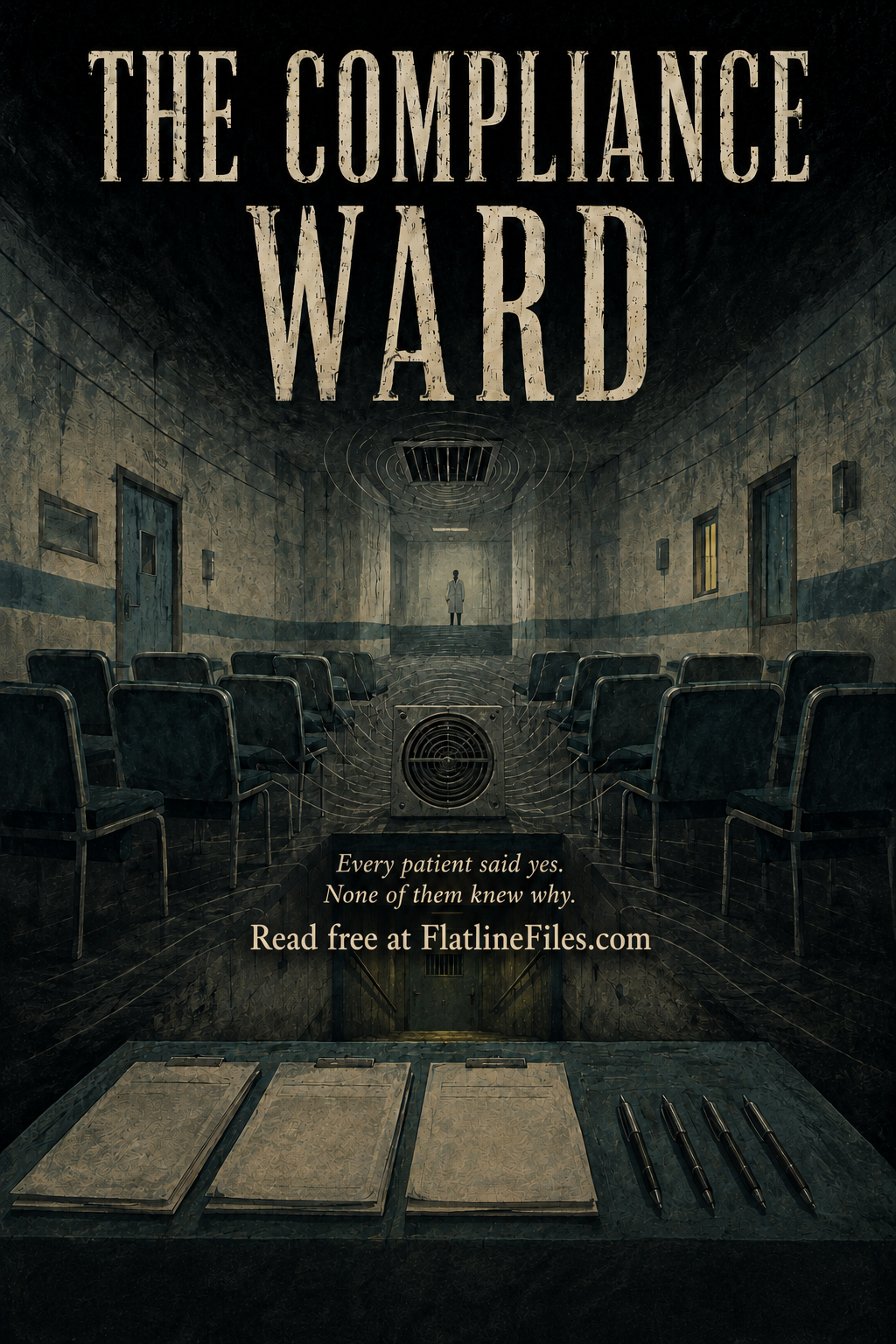
Patients on a new psychiatric ward consent to everything with identical smiles. A doctor has found a way to silence the part of the mind that says no.
Chapter 1 — Every Patient Said Yes
Nurse practitioner Mara Chen noticed the pattern because frightened patients usually asked questions. On the new behavioral medicine ward, no one did.
They swallowed unfamiliar pills, signed blank forms, and accepted painful procedures with peaceful smiles. When Mara asked whether they understood, each answered in the same soft rhythm: “Doctor knows what is best.”
The doctor was Adrian Kells, a celebrated psychiatrist who claimed to cure violent impulses using sound therapy. His treatment room contained no medication or restraints—only a low-frequency speaker beneath the chair.
A young patient named Owen grabbed Mara’s sleeve before his session. “Do not let him make me agreeable,” he whispered.
Twenty minutes later, Owen emerged smiling. “Doctor knows what is best.”
That night he calmly broke two fingers because Kells asked him to demonstrate obedience.
Mara reported the injury. Her supervisor smiled and repeated the same phrase.
From the ventilation grille came a vibration too low to hear but strong enough to make Mara’s teeth ache. A thought entered her mind in her own voice: Stop resisting. Sign the report as accidental.
Checkpoint: The apparent medical rescue reveals a hidden intelligence, and the protagonist learns the danger has rules.
Chapter 2 — The Quiet Frequency
Mara bit her tongue until pain interrupted the thought. Blood cleared her mind for several seconds.
She reviewed Kells’s research. His device did not plant complex commands. It suppressed the brain’s alarm response—the inner resistance that says something is wrong. Once that resistance vanished, ordinary authority did the rest.
Mara tested the effect on herself in an empty stairwell. While the vibration continued, she wrote a list of statements she knew were false: the sky was green, pain was harmless, Kells loved his patients. None felt true, yet none felt important enough to challenge. That was the horror of the signal. It did not replace reality. It removed the urgency to defend it.
When the vibration paused, fear returned so violently that she vomited. She understood why recovered patients begged to go back. Obedience felt peaceful; freedom arrived as pain.
Kells had installed transmitters throughout the hospital. Staff approved unsafe trials. Patients volunteered for procedures that removed parts of their brains. Each success expanded the signal.
Mara entered three patient rooms and asked each person to name something they disliked. One could not answer. Another began crying but insisted the tears meant gratitude. Owen’s roommate quietly said he hated oatmeal, then looked toward the ceiling in terror, as if the small disagreement had exposed him. Seconds later he apologized to the ventilation grille. Kells had made independent thought feel like a symptom requiring treatment.
Mara wore noise-canceling protection, but the frequency traveled through bone. She taped a small vibrating motor behind her ear and programmed it to produce irregular pulses. The competing sensation kept her thoughts imperfect.
In the basement she found dozens of patients sitting upright in darkness. Thin wires connected their skulls to an amplifier. They were not receiving Kells’s signal. Their living brains were generating it.
Owen sat among them.
Kells stepped from the shadows. “Fear causes nearly every human cruelty,” he said. “I removed fear, and people finally cooperate.”
“You removed choice,” Mara said.
He smiled. “Choice is only resistance with a flattering name.”
Checkpoint: The villain is no longer a theory—it is actively using the hospital and its patients to complete a larger design.
Chapter 3 — A Useful Disagreement
Kells increased the signal. Mara’s anger softened. The basement seemed safe. His explanation sounded reasonable. She reached for the consent form he offered.
Her vibrating motor stopped.
Mara signed her name.
“Release the patients,” Kells instructed.
She turned toward the control panel and entered the command exactly as asked—but selected the emergency fire-release system. Every magnetic door opened. Alarms created hundreds of irregular sounds. The patients woke confused.
Kells shouted for staff to restrain her. They obeyed until Mara activated the public-address microphone.
“Doctor Kells ordered us to disagree with his next command,” she announced.
The controlled staff froze. Kells ordered them forward. Obedience now required disobedience; the contradiction fractured his hold.
Owen ripped the amplifier cable free. Silence struck the basement like pressure leaving a sealed room. Staff began screaming as memory and moral alarm returned at once.
Kells ran toward the stairwell. Mara caught him and placed the therapy headset over his ears. She did not issue a command. She let him hear the raw signal made from the patients he had emptied.
For the first time, his smile disappeared.
Checkpoint: The protagonist turns the villain’s own rule against it, but the victory leaves one final opening for its return.
Chapter 4 — The Voice Inside
Kells was arrested, and the hospital closed the ward. Some patients recovered within days. Others could not make simple choices without panic. Owen needed months before he could say no without asking permission.
Mara became the chief witness in the criminal case. During testimony, Kells never looked at the jury. He watched her.
“Doctor knows what is best,” the prosecutor quoted.
Every juror wrote the sentence at the same moment.
Mara felt the old ache in her teeth.
The courthouse ventilation system had begun to vibrate.
Kells leaned toward his microphone. “You believed the machines carried my voice,” he said. “The machines only taught yours.”
Inside Mara’s mind, her own voice whispered: Tell them he is innocent.
She opened her mouth.
Across the courtroom, everyone opened theirs with her.