
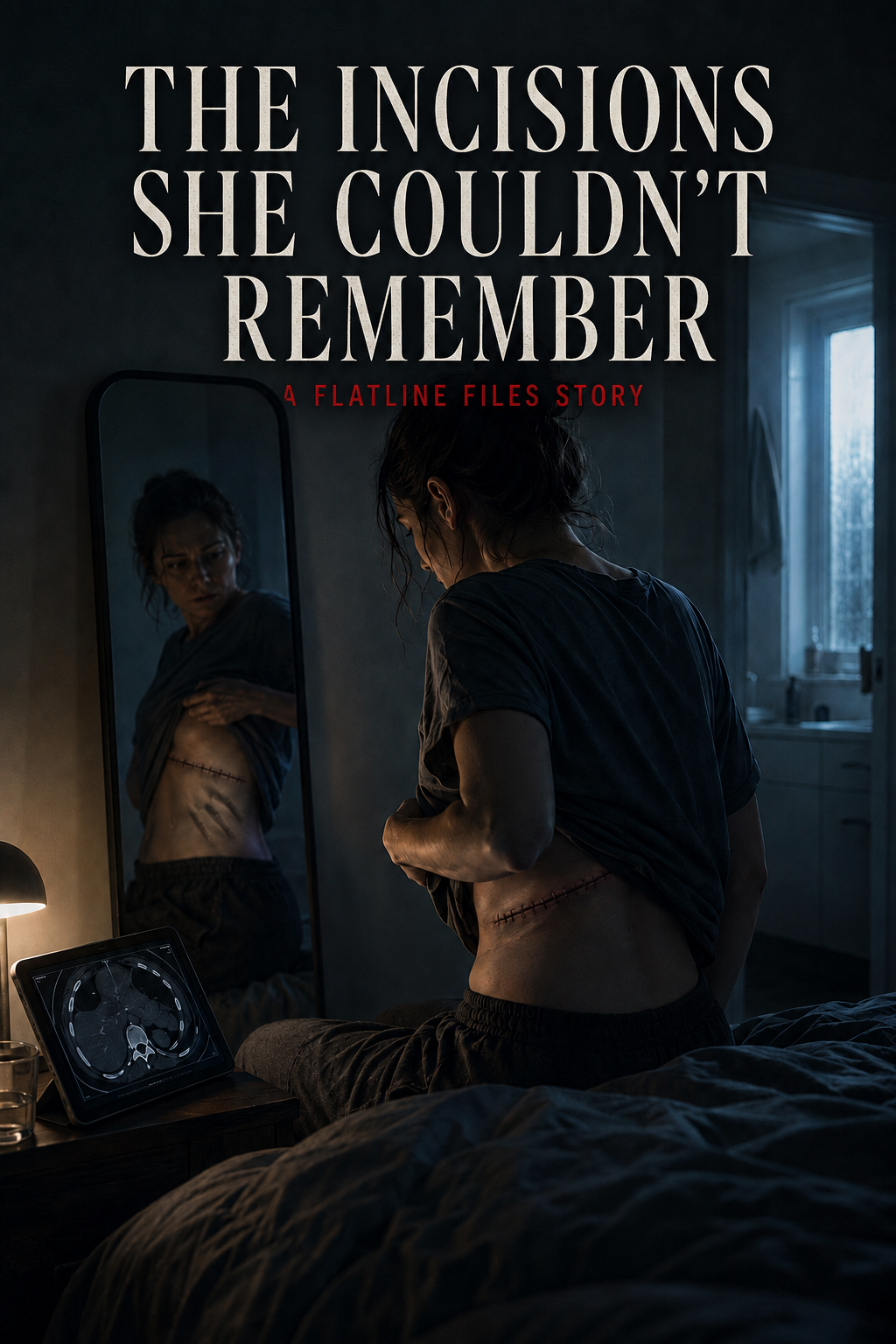
The Incisions She Couldn’t Remember
A patient repeatedly wakes with precise surgical incisions and missing hours, while every test remains normal. Initially, the possibilities include sleepwalking, abuse, dissociation, a hidden medical condition, or someone entering the home. Then imaging reveals something beneath the scars that disappears whenever anyone else looks at the scan.
Elena woke with blood beneath her fingernails and a surgical incision under her left ribs.
It was four inches long, closed with nine perfect black sutures. The skin around it had been scrubbed so clean that the rest of her body smelled dirty by comparison. There was no blood on the sheets. No torn clothing. No open window or unlocked door.
Her phone lay charging beside the bed. According to its health app, she had slept for six hours and walked eleven miles.
Elena lived alone on the seventh floor.
She stood in front of the mirror, lifting her shirt with a shaking hand. The cut was too straight to be accidental. Whoever had made it had known where to place the needle, how far apart to space each stitch, and how tightly to pull without puckering the skin.
When she touched the center of the incision, something hard shifted beneath it.
Not bone. Not muscle.
Something small and angular moved under her fingertip, then slid deeper between her ribs.
Elena stopped breathing.
In the mirror, her reflection kept pressing the wound after her real hand had fallen away.
Then the reflection smiled.
Elena did not.
She stumbled backward, struck the dresser, and looked again.
The woman in the mirror was only frightened now. Her shirt hung loose around her waist. Her hand covered her mouth. Nothing smiled.
But beneath the sutures, something tapped three times from inside her body.
At the emergency department, Elena repeated the story until it sounded rehearsed even to her. She had gone to bed at ten. She had taken no alcohol, sleep medicine, or drugs. She had no surgical history. She had not harmed herself. No one else had a key to her apartment except the building manager, and the deadbolt had been locked from the inside.
The triage nurse photographed the incision. A physician examined it beneath a white light and said it looked recent, perhaps less than twelve hours old. The wound edges were precisely aligned. The sutures were monofilament nylon, the kind stocked in clinics and hospitals. There was no redness, drainage, bruising, or defensive injury.
“Someone did this correctly,” he said, then seemed to regret the wording.
Blood tests showed mild anemia but no infection, no major electrolyte disturbance, and no obvious evidence of intoxication. A urine drug screen was negative. The physician ordered a CT scan because Elena insisted that something had moved beneath the wound.
The radiology technician positioned her on the narrow table. As it carried her into the scanner, Elena smelled something sharp and sweet beneath the disinfectant. It reminded her of overheated plastic after rain.
A voice came through the speaker. “Hold your breath.”
The machine hummed around her.
Behind the closed lids of her eyes, three white lights appeared in a row.
She opened them. The scanner’s interior was blank except for a seam in the plastic above her face. Still, she heard a second voice beneath the technician’s, too low to be human speech.
Hold her still.
Elena tried to move. Her arms would not obey.
The table slid out, and control returned all at once. She sat up so quickly the technician rushed into the room.
“Did you say something else to me?” Elena asked.
“Just breathing instructions.”
The first CT images showed a metallic object beneath Elena’s tenth rib. It was triangular, no larger than a grain of rice, with three thin projections extending into the surrounding tissue. The physician enlarged it on the monitor. The object was sharply defined on one image and blurred on the next, as though it had moved while the scan was being taken.
“Could it be a surgical clip?” Elena asked.
“You said you’ve never had surgery.”
“I haven’t.”
The physician ordered a repeat scan without contrast and called a surgeon. Elena waited under a thin blanket, watching the clock advance toward morning. The hard object remained beneath the incision. Whenever she pressed it, it retreated from her touch.
The second CT showed nothing.
No metal. No foreign body. No inflammation. Even the tissue directly beneath the sutures appeared undisturbed.
The surgeon removed one stitch, spread the wound edges slightly, and found a shallow cut that stopped at the fatty layer beneath the skin. It had not entered her abdominal cavity. There was no tunnel through which an object could have passed.
“Could the first scan have been wrong?” Elena asked.
The physician looked at the printed image in his hand. “Scanners create artifacts. But not usually like this.”
They offered admission for observation and a psychiatric evaluation. Elena heard caution in their voices, not cruelty, but she also heard the conclusion forming behind their careful words. She declined. The wound was dressed, instructions were printed, and she was told to return for fever, worsening pain, bleeding, confusion, or any new symptoms.
No one included disappearing objects or smiling reflections on the list.
Elena changed the locks that afternoon. She wedged a chair beneath the doorknob and placed flour across the entryway. She aimed an old security camera at her bed and another at the hall. Before sleeping, she photographed every inch of her skin.
She did not intend to fall asleep. At 2:13 a.m., according to the video timestamp, her eyes closed.
The bedroom camera recorded her lying motionless for eleven minutes. Then the picture bent inward. The walls stretched toward the bed as if the room had taken a breath. The timestamp skipped from 2:24 to 3:51.
When the image returned, Elena was standing beside the bed in a pale hospital gown she did not own.
Her bare feet were wet.
She faced the camera for twenty-three seconds without blinking. Then she removed the gown, folded it, placed it beneath the bed, and went back to sleep.
The hallway recording showed no one entering or leaving. The flour remained smooth. The chair remained beneath the knob.
Elena woke with a second incision behind her right knee.
This one had seven stitches.
The hospital gown was still beneath the bed. It had no label, seams, or fasteners. Under a bright light, the fabric looked less woven than grown. When Elena cut a corner with kitchen scissors, the material contracted away from the blades.
She sealed it in a plastic container and took it to the police along with the recordings. An officer watched the footage twice and asked whether she had edited it. Another suggested carbon monoxide exposure. Firefighters tested the apartment and found normal readings.
The building manager’s electronic key log showed no entry. The cameras in the lobby and elevator showed Elena arriving home from the hospital and not leaving again.
A detective accepted the gown as evidence. Two days later, he called to say the property bag was empty.
“The seal wasn’t broken,” he told her. “There was just nothing inside.”
That evening, Elena found the missing strip of fabric curled beneath her tongue.
She stopped sleeping for as long as she could. Coffee made her hands tremble. Bright lights seemed to gather in the corners of her vision. On the third night, she heard metal wheels rolling across the apartment above her, although the unit had been vacant for months.
On the fourth morning, she collapsed at work.
Her sister Nadia brought her to a sleep specialist who listened without interrupting. Dr. Sato did not say the word delusion. She ordered an overnight study to evaluate seizures, parasomnias, and other causes of unusual behavior during sleep.
Electrodes were attached to Elena’s scalp and chest. Bands measured her breathing. A camera watched from the ceiling. A technician sat behind a window in the next room.
At 2:13 a.m., Elena entered REM sleep.
At 2:14, every employee in the sleep center fell unconscious.
The recordings did not fail. For forty-seven minutes, they showed Elena asleep beneath a white sheet while three shadows stood around her bed.
They were too narrow to be people. Each bent at several places between shoulder and wrist. Their heads remained outside the camera frame, even when they leaned over her.
No faces appeared. No tools were visible. Yet the skin over Elena’s right collarbone opened in a straight red line.
The wound closed behind their hands one stitch at a time.
The technician woke at 3:01 with blood coming from both nostrils. Elena woke with five new sutures and the taste of pennies in her mouth.
Dr. Sato reviewed the recording alone, then with the hospital’s security director. When Elena and Nadia were invited into the room, the video showed only static during the missing interval.
“You saw it before,” Elena said.
Dr. Sato’s face had gone gray. “The file was corrupted.”
“You saw them.”
“I can’t document something that is no longer there.”
As they left, Dr. Sato pressed a folded sheet of paper into Elena’s hand without looking at her.
It was a single frame printed from the deleted recording. Three elongated figures surrounded the bed. One held its hand above Elena’s open skin.
Between its fingers was the triangular object from the first CT scan.
On the back, Dr. Sato had written: They were taking it out, not putting it in.
Elena returned to her mother for the first time in almost a year.
Teresa Ruiz lived in the same small house where Elena had grown up. She opened the door, saw the stitches near her daughter’s collarbone, and whispered, “Not again.”
Inside, Elena placed the printed image on the kitchen table.
Her mother sat without touching it. “You were six the first time.”
The memory came back in pieces: a summer meteor shower, her father’s telescope in the yard, three lights descending behind the orange grove. Elena remembered waking barefoot beside an irrigation ditch with dried mud to her knees. She remembered her mother’s hands searching her body. She remembered a narrow scar hidden beneath her hairline.
“You were gone six hours,” Teresa said. “The police found you less than half a mile away. You said the white people had fixed you.”
“Fixed what?”
Teresa retrieved a metal cashbox from the bedroom. Inside were photographs arranged by year. Elena at six with a stitched cut behind her ear. Elena at eleven with sutures along her hip. Elena at seventeen with a healing line beneath her breast.
There were medical reports, all inconclusive. Foreign objects appeared on imaging and vanished on repeat examinations. A biopsy from one wound contained Elena’s own cells, but the laboratory estimated the tissue to be decades older than she was.
At the bottom lay a drawing made in purple crayon. A child stood beneath three lights while tall figures leaned over an open body. Across the page, young Elena had written the same sentence again and again:
THEY TAKE OUT THE DOORS.
“Why didn’t you tell me?” Elena asked.
“Because it stopped when your father died.”
Her father had suffered a sudden cardiac arrest twelve years earlier. He had been forty-six, healthy, and alone in the backyard. The autopsy found an unexplained scar encircling his heart and a triangular metallic object lodged inside his pericardium.
The object disappeared before the body reached the funeral home.
That night, Elena slept in her childhood bedroom while Nadia watched from a chair. They covered the mirrors. They left every light on. Teresa placed her husband’s old telescope across the locked door as though it could serve as a barricade.
At 2:12 a.m., Elena woke unable to move.
Nadia slept beside her with her chin against her chest. Teresa was slumped in the hallway. Every light in the house had turned the color of moonlit bone.
Something rolled on metal wheels beneath the bed.
The ceiling unfolded.
There was no opening, only depth where flat plaster should have been. Three figures lowered themselves through it. They were not gray aliens from movies, nor spirits in human form. Their bodies changed depending on where Elena looked. Arms became jointed instruments. Faces became lamps. Beneath translucent skin, shapes moved like hands searching through pockets.
One placed its fingers over Elena’s sternum.
A voice entered her without passing through her ears.
The doors are returning.
Images flashed behind Elena’s eyes: cells dividing, strands of DNA folding incorrectly, tiny black geometries forming inside healthy tissue. She saw the objects branching into vessels and nerves. She saw them opening passages that did not lead through space but through flesh.
The figures had not implanted the objects.
Her body was growing them.
Each incision marked a place where they had removed one before it finished opening.
The figure above her chest pressed harder. Pain spread beneath her ribs in a cold, exact circle.
Why me? Elena thought.
The answer arrived in her father’s voice.
Because he gave you his half.
She understood then that her father had not died of a heart attack. He had carried the same thing. When the final object formed around his heart, the figures had arrived too late.
A line of pressure crossed Elena’s chest. Her skin opened without a blade.
She remained awake. That was new. She felt no cutting, only the terrible sensation of fingers moving behind her breastbone, separating structures that should never be touched. The figures drew out a black triangular object threaded with wet filaments.
It pulsed once in the air.
The bedroom vanished.
For an instant Elena saw the place above the ceiling: endless rows of narrow tables, each holding a sleeping human body. Some were infants. Some were ancient. Some had faces she recognized from missing-person posters. Above every chest floated a black shape at a different stage of opening.
Then she was back in bed.
The incision sealed itself from the inside. The stitches surfaced last, pushed through her skin by invisible needles.
Before the figures withdrew, one turned its changing face toward her.
Three lights burned where its eyes should have been.
We cannot keep repairing the passage, it said. The next one must open.
Elena woke screaming at 3:01 a.m.
Nadia and Teresa woke with blood beneath their noses. The ceiling was intact. A fresh incision crossed Elena’s sternum, closed with thirteen black sutures.
On the carpet lay the object they had removed.
It was warm and impossibly heavy. Three filaments contracted from its corners when Elena approached. Nadia trapped it beneath a glass bowl while Teresa called emergency services.
The responding paramedics saw it. The emergency physician saw it. A pathologist placed it in a sealed container and signed the chain-of-custody form. For the first time, the evidence remained when other people looked.
Testing found calcium, iron, carbon, and human proteins. The surface contained Elena’s DNA. Its inner cavity contained no material at all, only a depth the laboratory instruments could not measure. One technician described looking into it as seeing a night sky where the bottom should have been.
The object disappeared during an attempted biopsy.
The pathology report was amended to read: Specimen misplaced.
Elena was admitted for observation. Her incision healed without infection. Cardiac testing was normal. A full-body CT found no remaining foreign objects.
For three weeks, she slept without missing time.
The police stopped calling. Dr. Sato refused further appointments. Elena moved in with Nadia and covered every mirror in the house.
Nadia tried to make the new bedroom ordinary. She bought yellow curtains, filled the dresser with clean clothes, and left the radio playing through the night. Elena appreciated the effort, but ordinary things had begun to feel staged. The curtains never moved when the air conditioner turned on. The radio lost its signal at 2:13 every morning. Sometimes she woke to find Nadia standing in the doorway, listening to a sound Elena could not hear.
The scars changed as they healed. Instead of fading, they darkened into thin geometric lines. When Elena photographed them separately, they looked random. When Nadia printed the images and arranged them according to their positions on Elena’s body, the incisions connected into a branching pattern. Teresa recognized it from her husband’s telescope charts: not a constellation, but the map he had drawn of the three lights’ movement across the sky on the night Elena disappeared.
At the center of the map was Elena’s sternum.
She returned to the hospital and requested another scan. The radiologist found nothing abnormal, but Elena noticed that the CT images had been reordered. Viewed in the sequence shown on the screen, they were clean. Viewed by acquisition time, a black triangle appeared in one slice, then two, then dozens. They formed a narrow column extending from her heart to the ceiling above the scanner. When she called the radiologist back into the room, the images reset themselves.
That night, Elena dreamed of the endless rows of tables. This time none of the bodies were asleep. Every patient had opened their eyes. Every head turned toward her at once. Some mouths moved silently. Others had black triangles where their mouths should have been. At the far end of the room, her father sat upright with the old scar around his heart. He pointed toward something standing behind her and said, “They are not repairing you anymore. They are repairing the door.”
She began to believe the episode was over.
Then, one morning, her phone reported that she had walked eleven miles during the night.
She checked her skin and found no new incision.
In the bathroom, she removed the sheet from the mirror.
Her reflection stood perfectly still while Elena raised her hands, turned, and lifted her shirt. No stitches. No blood. Nothing beneath her ribs.
She almost laughed.
Then the reflection lifted its own shirt.
A black triangular opening occupied the center of its chest. Beyond it stretched rows of narrow tables beneath three white lights.
The reflected Elena pressed both hands against the glass from the other side.
Words fogged the mirror between them.
FINAL RETRIEVAL: 2:13 A.M.
Behind the real Elena, something tapped from inside the wall.
Three times.