
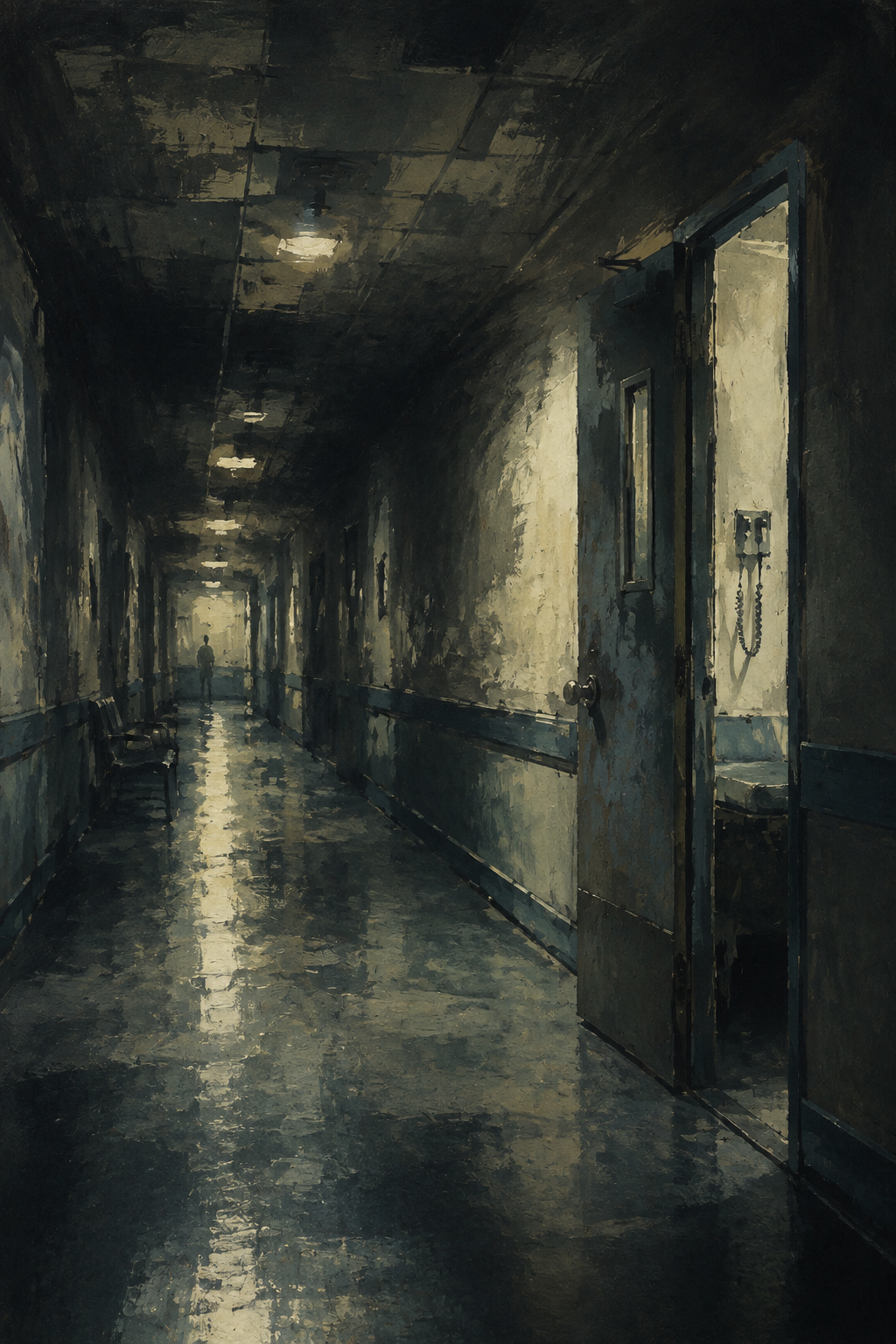
Daniel woke inside a hospital room with no memory of being admitted. The monitors worked, but the ward outside his door had been closed for thirty years. Then a patient in the darkness whispered that Daniel had been there before...
Daniel opened his eyes to the sound of a telephone ringing.
The room was cold. A thin blanket covered his legs, and adhesive pads clung to his bare chest. Beside the bed, a heart monitor drew a green line across its screen.
Beep.
Beep.
Beep.
The telephone kept ringing from somewhere beyond the open door.
Daniel tried to sit up. Pain tightened around his skull, forcing him back onto the pillow. His mouth tasted like metal, and every breath carried a faint smell of burned dust.
“Hello?” he called…..
No one answered………….
The monitor showed a pulse of 112. Daniel knew that was fast, though he could not remember how he knew. He looked for a call button, but its cord had been cut. Only two bare wires remained.
The telephone stopped ringing.
Silence filled the room…..
Then footsteps moved past his door.
“Wait,” Daniel said. “I need help.”
The footsteps continued down the hallway.
He pulled the pads from his chest and lowered his feet onto the floor. His knees nearly folded beneath him, but he caught the bedrail. The room swayed until he focused on the doorway.
Outside was a long hospital corridor. Most of the ceiling lights were dead. The few still working cast weak yellow pools across the floor.
A figure stood at the far end.
It looked like a man wearing a patient gown….
“Excuse me!”
The figure stepped backward into the darkness.
Daniel followed.
Every room he passed was empty. Some contained rusted beds. Others had peeling wallpaper and black stains around the vents. Room numbers hung crooked beside the doors.
There was no room 313.
A wheelchair rested against the wall. When Daniel passed it, one wheel began turning.
Slowly.
By itself.
Daniel walked faster…………………………………..
Daniel had awakened as a patient, yet the ward showed years of decay. Someone else was walking through it, and whatever had happened to Daniel had left him confused, weak, and struggling to remember.…………..
The telephone rang again.
This time, Daniel saw it mounted on the wall near the nurses’ station. It was an old beige phone with a coiled cord.
He lifted the receiver.
“Emergency department,” a woman said. Her voice sounded distant and broken by static. “Can you tell me your location?”
“I’m already in the hospital.”
“What hospital?”
Daniel looked behind the counter. Papers covered the desk, their edges brown with age. A faded logo appeared on one folder.
ST. ORISON MEDICAL CENTER.
“St. Orison.”
The woman stopped speaking.
“Hello?”
“Sir,” she finally said, “St. Orison closed in 1996.”
Daniel stared into the dark corridor.
“That’s impossible.”
“What is your name?”
“Daniel Mercer.”
Keys clicked on her end. Then they stopped.
“Daniel, listen carefully. Firefighters are searching the old St. Orison building now. Were you inside with the demolition crew?”
Memories flashed through him.
A hard hat.
A concrete saw.
Plastic sheets hanging across a corridor.
Then a generator roaring in a sealed room.
“I was working,” he whispered. “We were removing pipes.”
“Do you remember collapsing?”
“No.”
“You may have carbon monoxide poisoning. It can cause headache, weakness, confusion, and memory loss. You need to get outside immediately.”
Daniel glanced at the heart monitor glowing inside his room.
“But someone put me in a bed.”
“Daniel, that ward has no electricity.”
The receiver became slick in his hand.
Behind him, a floorboard creaked.
The patient stood near room 316.
He was closer now, but shadows still hid his face. His gown looked old and scorched around the collar.
“Who is that?” the dispatcher asked.
“I don’t know.”
The patient raised one arm and pointed toward a pair of metal doors marked EXIT.
Daniel moved toward them.
“Stay on the phone,” the woman said.
He reached the doors and pushed.
They did not open.
A chain had been wrapped through the handles from the other side.
The patient pointed in another direction—toward the missing room between 312 and 314.
There, where Daniel had seen only a blank wall, stood a narrow door.
The number 313 was scratched into its paint.
….
“Don’t go deeper into the building,” the dispatcher warned.
But smoke began spilling from the ceiling vents.
Daniel coughed. His legs weakened again. The invisible gas might have had no odor, but now something else was burning.
The patient opened room 313 and waited.
Daniel stepped inside…………………………………………………..
Daniel’s symptoms fit carbon monoxide poisoning from the generator, but that could not explain the working monitor, the ringing telephone, or the patient guiding him through a ward without power. With the main exit chained shut and smoke entering the corridor, room 313 offered his only escape.
Room 313 was not a patient room.
It was a stairwell.
Daniel began descending, one hand against the wall. The dispatcher’s voice faded beneath bursts of static.
“Firefighters are entering from the east side,” she said. “Make noise if you hear them.”
On the landing below, Daniel found the patient waiting again.
“Who are you?” Daniel asked.
The man turned toward a framed photograph hanging on the wall.
It showed twelve hospital employees standing beneath a banner:
NIGHT SHIFT—DECEMBER 1987.
Daniel wiped dust from the glass.
The patient was in the photograph. He looked younger, but the narrow shoulders and uneven posture were unmistakable. He wore an orderly’s uniform.
Beneath the picture was a list of names.
Daniel found the man’s face and traced downward.
THOMAS VALE.
A handwritten note had been added beneath it:
DIED DURING WARD 3 EVACUATION.
Daniel looked up.
Thomas stood at the bottom of the stairs.
Flames flickered behind him.
He pointed toward a red fire hose cabinet.
Daniel opened it. Instead of a hose, he found an old emergency axe. He swung it into the locked ground-floor door.
Once.
Twice.
On the third strike, the wood split.
Fresh air touched his face.
Daniel stumbled into another corridor, shouting until his throat burned.
“Here!”
Voices answered.
Firefighters appeared through the smoke and pulled him toward a broken window. Outside, they placed an oxygen mask over his face. A paramedic checked a blood sample using a machine that could measure carbon monoxide in his blood more accurately than an ordinary fingertip oxygen reader.
“Carboxyhemoglobin is twenty-eight percent,” she said. “We need to move.”
Daniel tried to explain about the ward and the man named Thomas, but the words became tangled. His vision narrowed.
Before the ambulance doors closed, a firefighter approached carrying something recovered from the stairwell.
It was the 1987 staff photograph.
“Where did you find this?” Daniel asked.
“On the third floor.”
“And the man?”
“What man?”
Daniel pointed at Thomas Vale’s face.
The firefighter examined the photograph.
“There’s no one there.”
Daniel looked again.
A blank space separated two nurses where Thomas had stood.
….
Three days later, Daniel returned to St. Orison with an investigator. The headache was gone, and oxygen treatment had cleared the poison from his blood. Doctors said carbon monoxide explained his confusion and hallucinations.
That explanation almost satisfied him.
They entered the ruined building through the east side. The third-floor corridor was exactly as Daniel remembered, except there were no working lights, no telephone, and no room 313.
Only a solid concrete wall stood between rooms 312 and 314.
The investigator checked the original blueprints.
“There was never a room here,” she said.
Daniel touched the cold wall.
Something rang behind it.
Once.
Twice.
The investigator stepped back. “What is that?”
Daniel did not answer.
…
…
…
A dark stain slowly appeared on the concrete. It spread into the shape of a hand, one finger pointing toward the east exit.
Then, from somewhere sealed inside the empty ward, a man whispered….
“You made it out this time.”