
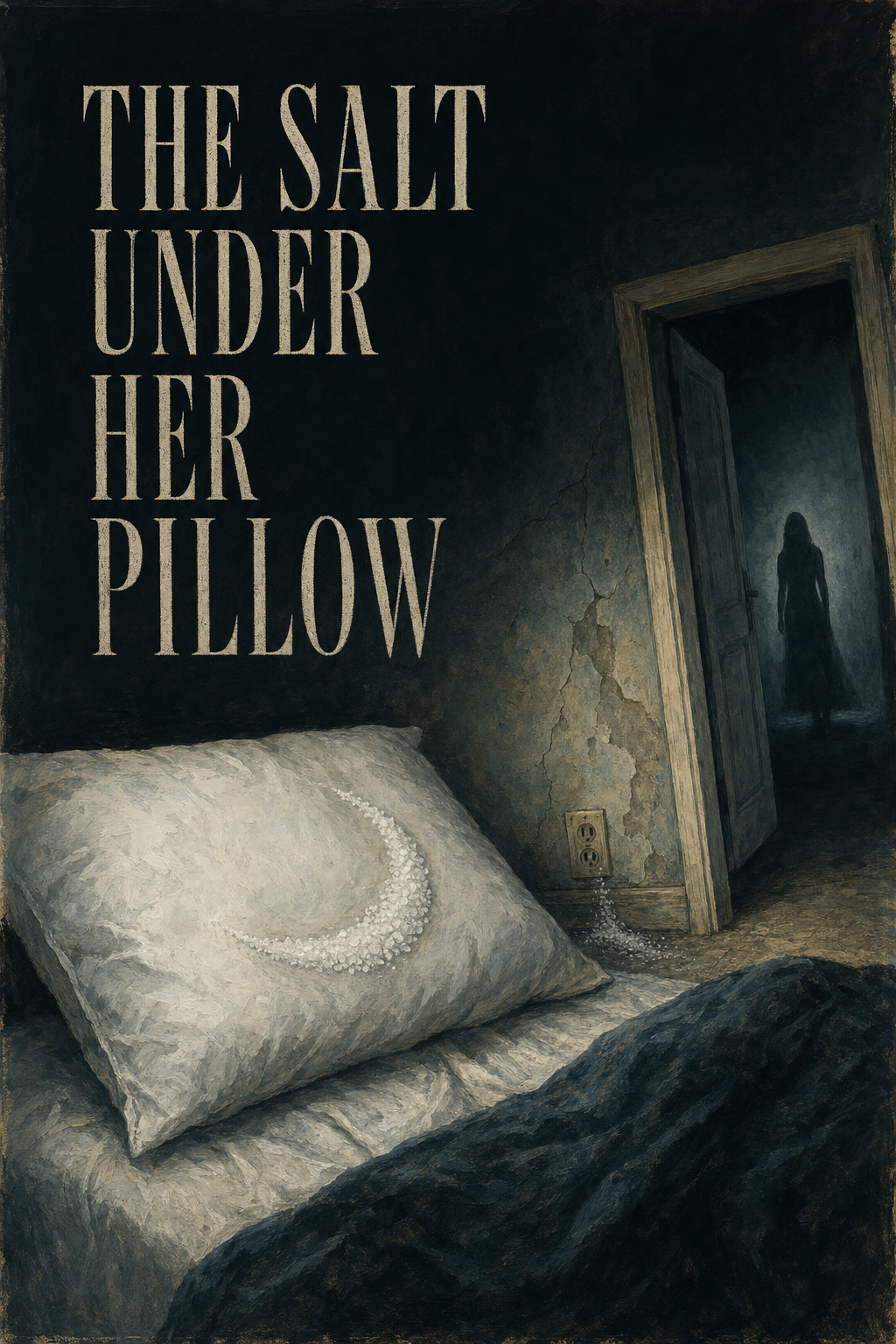
After thirty-two-year-old Iris Bell began waking with a swollen tongue, cracked lips, and piles of coarse salt beneath her pillow, doctors considered dehydration, sleepwalking, a medicine reaction, an allergy, kidney trouble, and someone entering her apartment at night. Her blood tests were nearly normal and her door camera showed no visitor, but when Iris spent a night in the hospital, salt began leaking from the sealed wall outlet beside her bed.
Chapter 1
Iris first thought the crystals were from a bag of pretzels.
She woke before sunrise with her mouth so dry that her tongue stuck to her teeth. The pillow beside her cheek was covered in white grains. Some had pressed into the damp skin of her neck. She sat up fast, coughing, and tasted the sea.
There were no pretzels in her room. There was no food at all. Iris kept her apartment neat, partly because she worked from home checking insurance forms and partly because mess made her nervous. She stripped the bed, vacuumed the floor, and told herself that salt could get anywhere.
The next morning, it was back.
This time the pile was larger. It lay in a rough half-circle around her head, as if someone had carefully poured it while she slept. Her lips were split. Her throat hurt. When she drank water, she threw it up ten minutes later.
At urgent care, the nurse checked her blood pressure twice. It was low. The doctor said Iris might be badly dehydrated. He asked about alcohol, diet pills, new medicine, and drugs. Iris answered no to all of it.
Blood work showed that her salt level was a little high, but not high enough to explain the strange piles in her bed. The doctor told her to drink fluids with small amounts of sugar and minerals. He also suggested checking for a leak in her apartment or a problem with the heating system.
Iris did not mention that the grains beneath her pillow were warm.
Iris has woken twice with salt around her head and signs of dehydration, but ordinary tests offer only partial answers. She believes something in her apartment may be causing it, so she begins watching her own nights.
Chapter 2
She bought a small motion camera and aimed it at her bed.
For two nights, nothing happened. Iris slept badly anyway, afraid to close her eyes. On the third night, she took the doctor’s advice, drank two full glasses of water, and placed a clean white towel over her pillowcase.
At 3:08 in the morning, the camera recorded her sitting up.
Iris watched the video after sunrise, holding one hand over her mouth. She was sitting perfectly straight, eyes open but dull. She turned toward the bedroom wall. Then she leaned close enough for her forehead to touch the peeling paint.
Her lips moved.
The camera had no sound, but Iris could read one word clearly.
“Open.”
For eleven minutes, she stayed there. Then white grains began to appear beneath her face. They slid down the wall in thin streams, gathering on the towel. At the end of the recording, Iris lay down again and pulled the blanket to her chin.
She had no memory of any of it.
The landlord came that afternoon. He checked the wall for damp spots and broken pipes. There were none. He laughed uneasily when Iris showed him the video. He said she might be sleepwalking and spilling something from a hidden bag.
“I don’t own salt,” Iris said.
That night she slept at her sister Mae’s house across town. Mae put her in the guest room, took Iris’s phone, and sat awake in the hall with a book.
At 3:08, Mae heard a soft scraping sound.
The guest room door was still locked from inside. White dust pushed slowly from the narrow space beneath it.
The camera proves Iris rises in her sleep and faces a wall, yet neither a hidden visitor nor a simple spill explains the salt. When the same thing happens in Mae’s locked guest room, Iris understands that she may be carrying the danger with her.
Chapter 3
Mae drove Iris to the emergency room before dawn.
Iris felt embarrassed sitting under bright lights in a hospital gown while a doctor asked whether she had been under stress. Her mother had died six months earlier. Her job was shaky. She had barely slept since Christmas. Iris knew how the story sounded.
Still, the doctor listened. He ordered more blood tests and kept her overnight because her blood pressure had fallen again. He explained that severe dehydration could cause confusion, weakness, and strange behavior during sleep.
The tests for kidney trouble came back normal. A brain scan showed no bleeding or obvious growth. A urine test showed that Iris’s body was losing too much water, but it did not show why.
Near midnight, a nurse named Paula found Iris standing beside her hospital bed.
“Iris?” Paula said gently.
Iris did not answer. Her face was turned toward the wall outlet beside the bed. Her swollen lips formed the same word.
“Open.”
Paula pressed the call button. A second nurse entered just as the outlet cover gave a tiny click.
Salt spilled from its edges.
Not much at first. Just a white thread. Then it poured onto the blue floor in a dry, steady stream.
Iris screamed and stumbled backward. The outlet was not plugged in. No water pipe ran through that wall. An electrician later removed the cover and found only old wires inside, blackened but dry.
Before he put the cover back, Iris saw something scratched into the metal box behind it.
Three words, written in a child’s crooked hand.
NOT ENOUGH WATER.
Hospital tests rule out several common causes, but Iris’s sleepwalking and the salt continue even under observation. The words inside the outlet make the problem feel less like an illness and more like a message, and Iris decides to search the history of the building where it began.
Chapter 4
Iris went home only long enough to pack clothes and old papers.
Her apartment building had once been a small private hospital. The city library kept newspapers on a computer, and Mae helped her search through faded articles. In 1978, during a summer heat wave, the hospital had lost water for two days after a main pipe broke.
Most patients were moved. One room had been missed.
A little girl named Elsie Crane had been recovering from a throat operation. She could not speak clearly. The article said staff found her dead in a sealed treatment room after the hospital closed. The report blamed heat and lack of water.
Room 214 had been where Iris’s apartment now stood.
Mae wanted to call the police. Iris wanted to run. But the words in the outlet would not leave her alone. Not enough water.
That evening, Iris returned with Mae and a plumber. They opened the wall behind Iris’s bed.
There was no hidden room. There was only a narrow space between old bricks, packed with white salt. In the center sat a rusted child’s drinking cup.
The cup was empty.
Iris picked it up before anyone could stop her. The metal was ice-cold. She carried it to the kitchen sink and turned on the tap.
Nothing came out.
All the faucets in the apartment had gone dry.
From inside the wall, a small voice began to cough.
Iris learns that her apartment stands over a former hospital room where a thirsty child died during a water outage. She finds the child’s empty cup inside a salt-filled wall, but when the building’s water fails and coughing begins behind the bricks, Iris realizes the plea may not be finished.