
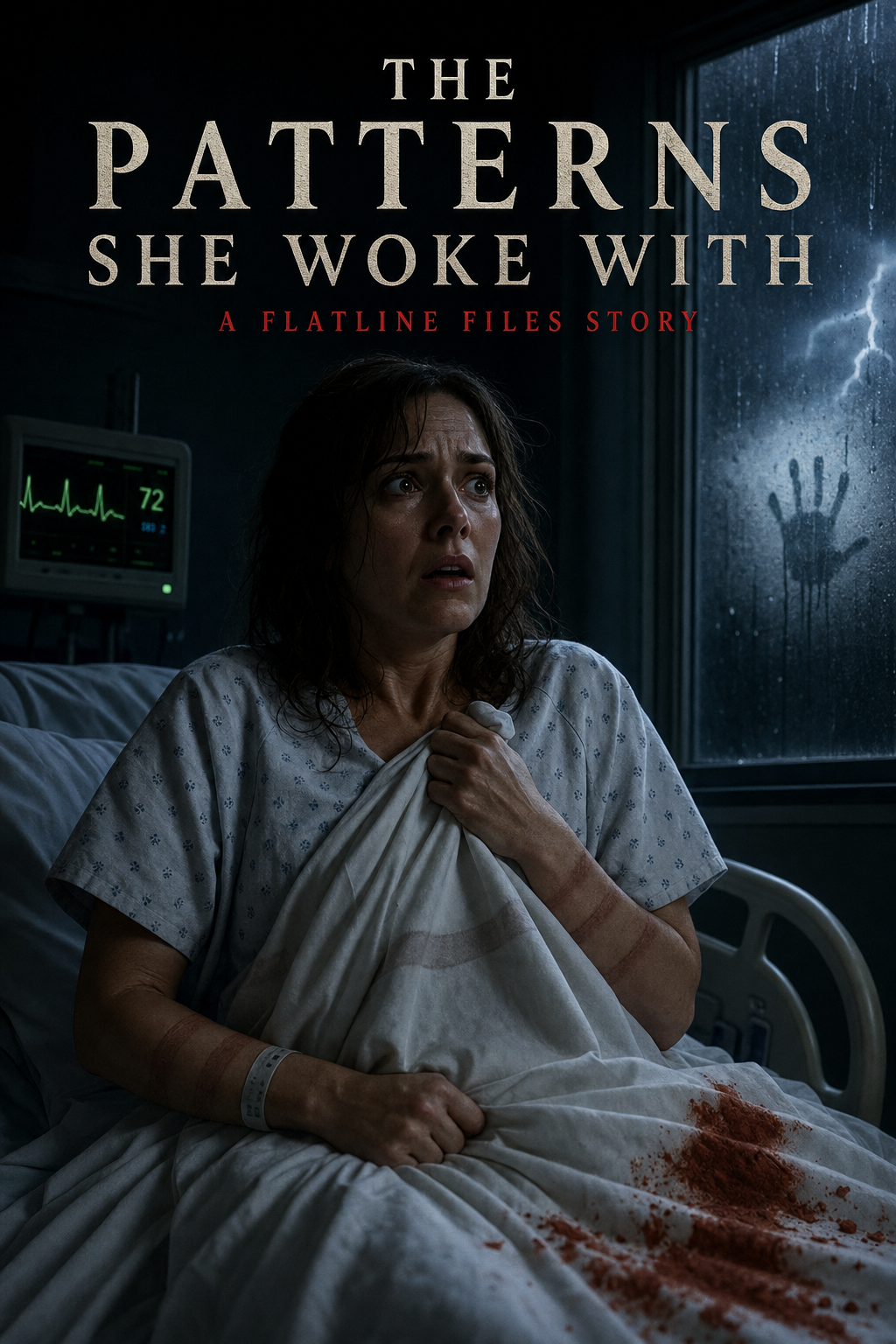
Thirty-five-year-old Lena Ward began waking with painful marks pressed deep into her skin, including seatbelt lines, metal buckles, and tiny handprints that could not have come from her bed. Doctors considered pressure hives, sleepwalking, seizures, blood-clotting trouble, an abusive visitor, and stress from Lena’s recent divorce, but cameras showed that nobody entered her locked apartment. Then Lena woke in a hospital room with red clay beneath her fingernails and the clear imprint of a child safety seat across her ribs.
Lena woke screaming because something hard was crushing her chest.
For a few blind seconds, she thought the ceiling had fallen. Her room was dark. Rain ticked against the window. Her cat, Pockets, stood at the foot of the bed with his back bent high and his ears flat against his head.
Lena grabbed at her ribs. There was no broken beam. No person on top of her. Only the heavy quilt she had used every night since college.
Then lightning flashed through the curtains.
Across Lena’s bare stomach ran a dark red band, two inches wide, slanting from her left shoulder toward her right hip. It looked exactly like a seatbelt had been pulled tight across her body. Below it, just above her waist, was a round purple mark with a square metal shape pressed into the center.
She climbed out of bed and stumbled to the bathroom mirror. The mark did not fade when she touched it. It was swollen. Hot. Real.
On the inside of her left forearm, five little finger-shaped bruises curled around her skin.
They were much too small to be her own.
Lena had gone to sleep alone in her locked apartment and awakened with injuries that looked like they came from a vehicle, not a bed. The marks were painful enough to be real, and the small handprint made an ordinary sleep problem feel much worse. She needed to learn whether someone had entered her home, or whether something had happened to her while she could not remember it.
By sunrise, Lena had checked every lock twice. Her chain was still on the door. Her windows were closed. The old fire escape outside her kitchen window was wet with rain but showed no fresh shoe prints.
She lived on the third floor of a narrow brick building above a bakery. The place had one bedroom, a small kitchen, and walls so thin she could hear the man next door cough. There was nowhere for a stranger to hide.
Still, she searched under the bed. She opened closets. She even checked the bathtub behind the shower curtain, feeling foolish until she saw the bruises again.
Lena worked restoring old furniture for a shop called Harker and Sons. Most days, she stripped chairs, repaired broken springs, and brought faded fabric back to life. She knew what pressure could do to cloth, wood, and foam. She knew how a heavy object left a pattern behind.
Her skin looked as if it had been used as the surface of an old mattress.
Her coworker, Damon, drove her to an urgent care clinic after taking one look at her stomach. The nurse asked if Lena felt safe at home. Lena said yes, then hated how quickly she answered.
A doctor named Priya Shah studied the marks with a quiet face. She asked about new soap, new medicine, allergies, drinking, drugs, nightmares, and sleepwalking. Lena had no new medicine. She had one glass of wine the night before. She had never sleepwalked as far as she knew.
Dr. Shah said some people got pressure hives. That meant their skin swelled after even a small amount of pressure. Others bruised easily because of medicine or trouble with blood clotting. Stress could also make sleep strange.
“Can stress put a seatbelt on me?” Lena asked.
Dr. Shah did not smile. “No. But stress can make us miss things. We will check what we can.”
The blood tests were normal. Lena’s platelets, the tiny blood parts that help stop bleeding, were normal. Her iron was normal. Her blood did not show signs of infection. An X-ray showed no broken ribs.
By late afternoon, the belt mark had turned yellow around the edges. The tiny handprint remained dark.
That night, Lena bought a camera with motion alerts. She placed it on her dresser, facing the bed. She wedged a chair under the front door knob. She put a strip of tape across the kitchen window.
Then she slept in jeans, a long-sleeved shirt, and socks, like a child afraid of monsters.
The first medical tests did not show a bleeding problem, infection, or broken bone, and Lena had no reason to think she was leaving her apartment. She set up a camera because the marks had a clear shape, and a clear shape should have had a clear cause. By morning, she expected proof of a person, a nightmare, or her own sleepwalking.
The camera alert woke her at 2:46 in the morning.
Lena sat up so fast that her neck cracked. Nothing moved in the bedroom except Pockets, who was crouched under a chair.
Her phone screen showed the live camera view. Lena lay in bed, pale under the quilt. The picture shook once. Then it steadied.
For nearly a minute, nothing happened.
Then Lena’s body bent upward.
Not like a person sitting up. Not like a person having a bad dream. Her back arched hard against the mattress. Her arms pressed flat at her sides. Her face tightened as if she could not breathe.
The quilt sank over her chest.
It sank in several places at once, as though invisible hands were pushing down on it.
Lena watched herself struggle on the screen while she sat awake in the same bed, holding her phone.
The video froze.
When it started again, the room was still. Lena was lying flat. The clock on the wall read 3:03.
Seventeen minutes had passed.
She remembered none of them.
Her shirt was damp with sweat. A narrow row of raised circles ran across her upper thighs. They looked like the edge of a plastic seat. Her right wrist had a fresh scrape, and beneath the scrape was packed red-brown dirt.
Not dust. Not dried blood.
Clay.
Lena did not sleep another minute. At six, she called Dr. Shah, who told her to go to the emergency room.
The hospital staff took the video seriously. A young resident mentioned a seizure, an electrical storm in the brain that could make someone move or lose time. Another doctor mentioned a sleep disorder. They put sticky pads on Lena’s chest to watch her heart and arranged a brain scan.
Everything looked normal again.
At noon, an older nurse named Maureen came to change Lena’s blanket. She stopped halfway through the job.
“Honey,” she said softly, “where did this come from?”
There was a small clump of red clay in the clean white sheets.
The camera proved that Lena’s body was being forced into painful positions during a seventeen-minute gap in her memory, yet no one entered the room and her first hospital tests were normal. The red clay made the problem feel less like an illness inside her body and more like contact with another place. Lena agreed to stay overnight, hoping the hospital could catch the event as it happened.
They gave Lena a private room near the nurses’ station. A camera watched the door. A thin wire ran from her scalp to a machine that measured brain activity. The test was called an EEG. It could sometimes show a seizure even if a person did not shake or fall down.
Lena tried to joke about looking like a science project. Nobody laughed much.
Maureen stayed with her longer than she needed to. She was maybe sixty, with gray hair pulled into a thick bun and the tired, kind eyes of somebody who had spent years watching families get bad news.
“Those marks,” Maureen said, “are they always different?”
Lena nodded.
“Do you recognize any?”
“The belt. The buckle. A row of plastic circles. It feels stupid to say, but it looks like the inside of a car.”
Maureen looked toward the rain-dark window. “There was a missing-person notice on the news this morning. A woman and a little girl. Their car was swept off Old Quarry Road during the storm.”
Lena felt cold under the warm blanket.
“That happened yesterday?”
“Last night. They found part of the guardrail smashed. Haven’t found the car.”
Lena tried to tell herself the connection meant nothing. Cars had seatbelts. Millions of people used them every day. Storms made people think of accidents. Her mind was scared and looking for a story.
Then Maureen handed her a cup of water.
Lena saw a tiny smear of red clay under the nurse’s thumbnail.
“Do you garden?” Lena asked.
Maureen looked down. “No.”
The clay was gone when Lena blinked.
At 2:46 that night, Lena was awake, staring at the ceiling. The room hummed. Rain whispered against the glass. Her heart monitor made small green hills across a screen.
At 2:47, the lights flickered.
At 2:48, something cold touched her ankle.
Lena jerked upright. Her body stopped halfway. Her arms locked tight against the bed. Her mouth opened, but no sound came out.
The pressure came down.
Her chest flattened. Her left shoulder twisted. She smelled wet leaves, gasoline, and the sharp muddy smell of a creek bank after floodwater had gone down.
There was a child crying somewhere close.
Not loudly. Just small, tired sounds. The kind a child makes after crying for too long.
Lena fought to turn her head. Her eyes found the wall across from the bed.
Water was sliding down it.
For one horrible second, the hospital room was gone.
She was in the back seat of a car lying on its side. Rainwater slapped against a cracked window. A woman hung sideways in the front, held by a belt across her chest. Her face was hidden by wet hair.
A child was curled beneath Lena’s own body.
The little girl pressed one muddy hand against Lena’s ribs.
“Don’t sleep,” the child whispered.
The hospital room snapped back.
Lena fell sideways onto the mattress, gasping. Nurses rushed in. Her heart was racing. The EEG machine had drawn wild, jagged lines, but the technician said they did not look like a seizure.
Across Lena’s ribs was the perfect raised pattern of a child’s safety seat.
During the hospital episode, Lena experienced a flooded overturned car and heard a child begging her not to sleep. The test did not support a simple seizure, and the new imprint matched a child seat rather than anything in her room. Lena no longer believed the missing car was a random news story, so she had to find where Old Quarry Road had taken it before the storm water rose again.
The police officer who came to hear Lena’s report had the careful face people used when they expected a frightened person to say impossible things.
Lena understood why. She heard herself describing muddy smells and a crying child trapped in a car that nobody had found. It sounded like a dream built from a news report.
Then she told him something she had not said out loud before.
“The car was not in the creek,” she said. “It was under something. I heard water above it, but the water wasn’t all around it.”
The officer wrote that down. His name was Grant Bell. He said search crews had checked the main creek twice. Old Quarry Road crossed a wide drainage ditch before it reached the quarry itself. The ditch ran through woods and under an old service road.
“The road collapsed there years ago,” he said. “There are culverts. Big pipes that carry rainwater under the ground.”
Lena grabbed his sleeve. “There was a sound. Metal knocking three times. Then a high sound, like a train whistle.”
Officer Bell paused.
“The quarry has an old warning siren,” he said. “It goes off when floodwater reaches the spillway.”
He left the room to make a call.
Lena should have felt relieved. Instead, she felt the pressure return, low in her belly. Not hard enough to bruise. More like a hand resting there.
She knew the child was still alive. She also knew, with sick certainty, that the child had not been talking to the woman in the front seat.
The child had been talking to Lena.
By dawn, the rain had slowed. Officer Bell called from the quarry road. Crews had found tire tracks where a vehicle had slid through wet grass. The tracks ended at a broken fence near the drainage ditch.
They had not found the car.
“We’re bringing equipment,” he said. “Stay where you are.”
Lena looked at the hospital window. Beyond it, clouds pressed low over the town.
“She doesn’t have time,” Lena said.
“Ms. Ward, we have trained people searching.”
“She told me not to sleep.”
There was a silence on the line.
“Please stay in the hospital,” he said finally.
Lena did not.
The police found evidence that the missing vehicle had left Old Quarry Road near the underground drainage pipes, which matched Lena’s vision. Search crews were coming, but Lena believed the trapped child was fading fast and that her own episodes were tied to the child’s struggle. She left the hospital because waiting safely in a bed felt worse than following the pain toward its source.
She signed herself out against advice, pulled on the same damp clothes from the night before, and drove toward the quarry in Damon’s old pickup. Damon had come to the hospital after Maureen called him. He did not understand Lena’s story, but he believed her fear.
“You don’t have to believe me,” Lena told him as they bounced along the muddy road. “Just don’t leave me alone.”
“Wasn’t planning to,” he said.
The quarry sat beyond the edge of town, a huge gray cut in the earth filled with black water. The storm had torn branches from the trees. Search trucks flashed blue lights near a fence line.
Officer Bell saw Lena climbing from the pickup and swore under his breath.
“I told you to stay at the hospital.”
“I know.”
“You could get hurt out here.”
Lena looked past him toward the ditch. “She already is.”
One of the search workers had found a pink backpack caught in thorn bushes. It belonged to the missing child, a seven-year-old named Elsie Park. Her mother, Nora, had been driving home from her sister’s house when the road washed out.
Lena stood near the broken fence and shut her eyes.
Nothing happened at first.
Then the invisible pressure touched her shoulders.
She turned left, toward a stand of alder trees. The ditch there was full of brown water and broken branches. It flowed beneath the old service road through two round concrete pipes, each wide enough for a person to crawl through.
“There,” Lena said.
A worker shook his head. “We checked both culverts. Water’s too high. Nothing in them.”
“Not in the pipe.” Lena pointed farther uphill. “Behind it. There is another space.”
Officer Bell looked at the cracked concrete wall above the pipes. Rain had opened a narrow hole where the ground had fallen away.
“Old inspection chamber,” he said. “It was sealed years ago.”
Lena dropped to her knees beside the hole before anyone could stop her.
The pressure slammed into her chest.
She cried out and reached her hand into the dark gap. Her fingers touched wet gravel, cold water, and something smooth.
Plastic.
A car door.
From deep underground came three weak knocks.
Knock. Knock. Knock.
Every person near the ditch went still.
Then a child began to cry.
Lena led the search team to a sealed inspection chamber hidden behind the flood pipes, where she felt the same crushing force and everyone heard a child knock from below. The missing car had not been swept down the creek; it had fallen into a buried space beneath the damaged road. Lena had found the truth, but rescuers still had to reach the car before the chamber filled completely with water.
The next hour became noise, mud, and waiting.
Workers brought a small digging machine. Firefighters tied ropes around their waists and crawled through the larger flood pipe. The chamber was partly filled with water. The car had dropped nose-first through a broken patch of ground and landed on its side against the concrete wall.
Its roof had made a small air pocket.
Nora Park was still strapped into the front seat. She was not breathing.
Elsie was alive in the back.
The safety seat had twisted sideways. A piece of the rear door had pinned the child’s legs, but the seat had held enough space around her chest for her to breathe.
Lena could not see the rescue through the narrow opening. She heard the workers calling instructions. She heard metal groan. She heard a firefighter say, “I’ve got her.”
When Elsie finally emerged, wrapped in a silver emergency blanket, the whole muddy bank seemed to let out one breath.
The girl was blue-lipped and shivering, but awake. A paramedic carried her toward an ambulance.
Lena stood in the rain, unable to move.
Elsie lifted her head from the paramedic’s shoulder.
Her eyes found Lena at once.
“You came,” she whispered.
Lena stepped closer. “Yes.”
“The lady told me you would.”
The paramedic looked between them. “Do you know her?”
Lena shook her head.
Elsie held out her small muddy hand. On the child’s wrist was a thin silver bracelet. A heart charm dangled from it.
Inside the heart was a tiny photograph of Nora Park and Elsie smiling together.
But behind them, blurred in the picture, stood a third woman.
She had wet dark hair over her face and one hand pressed against the car window.
Lena knew the shape of that hand.
It was the handprint that had appeared on her arm.
Elsie survived because the trapped car had held a small pocket of air, though her mother did not. The child said another woman had promised that Lena would come, and a photograph showed a wet-haired stranger already connected to the family. Lena had helped save Elsie, but the person who used Lena’s body to send the warning was still unexplained.
Lena spent two nights back in the hospital after that. The doctors treated her bruises, watched her heart, and repeated the brain test. The strange lines on the EEG never returned.
Dr. Shah told Lena that fear, lack of sleep, and the shock of the rescue could have affected what she remembered. Lena did not argue. Dr. Shah had done what she could. She had listened when most people would have laughed.
But Lena knew what she had felt in the hospital bed.
Something had pressed her into the shape of that car.
Something had put clay under her nails.
Three weeks later, Elsie left the hospital and went to live with her aunt. Lena visited once, bringing a rebuilt wooden doll chair from the furniture shop. Elsie was quiet, thinner than before, but she smiled when she saw it.
“Do you still see the lady?” Lena asked gently.
Elsie nodded.
“Is she your mom?”
“No.”
“Who is she?”
Elsie looked down at the doll chair. “She is looking for her little boy.”
Lena felt the room turn cold.
“What little boy?”
Elsie shrugged. “She says he is under the road too. She says nobody heard him knocking.”
That night, Lena went home and locked her apartment door. Pockets followed her from room to room, crying at empty corners.
She did not sleep for a long time.
Near dawn, exhaustion pulled her under anyway.
When she woke, her bedroom was bright with morning light. Her body did not hurt. No marks crossed her ribs. No clay stained the sheets.
For one peaceful moment, Lena believed it was over.
Then she looked at her right hand.
Pressed into the center of her palm was a fresh purple circle, small as a coin.
Inside it were three tiny raised lines.
Knock. Knock. Knock.