
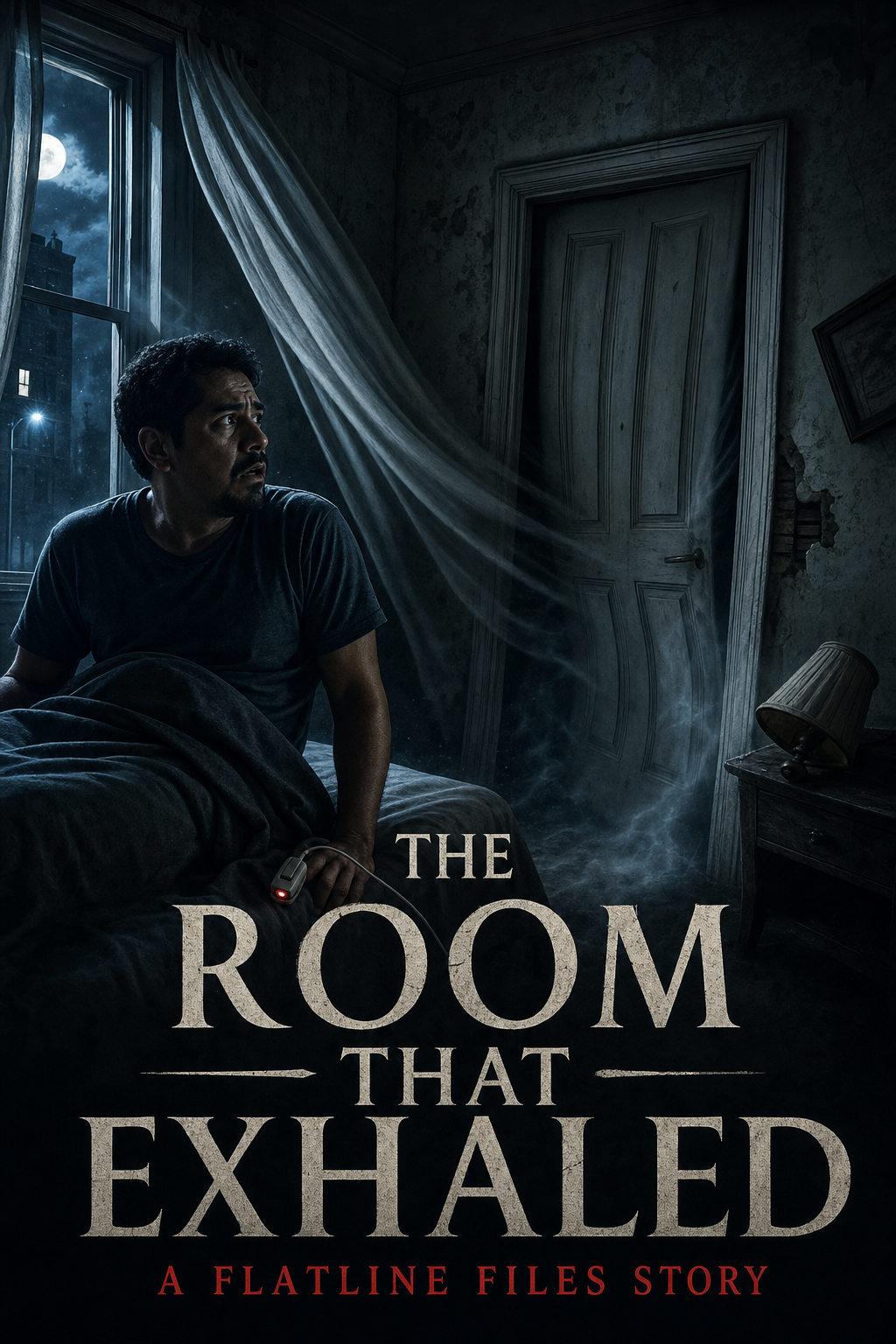
Thirty-six-year-old Mateo Ruiz began waking before dawn with crushing chest pain, blue lips, and an oxygen level so low that his phone warned him to call for help. Doctors considered asthma, panic attacks, sleep apnea, mold, carbon monoxide, heart trouble, and a faulty home monitor, but his lungs and heart looked normal whenever he reached the hospital. Then Mateo set up a camera in his bedroom and watched his sealed apartment door slowly bend inward at 3:17 every morning, as if the room itself had taken a breath.
Mateo woke with both hands clawing at his throat.
For one terrible second, he thought somebody was kneeling on his chest. The room was black except for the green numbers on his alarm clock. 3:18. His mouth opened wide, but the air that entered him was thin and cold. It felt used. It smelled like wet plaster and old pennies.
He rolled out of bed and hit the floor hard enough to bruise his shoulder. His phone was on the nightstand. The little health app connected to his fingertip reader flashed a number in red.
82.
Mateo knew enough to be afraid of that number. A healthy oxygen reading was usually above 95. Eighty-two meant his body was not getting enough air. He dragged himself toward the window, knocking over a lamp as he went.
The window would not open.
He had painted it shut the month before, after cold wind had rattled through the frame. Now he rammed his shoulder against it once, twice, three times. On the fourth blow, the old paint cracked. A narrow line of outside air slipped in.
Mateo pressed his face to the gap and sucked in the freezing November night.
His lungs filled.
The pain eased so quickly that he began to cry.
He stayed there on his knees until his fingers stopped shaking. When he looked around the bedroom, nothing seemed wrong. The door was closed. The heating vent hissed softly. His lamp lay on its side. A glass of water stood untouched beside the bed.
Then he noticed the bedroom door move.
It did not swing open. It bowed toward him, slowly, as if something enormous on the other side had pulled the air from the room.
Mateo stared at the door until dawn.
He told himself it had been a panic attack.
That was what his older sister, Carmen, suggested when he called her from the emergency room at six in the morning. Mateo could hear traffic behind her. She had probably stepped outside her bakery to take the call.
He did not blame her. He had been under pressure. The city had cut hours at the public records office where he worked. His rent had gone up. He had moved into the old apartment building on Briar Street because it was cheap, not because he liked it.
Still, panic did not explain the blue color Carmen had seen around his lips when she rushed him to the hospital.
The emergency doctor listened to Mateo’s lungs, ran blood tests, took an X-ray of his chest, and checked his heart with sticky pads and wires. Everything looked ordinary. His oxygen level had climbed back to 98 by the time he was examined.
The doctor asked about asthma. Mateo had never had it. He asked about smoking. Mateo quit seven years ago. He asked about drugs, sleep medicine, anxiety, allergies, mold, and whether Mateo had a working carbon monoxide detector.
Mateo answered no to almost all of it.
The doctor did not laugh when Mateo mentioned the moving door. That somehow made Mateo feel worse.
He said a lack of oxygen could make people see strange things. He told Mateo to buy a new detector, keep the window unsealed, and return if it happened again.
It happened again the next night.
This time Mateo was ready.
He had bought two carbon monoxide detectors, one cheap and one expensive. He put one near the bed and one in the hall. He left the window open two inches despite the cold. He propped the bedroom door open with a shoe. He also placed his phone on a stack of books, recording video toward the door.
At 3:16, he woke because the room had gone quiet.
Not normal quiet. Not the soft kind that comes when traffic dies down and a person is almost asleep. This was the quiet of a place with no air moving through it at all. The heater stopped. The loose paper on his desk stopped rustling. Even the sound of his own breathing seemed far away.
Mateo sat up.
The open bedroom door had begun to close.
The shoe scraped across the floor. It should have held the door open, but it slid backward inch by inch. The door kept moving toward its frame.
Both carbon monoxide alarms remained silent.
Then Mateo felt pressure in his ears, like he was riding down a mountain too fast. The curtains lifted toward the ceiling. A loose receipt flew off his desk and struck the wall. His chest tightened.
The room was being emptied.
Mateo lunged for the window. Before he reached it, the door slammed shut with a bang that shook dust from the ceiling.
He got the window open and hung half his body outside. Air washed over his face. He breathed until his lungs stopped burning.
When he dared to turn around, the bedroom door was standing open again.
The shoe was back where he had placed it.
Mateo now knew the attacks were not only in his mind: they came at nearly the same minute, changed the air in his room, and left no sign on the alarms meant to protect him. Carbon monoxide and panic still seemed possible, but the video on his phone might show whether something in the apartment was moving while he fought to breathe.
He watched the recording in his kitchen after sunrise.
For the first few hours, it showed nothing but Mateo sleeping under a gray blanket. At 3:16, the picture began to shake. The phone had not moved, but the image seemed to pulse in and out of focus.
At 3:17, the bedroom door bent inward.
Mateo watched it three times.
The door did not simply close. The whole flat wooden surface bowed toward the bedroom, deep enough to show a dark curve at its center. The brass knob stretched toward him. The crack around the frame narrowed until no light showed through.
Then the door opened its mouth.
That was the only way Mateo could describe it.
The narrow crack between door and frame widened from top to bottom. The dark hall beyond it seemed to pull forward. The video’s sound vanished for eleven seconds. During those eleven seconds, Mateo’s sleeping body jerked upright in bed.
His face turned toward the door.
His mouth fell open.
He sat that way, asleep, while the room bent around him.
At 3:18, the picture snapped back into focus. Mateo rolled toward the window and disappeared from the camera frame. The door stood open. The hall was empty.
He took the phone to the building manager, a narrow man named Mr. Bell who wore clean shirts with yellow sweat marks under the arms. Bell watched the video with his lips pressed together.
He said the door was warped.
Mateo pointed to the part where it bowed inward like rubber.
Bell said cameras could make things look strange.
Mateo asked if there had been gas leaks in the building.
Bell said no.
Mateo asked whether anyone had died in apartment 4C.
Bell’s eyes lifted from the phone at last.
It was only a quick look, but Mateo saw fear in it.
Bell said the building was old and people died everywhere. Then he handed back the phone and told Mateo not to scare the other tenants.
At work, Mateo searched old city records instead of sorting property files. He knew how to find building permits, fire reports, and old newspaper clippings. By lunch, he had learned that Briar Street Apartments had been built in 1926 as the Marrow Hotel.
The hotel had closed after a basement fire in 1948.
The fire report said three people had died. A night clerk. A cook. A boy whose name had been listed as unknown.
What bothered Mateo was not the fire. It was the part written in faded ink near the bottom of the report.
The basement had been sealed because of damage to the old air shafts.
Mateo went home before dark and stood in his hall with his ear against the wall. He felt foolish at first. Then he heard it.
A low sound came from behind the plaster.
Not pipes. Not rats. Not the building settling.
It was a long, slow inhale.
The sound stopped when a neighbor opened her door across the hall. Mrs. Veck was an elderly woman with silver hair and a walker. She looked at Mateo, then at the wall.
She asked if he had heard it too.
Mateo said yes.
Mrs. Veck shut her door behind her. She spoke so softly that he had to lean close.
She said the sound had been there when she moved in forty years ago. Most people heard it only once or twice. People who heard it often did not stay.
Mateo asked why.
Mrs. Veck looked down the empty hall toward the stairwell.
She said the building liked sleepers.
Mateo gave a short laugh because he did not know what else to do.
Mrs. Veck did not smile.
She told him that her husband had heard breathing in the walls for six nights before he died. The doctors said his heart had stopped during sleep. But when she found him, his face was turned toward the bedroom door, and every window in their apartment was open.
He had broken his hands trying to get out.
The old hotel had a fire, sealed air shafts, and a history that Mr. Bell clearly did not want discussed. Mateo could still blame bad ventilation, a damaged wall, or a frightened old neighbor, but his attacks had become tied to the building itself; he needed to find what lay below his apartment before the next morning came.
That evening, Mateo knocked on Bell’s office door until the manager answered.
Bell refused to discuss the basement. Mateo said he would call the city housing office. Bell tried to close the door.
Mateo put his foot in the gap.
He was not a brave man. He had spent most of his life avoiding fights. But he thought of waking alone at 3:17 with the room pulling the breath out of him, and something in him hardened.
Bell finally gave him a ring of keys.
He did not come along.
The basement door was beneath the back stairs. Mateo had passed it many times without noticing it. It was painted the same brown as the wall, with no sign or handle on the outside. One of Bell’s keys opened it.
A breath of cold air touched Mateo’s face.
The basement stairs went down farther than they should have. He counted thirty-two steps. The building had only three floors above ground, yet the darkness below seemed to have room for much more.
He used his phone flashlight.
The basement held old pipes, broken chairs, holiday boxes, and a rusted boiler. At the far end stood a brick wall that looked newer than everything around it.
In the middle of that wall was a narrow metal vent.
It was no bigger than a lunchbox.
Mateo stepped closer. The metal cover was covered in tiny scratches. Some were deep enough to expose bright silver beneath the rust. He saw marks that looked like fingernails.
Then the vent breathed in.
The flashlight beam bent toward it.
Dust rose from the floor and rushed through the slats. Mateo’s jacket flattened against his chest. His ears popped. The air left his mouth in a choking gasp, pulled away so hard that his teeth hurt.
He grabbed a pipe and held on.
From behind the brick wall, he heard many voices taking one long breath together.
He could not make out words. He heard men, women, and at least one child. Their breath slid through the vent in a single hungry pull.
Mateo kicked at the cover until it came loose.
Behind it was not an air shaft.
It was a room.
His flashlight shone through a narrow opening into a space lined with blackened tiles. There were no pipes inside. No furnace. No burned furniture.
Only a bed.
The bed was old iron, its mattress stripped away. Leather straps hung from its frame. Above it, fixed to the ceiling, was a wide brass funnel connected to a thick pipe that rose into darkness.
Mateo understood just enough to feel sick.
The old hotel had not had ordinary air shafts. It had used pipes to pull air from guest rooms into the basement.
Maybe it had been built for heat. Maybe for smoke. Maybe for something worse.
On the tiled wall beside the bed, someone had scratched dozens of names.
At the bottom was a fresh one.
MATEO RUIZ.
He ran.
He did not stop until he reached the street. He called Carmen. He called the fire department. He called the city inspector. He did not go back inside, even when Bell came out shouting that Mateo had broken into a locked area.
The fire crew arrived with masks and air meters. They found no gas leak. The inspector found the basement room, but the brick wall had no opening by then.
The metal vent was gone.
In its place was solid brick, old and soot-stained, fitted so neatly that it looked untouched since 1948.
Bell told them Mateo had been sick. He said Mateo had scared himself with old papers and poor sleep. The inspector looked at Mateo with patient eyes and suggested another hospital visit.
Mateo went because he had no better plan.
He spent the night in a hospital sleep lab. A technician attached small sensors to his head, chest, fingers, and legs. The room had a camera, a microphone, and a window that could not open.
Mateo did not sleep until almost three.
At 3:17, every machine in the room went still.
The monitor showing his heart rhythm became a straight line.
A nurse rushed in, followed by the sleep doctor. Mateo was sitting up in bed, awake and terrified. He could see them shouting, but for a few seconds he could not hear anything.
His chest was tight. His oxygen reading fell to 89, then 84.
The nurse put an oxygen mask over his face. It helped, but not enough.
Mateo pointed at the sealed window.
The glass was bending inward.
Not much. Just a little. Yet the curtain beside it pulled straight toward the pane as if a storm waited on the other side.
The doctor ordered the window opened. It took two staff members to force the latch. Cold night air poured into the room.
Mateo’s oxygen level rose at once.
The next day, the sleep doctor showed him the recording. During the eleven seconds when the machines had stopped, Mateo had spoken clearly.
He had not remembered speaking.
His voice on the video was calm, almost sleepy.
It said, Please do not close the window. It knows where I am now.
The hospital proved that Mateo’s body truly lost oxygen, even far from Briar Street, and the sealed basement could no longer explain it away. Whatever had first reached him through the old hotel was no longer trapped there, so Mateo had only one choice left: he had to stop sleeping before it learned how to take a full breath through him.
For four days, Mateo stayed with Carmen above her bakery.
He kept lamps on. He drank coffee until his hands shook. Carmen took his phone at night and sat beside him while he watched old game shows with the sound turned high.
On the second night, he fell asleep for six minutes in a chair.
When he woke, every candle in Carmen’s kitchen had gone out.
The room smelled like wet plaster and old pennies.
After that, Carmen stopped telling him to rest.
Mateo called in sick from work. He bought a portable oxygen tank, though the doctor warned him not to depend on it without medical need. He taped windows open wherever he went. He slept in short bursts in parks, on buses, and once on a bench outside a crowded grocery store.
He thought people might keep him safe.
They did not.
On the seventh morning, he woke on a city bus with an old woman beside him gripping his arm.
She asked if he was all right.
Mateo looked around. The bus windows were fogged from the inside, though the heater was off. Every passenger was breathing hard. A little boy near the front had his face pressed against the glass, leaving a clear oval in the mist.
Mateo stumbled off at the next stop.
That afternoon, Carmen found him sitting on the floor of her bakery’s walk-in freezer. He had no memory of going inside. The freezer door was open, and he was staring at the vents in the ceiling.
Carmen knelt beside him and held his face in both hands.
She said he needed to sleep. Real sleep. Doctors could watch him. They could give him medicine. They could help.
Mateo wanted to say no. He wanted to tell her that sleep was a door, and something had already placed its hand on the knob.
Instead, he nodded.
That night, he returned to the hospital.
They put him in a room with windows open wide. Carmen sat beside the bed until midnight. Mateo held her hand and listened to the city outside: tires on wet streets, faraway sirens, a delivery truck backing up somewhere in the dark.
Normal sounds. Human sounds.
At 3:16, Carmen woke him because his fingers had tightened around hers.
Mateo was still awake.
The room had gone quiet anyway.
The nurse call button had stopped glowing. The curtain rose toward the open window. Mateo felt the familiar pull in his chest, but this time it was not taking air from him.
It was waiting.
Carmen began to cough.
Mateo turned toward her.
Her lips were blue.
He grabbed the oxygen mask from beside the bed and pushed it over her face. The machine hissed. Her eyes widened. She tried to pull away.
Mateo held the mask in place until the nurse burst in.
The nurse called for help. People rushed around Carmen. Mateo backed against the wall, shaking.
Above the noise, he heard a low inhale.
It came from inside his own chest.
The sound ended with a small, satisfied sigh.
By morning, Carmen was stable. Her tests showed the same strange drop in oxygen that Mateo had suffered. The doctors had explanations ready: stress, a bad sensor, a hidden breathing problem, an illness they had not found yet.
Mateo listened politely.
He did not tell them about the sound in his chest.
He did not tell Carmen either.
Three weeks later, the city closed Briar Street Apartments after inspectors found dangerous damage in the old basement. Workers broke through the sealed brick wall at last.
They found no bed, no straps, no brass funnel, and no names scratched into tile.
They found only a narrow air shaft leading upward through the building.
At the bottom of it lay a fresh pile of pale dust.
Mateo saw the news report from Carmen’s apartment. He watched it with all the windows open, even though snow had begun to fall.
His oxygen reader rested on the table beside him.
It showed 98.
Then, at exactly 3:17, the number dropped to 97.
Mateo held his breath and listened.
From the dark hall outside Carmen’s bedroom came a slow, careful inhale.