
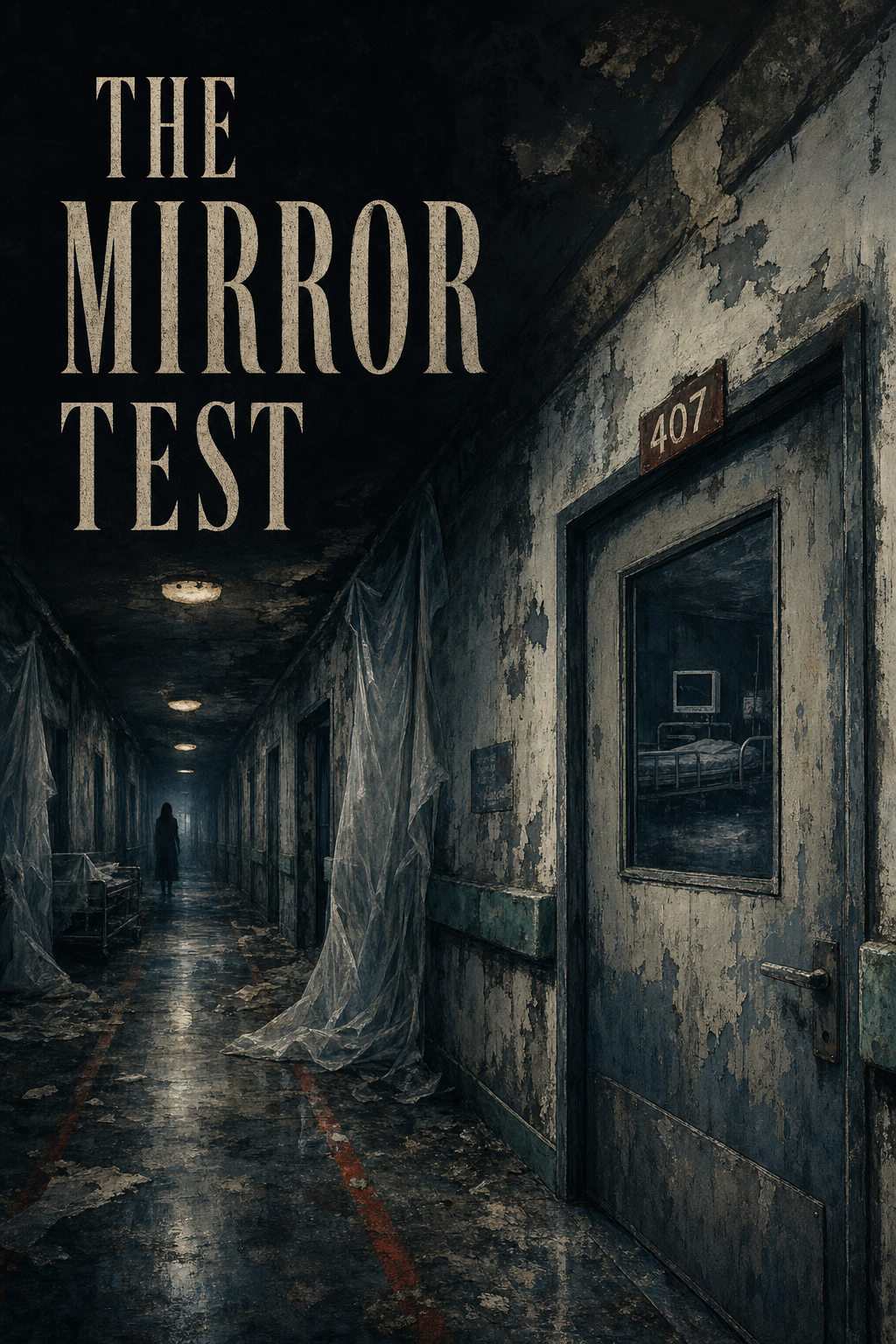
After a routine scan for worsening headaches, thirty-four-year-old Tessa Vale began seeing a pale gray shape in every mirror, while doctors considered migraines, seizures, eye strain, medicine side effects, anxiety, and a problem with the scan itself. Her vision tests were normal, and the shape vanished whenever another person stood beside her. Then Tessa found it reflected in the black screen of a powered-off hospital monitor, standing behind her bed where no one could have been.
Chapter 1
Tessa first saw the shape in the bathroom mirror at the imaging center.
She had spent forty minutes inside a loud scanning machine because of headaches that had begun three months earlier. The headaches came behind her left eye. Sometimes they made her sick. Sometimes they made her forget small things, like why she had opened the refrigerator or where she had parked her car.
The technician had told her to drink water and wait for the doctor. Tessa went to the restroom, splashed cold water on her face, and looked up.
A gray person stood behind her.
It was not clear enough to be a man or woman. It had shoulders, a head, and something that might have been a hospital gown. Its face was smooth as fogged glass. Tessa spun around so hard that her elbow struck the paper-towel holder.
The restroom was empty.
When she looked back, the gray figure was gone. Her own face stared at her from the mirror, pale and wet, with a red mark on one cheek from the scan table.
She told herself it was exhaustion. She had not slept well. She had been taking new migraine medicine. The imaging center had bright lights, long hallways, and too many dark windows.
Then she noticed that the mirror had been covered in tiny fingerprints, all pressed at shoulder height from the other side.
Chapter 2
The scan did not show a tumor, bleeding, or anything else that could explain the headaches. The doctor said that was good news.
Tessa tried to believe him.
For two days, she saw nothing strange. Then, while brushing her teeth at home, she noticed the gray shape behind her again. It stood at the far end of the narrow hall outside her bathroom.
This time she did not turn around.
She watched through the mirror. The shape did not move. It seemed farther away than her hallway should allow, as if the hall had stretched into a long hospital corridor.
Tessa grabbed her phone and took a picture of the mirror.
In the photo, she stood alone.
Her sister Mara came over that evening. Mara checked the hall, the closets, and the small storage room under the stairs. She found nothing but winter coats, a vacuum cleaner, and Tessa’s old moving boxes.
When Tessa showed her the picture, Mara sat beside her on the couch and spoke gently. She said migraines could cause strange sights. So could lack of sleep. So could stress. Tessa had been working late at the city records office since their mother died the year before.
Tessa agreed because she wanted the answer to be simple.
But after Mara left, Tessa passed the dark television screen in her living room. In its black glass, a gray figure stood directly behind the couch.
Tessa’s scan has ruled out the most immediate danger, but the gray figure returns in mirrors and dark screens even when no camera can capture it. Migraine symptoms, medicine effects, and stress still seem possible, yet the strange fingerprints and changing reflections make Tessa afraid to be alone in her own house.
Chapter 3
At her next appointment, Tessa described the figure carefully.
She did not say ghost. She did not say haunted. She said she was seeing a shadow in reflective surfaces. She said it appeared during headaches. She said it was worse at night.
The doctor asked whether she heard voices.
Tessa said no.
He asked whether she had lost time.
She hesitated. Once, she said, she had driven home from work and could not remember the last ten minutes of the trip. But everyone forgot things sometimes.
The doctor ordered an eye exam and an electrical brain test. The brain test measured the tiny signals made by the brain. It could help find seizures.
Tessa spent a whole afternoon with small wires taped to her scalp. Nothing unusual happened. No gray figure appeared in the white exam room.
The eye doctor found that Tessa’s eyes were healthy. Her left eye was slightly dry. That was all.
For a few hours, Tessa felt foolish. Maybe she was making a frightening story out of headaches and grief.
Then she stopped at a grocery store on her way home. At the end of the freezer aisle, she saw herself reflected in the dark glass door.
The gray figure stood beside her.
Not behind her this time.
It held one arm against its chest, as if it was hurt.
Chapter 4
Tessa left her cart in the aisle and walked out without buying anything.
At home, she pulled every curtain shut. She covered the bathroom mirror with a towel. She turned the television toward the wall. She put her phone face down on the table.
By midnight, her headache had become a hard, pounding pain. She took the medicine her doctor had given her and sat in the kitchen with every light on.
Her kettle began to whistle.
She had not filled it.
Tessa stared at it from across the room. Steam rose from the spout. In the curved metal side of the kettle, the kitchen looked bent and silver.
The gray figure was sitting at her table.
Its smooth face was turned toward a small notebook beside Tessa’s hand.
Her mother had used that notebook for grocery lists before she got sick. Tessa had not opened it in months.
With shaking fingers, Tessa flipped through the pages. Most were old lists: milk, bread, cat food, tomatoes.
Near the back, she found a page covered in writing that was not her mother’s.
It said: Room 407. Do not look at the glass.
Tessa had never been in Room 407.
But the number was printed clearly on the hospital paperwork from the day of her scan.
The figure now appears closer and seems to point Tessa toward a notebook containing a message about Room 407, the same room where she waited after her scan. Medical tests have not found a clear cause, and Tessa begins to wonder whether the strange sight is tied to the hospital rather than her home.
Chapter 5
Tessa did not want to go back to the hospital. She went anyway.
In daylight, the building looked harmless. Families pushed strollers through the front doors. A volunteer handed out coffee. A television played a cooking show above the waiting room chairs.
Tessa asked the front desk if she could speak to someone about an item she might have left behind.
The clerk frowned at the room number. Room 407 was not used for scans, she said. It was on an older floor that had been closed during repairs.
Tessa said she only wanted to check.
A security guard named Ellis took pity on her. He walked her to a stairwell and up four flights. The fourth floor smelled like dust, old paint, and the sharp clean scent of disinfectant.
The hallway lights were off. Plastic sheets covered most of the doors. At the end of the hall was Room 407.
Its door was locked.
There was a narrow square of glass in the door. Tessa stared at it before Ellis could stop her.
She saw the gray figure inside.
It was lying on a hospital bed with one arm pressed across its chest. Beside the bed stood a black monitor. The monitor was off, but its screen reflected Tessa in the hall.
Behind reflected Tessa stood another Tessa.
The second one was wearing a hospital gown.
Chapter 6
Tessa screamed. Ellis pulled her away from the door and called downstairs for help.
When the lights came on, Room 407 was empty. There was no bed. No monitor. Only bare floor, patched walls, and a long stain where something heavy had once stood.
Ellis said the floor had been used for patient recovery years ago. The rooms were closed after a small fire in an electrical panel. Nobody died, he added quickly.
Tessa asked if anyone named Vale had been treated there.
Ellis checked his tablet. He found one record from eleven years earlier. A patient named Theresa Vale had been brought in after a car crash.
Tessa almost laughed. Her name was Tessa, short for Theresa. But she had never been in a serious crash.
Then she remembered something her mother used to say when Tessa asked about the scar near her collarbone.
You had a bad fall when you were little, honey. You do not remember it.
At home, Tessa found an old family photo album. Between pictures of birthdays and school plays was a photograph she had never seen.
She was twenty-three in it, not little. She lay unconscious in a hospital bed. A thick white bandage crossed her chest. Her mother sat beside her, crying into both hands.
On the back, in her mother’s handwriting, were four words.
Theresa came back wrong.
Tessa learns that a patient with her full name was treated in the closed hospital room eleven years earlier, even though she remembers no crash or admission. An old photograph proves that she was there, and her mother’s hidden note makes the missing years feel more dangerous than the gray figure itself.
Chapter 7
Mara did not want to talk about the photograph.
At first she said their mother had been upset after the crash. Then she said Tessa had suffered a concussion, which was a hard blow to the head. People could lose memories after that.
Tessa asked why nobody had told her.
Mara began to cry.
Eleven years earlier, Tessa had been driving home from a late shift when a truck ran a red light. Her car was crushed against a utility pole. Tessa’s heart stopped in the ambulance.
Doctors brought her back.
She woke three days later, confused and terrified. She kept saying there was another woman in her hospital room. She said the woman had asked her to trade places.
The woman had been named Theresa Vale too.
Not Tessa. Another Theresa Vale.
She was an older patient from Room 407. She had died during the electrical fire years before Tessa’s crash.
The hospital had never told Tessa this part. Her mother had found it in an old newspaper article after Tessa began waking at night and staring into mirrors.
Tessa asked what happened after that.
Mara looked toward the covered bathroom mirror.
She said Tessa eventually stopped talking about the woman.
Then Tessa changed her name to Tessa and refused to answer when anyone called her Theresa.
Chapter 8
Tessa slept at Mara’s apartment that night. She kept the bedroom light on. She did not look at the dark windows.
At 3:12 in the morning, her headache woke her.
The pain was worse than before. It felt as if a nail had been driven behind her eye. Her nose began to bleed.
Mara rushed in and called for an ambulance.
At the emergency department, doctors checked Tessa’s blood pressure, heart rhythm, and pupils. The scan from the week before was still normal. Another brain test showed no seizure while she was awake.
Tessa lay in a curtained room with a cool cloth over her forehead. Across from her, a monitor screen had been turned off.
In its dark reflection, the gray woman stood at the foot of the bed.
For the first time, Tessa noticed details.
The woman had a burn scar along her neck. Her right arm was held tight against her chest. A plastic hospital band circled her wrist.
Tessa sat up.
The band had a name on it.
THERESA VALE.
The woman raised her smooth gray face. Slowly, she pointed toward the curtain separating Tessa from the next patient.
On the other side, someone began to cough.
Tessa’s sister confirms the forgotten crash and the older patient who died in Room 407, but a new headache attack brings the figure into the hospital again. The reflected woman now has a name band and points toward another patient nearby, suggesting that Tessa may not be the only person in danger.
Chapter 9
The patient behind the curtain was a teenage boy named Colin. He had fainted at school and struck his head on a locker. His mother sat beside him, tired and frightened.
Tessa asked whether Colin had seen anything strange in mirrors.
The mother stared at her.
Colin gave a small nod.
He said he had seen a gray woman in the school bathroom. He thought it was a joke at first. Then she appeared in the screen of his dead phone.
His mother said he had been having headaches for weeks.
Tessa looked toward the dark monitor. The woman was gone.
Later, while Colin was taken for a scan, Tessa asked a nurse about the old fire on the fourth floor. The nurse did not know much. She only knew that the damaged electrical panel had been removed after several patients complained of strange symptoms.
Headaches. Confusion. Missing time. Seeing things in glass.
The nurse lowered her voice. She said one technician had believed the old monitors were leaking a kind of electrical interference. Not enough to hurt most people. But perhaps enough to affect patients with recent head injuries.
Tessa held onto that explanation. It was solid. It had wires and machines and a reason.
Then Colin returned from his scan and whispered that the gray woman had told him something.
She had said, in a voice like radio static, that the room was filling again.
Chapter 10
Tessa convinced Mara to help her search their mother’s locked desk.
Inside, beneath tax papers and old birthday cards, they found a large envelope from the hospital. It held copies of records from Tessa’s crash.
One page had been marked with yellow pen.
It said that Tessa had been briefly moved to Room 407 because every other recovery room was full. During that time, a power failure had shut down the floor. Staff found Tessa standing beside the black monitor, speaking to someone nobody else could see.
There was another note, written by a doctor.
Patient repeatedly states that she is not Theresa Vale.
Tessa read the words until they blurred.
At the bottom of the envelope was a second paper. It was not a medical record. It was a photocopy of a newspaper clipping about the fire.
The older Theresa Vale had not died from flames. She had died from smoke after being trapped in Room 407. She had been found facing the room’s dark monitor.
Her final words were written in the article.
The room is full of me.
That evening, Tessa looked into the covered bathroom mirror at Mara’s apartment. She did not pull away the towel.
She only listened.
From behind the glass came a faint knocking, steady and patient, like someone trapped inside a wall.
Chapter 11
Tessa understood one thing at last: running had not helped.
The headaches were getting worse. Colin was still in the hospital. If the figure had followed Tessa from the old room into mirrors and screens, then maybe it could follow anyone who had been near the damaged floor.
Before dawn, Tessa returned to the hospital alone.
The fourth-floor stairwell door was unlocked. The hall beyond it was dark, but moonlight came through the covered windows. Room 407 waited at the end.
Tessa carried a flashlight, her mother’s notebook, and the old photograph.
She stopped outside the door. Through the small square of glass, the room was empty.
Then the black shape of a monitor appeared against the far wall.
Its screen lit by itself.
Tessa saw the room reflected inside it, though she was standing outside. She saw a hospital bed. She saw the older Theresa Vale lying on it, coughing in smoke.
And she saw herself standing beside the bed in a hospital gown, just as she had eleven years ago.
The younger Tessa was holding the older woman’s hand.
The gray woman looked up from the bed. Her face was no longer smooth. It was Tessa’s own face, older by many years and gray with fear.
Chapter 12
Tessa opened the door.
The room smelled of cold ash.
On the floor sat the old black monitor, though it had not been there before. Its power cord trailed into a hole in the wall. The screen showed Tessa’s reflection.
Not the Tessa standing in the room.
The reflection wore a hospital gown. It pressed both palms against the inside of the glass.
Tessa remembered everything at once.
After the crash, she had been moved into Room 407. She had seen the trapped woman in the monitor. The woman had begged her not to leave her there alone. Tessa had touched the screen.
For one terrible second, the room had doubled. There had been smoke in her lungs, alarms in her ears, and another life pressing against her own.
Tessa had not brought Theresa back.
Theresa had left an echo behind, caught in the damaged monitor and passed from one injured mind to another. Tessa had carried that echo for eleven years. Now it was slipping loose.
She placed her mother’s notebook on the monitor and spoke the older woman’s name.
The screen went black.
The ash smell vanished. The headache eased.
For a moment, Tessa thought it was over.
Then the black screen reflected the empty room behind her.
In the reflection, a gray teenage boy stood at the doorway.
Colin raised one hand to the glass.
Tessa returns to Room 407 and remembers that the dead patient was not a simple ghost but an echo tied to the damaged monitor and to people with injured brains. She believes she has quieted the echo by facing it and naming Theresa, but the final reflection shows Colin carrying the gray shape away from the room.