
Author: Mark Aquino

  • SHE REMEMBERED TOMORROW

    SHE REMEMBERED TOMORROW

    Lena Brooks began waking with clear memories of things that had not happened yet, including conversations, small accidents, and a stranger’s face pressed against her bedroom window. Doctors first blamed stress, unusual seizures, a sleep disorder, or a new medicine, but each memory came true the next day in exact detail. Then a test that measured her brain waves recorded Lena answering a question seven seconds before the nurse asked it—and the voice on the recording did not sound like hers.

    On Monday morning, Lena remembered breaking a blue cup.

    She did not dream about it. Dreams were soft around the edges. This felt sharp and complete, like something that had already happened.

    She remembered standing in her kitchen at 6:42 in the evening. She remembered reaching for a jar of sugar. Her elbow struck the cup beside it. The cup hit the floor and broke into three large pieces.

    She even remembered the tiny cut on her right thumb.

    Lena opened her eyes.

    Gray morning light filled her bedroom. Her alarm clock said 6:11. Her husband, Noah, was still asleep beside her.

    She checked her thumb.

    There was no cut.

    The blue cup sat in the kitchen cabinet where it always did. Lena took it down and turned it in her hands. Her daughter June had painted a crooked yellow sun on it during a school art day. Lena used it every evening for tea.

    She placed the cup on the highest shelf.

    All day, the memory bothered her. She worked from home, answered emails, and tried to laugh at herself. By dinner, she had almost forgotten it.

    At 6:41 that evening, Noah asked where they kept the sugar.

    “Top cabinet,” Lena said.

    He opened the door. The sugar jar sat behind the blue cup. When he reached for it, his elbow struck the cup.

    It fell.

    Lena lunged forward and caught one side, but the handle hit the counter. The cup slipped from her fingers and broke into three large pieces.

    One piece cut her right thumb.

    For several seconds, Lena could only stare at the blood.

    “Are you okay?” Noah asked.

    “I remember this.”

    “You remember what?”

    “This happened this morning.”

    Noah thought she meant she had dreamed it. Lena let him believe that because she did not know how to explain the difference.

    The next morning, she remembered a red balloon caught in a tree.

    In the memory, she was walking June to school. A little boy stood under an old pine tree and cried while his father tried to reach the string. A city bus drove past and sprayed muddy water onto Lena’s shoes.

    Lena did not want to test it, but she also did not want to hide at home.

    She wore old shoes.

    At 7:55, she and June turned the corner near the school. A red balloon floated above the sidewalk. Its string was tangled in the pine branches. A little boy cried beneath it.

    “Mom, look,” June said.

    Lena pulled her daughter away from the curb just before the bus passed. Muddy water splashed across the empty place where they had been standing.

    The father thanked her for moving so fast.

    Lena smiled, but her stomach felt cold.

    On Wednesday morning, she remembered a phone call from her sister.

    Her sister would say their mother had fallen in the grocery store. She would be frightened but not badly hurt. The hospital would find a sprained wrist and a bruise on her hip.

    At 2:16 that afternoon, Lena’s phone rang.

    She answered with, “Mom fell, but she’s okay.”

    There was a long silence.

    “How did you know?” her sister asked.

    Lena did not have an answer.

    That night, she told Noah everything.

    He listened as she described the cup, the balloon, and the phone call. He asked if she had seen messages about any of those things before falling asleep. He wondered if she was remembering dreams and joining them to real events afterward.

    “You think I’m making the details fit,” Lena said.

    “I think the brain can play strange tricks.”

    “Then write something down. Anything. Seal it in an envelope. Tomorrow, I’ll tell you if I remember opening it.”

    Noah did not like the idea, but he agreed.

    He went into the garage and locked the door. Ten minutes later, he returned with a sealed envelope. He signed his name across the flap and placed it inside his locked desk drawer.

    On Thursday morning, Lena woke crying.

    She remembered the paper inside the envelope.

    Noah had drawn a black bird with a key in its beak. Under it, he had written, “June’s first word was moon.”

    But that was not why Lena cried.

    In the memory, someone had been standing behind Noah while he made the drawing.

    It was a woman in a white hospital gown.

    Her hair hung across her face. Her bare feet were gray with dirt. She stood so close that her chest almost touched Noah’s back.

    Noah could not see her.

    The woman looked straight at Lena, even though Lena was only remembering the scene.

    Then the woman lifted one finger to her lips.

    Lena woke with the same finger pressed against her own mouth.

    She ran to Noah’s desk and made him unlock it. The paper showed the black bird. The sentence below it was exactly right.

    Noah turned pale.

    “Did you come into the garage?” he asked.

    “No.”

    “Did you watch through the window?”

    “The blind was closed.”

    “Then how?”

    Lena told him about the woman.

    That was when Noah asked her to see a doctor.

    Lena’s family doctor gave her a careful exam. Her strength was normal. Her balance was normal. She knew the date, the place, and everyone’s name. Her speech was clear.

    The doctor asked about headaches, fainting, lost time, new medicines, alcohol, and drug use. Lena had started a medicine for migraines three weeks earlier, but she had no other changes.

    “Some kinds of seizures can cause a sudden feeling that something has happened before,” the doctor said. “A seizure is a burst of unusual electrical activity in the brain. It does not always make a person fall or shake.”

    He told her to stop driving until they knew more. He also ordered a picture of her brain and a test of its electrical signals.

    “Could a seizure show me tomorrow?” Lena asked.

    The doctor paused.

    “It could make a memory feel real,” he said. “That does not mean the event came from the future.”

    Lena wanted to believe him.

    The picture of her brain was normal. There was no tumor, bleeding, or sign of a recent stroke. Her blood tests were normal too.

    The brain-wave test was scheduled for Friday.

    A nurse placed small metal disks across Lena’s scalp. Thin wires ran from the disks to a computer. The test was called an EEG. It watched the tiny electrical signals made by the brain.

    Lena lay on a narrow bed while the nurse sat behind a window.

    “Try to relax,” the nurse said through a speaker.

    Lena closed her eyes.

    For several minutes, nothing happened.

    Then she remembered the nurse asking, “Do you smell anything strange?”

    Lena remembered answering, “Burnt oranges.”

    Her eyes opened.

    The room was quiet.

    “Burnt oranges,” Lena said.

    Seven seconds later, the speaker clicked.

    “Do you smell anything strange?” the nurse asked.

    Lena sat up so fast that two wires pulled loose.

    The nurse entered the room. “What’s wrong?”

    “I answered before you asked.”

    “Answered what?”

    Lena pointed at the speaker. “You asked if I smelled anything strange.”

    The nurse frowned. “I was about to ask that.”

    They reviewed the recording.

    At 10:23 and fourteen seconds, Lena’s lips did not move. She was lying still with her eyes closed.

    Yet a voice on the room microphone said, “Burnt oranges.”

    At 10:23 and twenty-one seconds, the nurse asked the question.

    This time Lena’s lips moved as the recording captured her frightened reply.

    The first voice was lower than Lena’s. It sounded wet and tired.

    The nurse played it again.

    Under the words, they heard a slow clicking sound.

    Three clicks. A pause. Three more.

    “Is something wrong with the machine?” Lena asked.

    The nurse shut off the recording.

    “Machines can pick up other signals,” she said, but she would not meet Lena’s eyes.

    The doctor who read the test found a few brief changes near the part of Lena’s brain that helps make memories. The changes were not enough to prove she had seizures. He wanted a longer test at the hospital.

    Lena went home with more questions than answers.

    That night, she and Noah moved June’s mattress into their room. Noah checked every lock and window. He also placed a camera in the garage.

    “If the woman comes back, we’ll see her,” he said.

    Lena did not tell him what she remembered that morning.

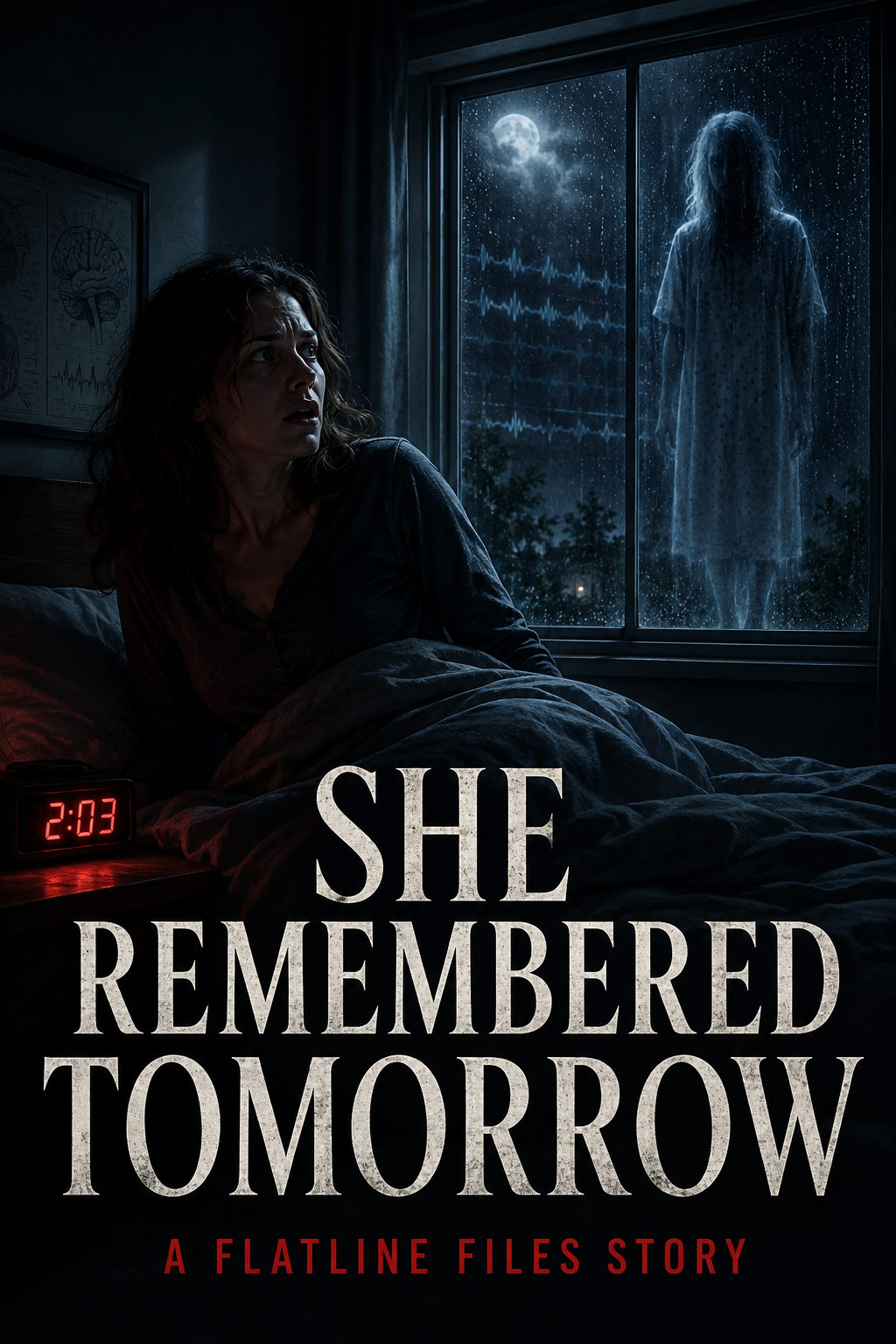
    She had seen the woman standing outside their bedroom window at 2:03 at night.

    Their bedroom was on the second floor.

    At 2:00, Lena sat awake with all the lights on. Noah held a baseball bat. Rain tapped against the glass.

    At 2:03, three soft knocks came from the window.

    Noah raised the bat.

    The woman stood on the other side of the glass.

    Her hospital gown moved in the wind. Her feet rested on nothing. Her hair covered most of her face, but Lena could see one eye looking in.

    Noah whispered, “Who is that?”

    The woman smiled.

    Then every light in the room went out.

    June screamed.

    Noah swung the bat at the window. The glass did not break, but the woman vanished.

    When the lights returned, wet footprints crossed the ceiling above their bed.

    They followed the prints into the hallway.

    The last print stopped above June’s bedroom door.

    Noah called the police. Two officers searched the house and yard. They found no one. One officer climbed into the attic but saw only dust and insulation.

    He also found something else.

    Above June’s room, someone had written a date on a wooden beam.

    It was Saturday’s date.

    Tomorrow.

    Noah wanted to leave the house at once. They packed a bag and drove to Lena’s sister’s home across town.

    Lena fell asleep near dawn.

    She remembered Saturday.

    She saw herself in a hospital room. Wires ran from her head to a machine. Noah sat beside her. June colored a picture near the window.

    At 4:10 in the afternoon, the woman in the hospital gown walked into the room.

    No one but Lena noticed her.

    The woman leaned down and whispered, “You have one day left.”

    Then she placed both hands around June’s head.

    Lena woke screaming.

    She refused to take June to the hospital. Noah argued that Lena needed the longer brain test. He said the doctors might finally find an answer. Lena told him the hospital was where the woman wanted them.

    In the end, they left June with Lena’s sister. Noah drove Lena to the hospital alone.

    “If anything feels wrong, we leave,” he promised.

    The hospital room looked exactly as Lena remembered, except June was not there. Lena felt a small hope. They had changed the future.

    More metal disks were placed on her head. A camera watched the bed. The doctors hoped to record one of her strange spells and see what her brain was doing at that moment.

    For hours, nothing happened.

    At 4:09, Lena’s phone rang.

    It was her sister.

    June had started vomiting and complained of a terrible headache. She was sleepy and hard to wake. An ambulance was bringing her to the same hospital.

    Lena tore the wires from her head.

    “We have to go,” she told Noah.

    Before they reached the door, the clock changed to 4:10.

    The woman in the hospital gown walked through the wall.

    Noah froze. This time he could see her too.

    The woman’s skin was pale. Water dripped from her hair, though the floor stayed dry. A faded name band circled her wrist.

    LENA BROOKS.

    “That’s my name,” Lena whispered.

    The woman lifted her head.

    Lena saw her own face.

    It was older and thinner. A long scar crossed one side of the scalp. The eyes looked empty from too many nights without sleep.

    “You have one day left,” the older Lena said.

    “Until what?”

    “Until you become me.”

    The room stretched around them. The walls seemed to move farther away. The monitor beside the bed began showing dates instead of heartbeats.

    Sunday.

    Monday.

    Tuesday.

    Each date flashed faster than the one before it.

    The older Lena stepped closer.

    “I tried to stop it,” she said. “Every warning changed one small thing. But each change brought us closer to this room.”

    “What happened to June?”

    The older Lena began to cry.

    “She saw tomorrow too.”

    The door burst open. Two nurses rushed in because Lena’s wires had come loose. The older woman disappeared.

    At that same moment, an emergency call sounded over the hospital speaker. A child had stopped breathing in the ambulance entrance.

    Lena ran.

    She reached the entrance as the paramedics pushed June through the doors. Her daughter’s face was white. A mask covered her mouth. One paramedic squeezed a bag to push air into her lungs.

    Then June’s eyes opened.

    She looked straight at Lena.

    “Duck,” June whispered.

    Lena dropped to the floor.

    A heavy light fixture broke loose above her and crashed against the wall. Glass flew across the hall. If Lena had remained standing, it would have struck her head.

    June began breathing on her own seconds later.

    Her tests showed no clear cause for the sudden illness. The doctor thought it might have been a severe migraine. A migraine could cause intense head pain, vomiting, confusion, and strange changes in vision. But it did not explain why June knew the light would fall.

    They stayed in the hospital overnight.

    By morning, June seemed normal. She ate toast and asked to go home.

    Lena sat beside her bed and held her hand.

    “What did you see?” she asked.

    June looked toward the empty corner.

    “A lady told me to make you duck.”

    “What lady?”

    “The old one who looks like me.”

    Lena’s grip tightened.

    June pulled her hand away and touched the side of her head.

    “She has a scar right here,” she said.

    On Sunday morning, Lena woke without a future memory for the first time all week.

    She laughed with relief. She woke Noah, hugged June, and opened every curtain in the house. Sunlight filled the rooms. The wet footprints on the ceiling were gone. The date in the attic had faded until only a dark smudge remained.

    For two weeks, life returned to normal.

    Then one morning, Lena found June sitting at the kitchen table before sunrise.

    The girl had covered dozens of sheets of paper with the same drawing.

    Each picture showed Lena lying in a hospital bed. A light fixture had crushed the pillow beside her head. An older woman stood in the corner.

    At the bottom of every page, June had written a different date.

    Lena flipped through them.

    There were hundreds.

    Some dates were only days away. Others were years in the future.

    “Why did you draw all these?” Lena asked.

    June looked up with dark circles beneath her eyes.

    “I didn’t draw them yet,” she said.

    From the hallway came three slow clicks.

    Lena turned.

    The older version of June stood at the foot of the stairs, wearing a white hospital gown and holding tomorrow’s picture in her hand.

  • THE TIDE INSIDE HER LUNGS

    THE TIDE INSIDE HER LUNGS

    For thirteen nights, Mara Velez woke coughing seawater onto her bedroom floor, though she lived two hundred miles from the coast and had not been swimming in years. Doctors considered reflux, pneumonia, mold exposure, sleepwalking, and an obscure disorder that made the lungs fill with fluid, but every test returned almost normal. Then a CT scan captured something small and jointed moving through the water in her left lung—and when the radiologist called the image back, the thing had vanished.

    The first time it happened, Mara dreamed she was standing beneath a black ocean.

    There was no surface above her, only darkness ribbed with pale currents. Her nightgown drifted around her thighs. Somewhere beyond sight, a bell rang once, deep enough that she felt it in her teeth.

    Then something touched the sole of her foot.

    Mara woke on her side with both hands around her throat. A violent cough folded her in half. Liquid rushed up—not spit, not the bitter acid that sometimes woke her after late dinners, but a mouthful of cold, salty water that splashed across the hardwood beside her bed.

    She stared at it while she dragged air into her lungs.

    The puddle held a ribbon of translucent weed no longer than her little finger.

    At 3:14 a.m., still trembling, she carried a towel and the weed into the kitchen. Her twelve-year-old son Nico slept down the hall. The house was silent except for the refrigerator and the dry August wind rubbing oleander branches against the stucco. Bakersfield had gone forty-three days without rain.

    Mara wrapped the weed in a paper towel and placed it in a sandwich bag. By sunrise it had turned brown and brittle. She decided it must have come from the salad she had eaten at work, though she knew she had not choked at dinner and knew, with the unreasonable certainty left by dreams, that it had not been in her stomach.

    She told no one.

    On the second night, the bell rang twice.

    She woke at 3:14 again. This time the coughing lasted nearly a minute. Salt water ran from her nose and soaked the collar of her shirt. When she finally looked down, three tiny shells lay on her pillow, each spiral smaller than a grain of rice.

    By the fourth morning, Mara had stopped calling them dreams.

    She began preparing for the attacks. She placed a mixing bowl beside the bed. She slept propped upright. She stopped eating after six, scrubbed black specks of mildew from the bathroom ceiling, replaced the air-conditioner filter, and checked the attic for a leaking pipe. The roof was dry. The walls were dry. The bowl was not.

    Each night at 3:14, she woke drowning.

    The amount varied from a few tablespoons to nearly a cup. The water was always cold. It tasted strongly of salt and left a faint mineral crust around the bowl when it evaporated. Once it contained a sliver of something pearly and curved. Once, a thread of red no thicker than hair writhed for several seconds before becoming still.

    On the sixth morning, Nico found her bleaching the floorboards.

    “Did you throw up?” he asked.

    Mara looked at his narrow, worried face and lied. “Just spilled water.”

    “It smells like the beach.”

    He said it casually, already reaching for cereal, but the spoon shook in Mara’s hand.

    She went to urgent care after dropping him at summer school. She told the nurse practitioner that she had been waking with coughing fits and a salty taste. She did not mention the weed or shells. Saying those parts aloud would transform a solvable symptom into a story told about her after she left the room.

    Her oxygen level was 98 percent. Her temperature was normal. Her lungs sounded clear. A chest X-ray showed a faint streak near the lower left lobe that might have been old scarring or mild atelectasis—the kind of finding that could come from taking a shallow breath during the image. She was given an inhaler and advised to try famotidine in case silent reflux was irritating her airway.

    Mara accepted both explanations because they belonged to the world she wanted.

    That night she slept in the living room, upright in the recliner, with her phone recording.

    The video showed her sleeping without movement until 3:13. At 3:14, her eyes opened.

    She did not cough immediately. She turned her head toward the dark hallway as if listening. Then she stood, walked barefoot to the blank wall behind the television, and pressed her ear against it.

    For nineteen seconds she remained there.

    Her lips moved.

    The recording was too quiet to capture her words, but another sound came through: a slow wooden creak followed by a distant wash of water.

    Then Mara returned to the recliner, lay down, and began to convulse with coughing. Water streamed from her mouth into her lap.

    She watched the video six times. At breakfast, she asked Nico whether there were pipes behind that wall.

    “No,” he said. “That’s where the door used to be.”

    Mara stopped buttering his toast.

    “What door?”

    Nico shrugged. “The one you talk to.”

    She forced herself to look at him. “When have you seen me talking to a door?”

    “I haven’t. I hear you sometimes.”

    “What do I say?”

    He stared into his cereal. “You ask if it can see the lights.”

    Mara took the inhaler, the famotidine, and the recording to her primary care physician. This time she described everything except Nico’s remark. The doctor listened without interrupting. He repeated her lung examination, ordered blood work and a CT scan, and asked careful questions about medications, alcohol, anxiety, trauma, and sleepwalking.

    Mara answered honestly. No drugs. A glass of wine once or twice a month. No history of psychosis. Anxiety since her husband Daniel died four years earlier, but nothing that made her lose time.

    “How did he die?” the doctor asked.

    “Drowning,” Mara said.

    The word changed the room.

    Daniel had disappeared during a solo fishing trip near Morro Bay. The Coast Guard found his empty boat adrift and one boot wedged beneath a seat. His body was never recovered. Mara had spent months waking to imagined phone calls and years learning not to scan crowds for his shoulders.

    The doctor suggested that unresolved grief could contribute to parasomnias—complex behaviors during sleep—and that reflux or aspiration might explain the coughing. He did not say that grief could manufacture seawater. He referred her for a sleep study and arranged the CT.

    Mara left angry at him for being reasonable.

    Her blood tests were nearly normal except for a mildly elevated eosinophil count, which could accompany allergies, asthma, parasites, or nothing important. The CT took place on the ninth afternoon.

    The technologist positioned her on the narrow table and told her when to hold her breath. Mara closed her eyes as the machine hummed around her. Halfway through the scan, she heard the bell.

    One note.

    Not through the room. Inside her chest.

    She gasped before the recorded voice told her to breathe. The technologist repeated the series.

    Afterward, Mara dressed and waited because the technologist asked her not to leave. Twenty minutes passed. Then forty. Finally a radiologist entered, a thin woman with silver glasses and the controlled expression of someone carrying a full cup.

    “Have you inhaled or aspirated any liquid recently?” she asked.

    “Only when I’m asleep.”

    The radiologist studied her. “There is fluid in part of your left lower lung. Not much, but enough that I would expect you to feel worse than you do. There are also branching densities that could represent mucus plugging or foreign material.”

    She hesitated.

    “During one sequence, we saw an artifact.”

    “What kind?”

    The doctor turned the monitor. The image was a landscape of gray anatomy. She pointed to a dark pocket inside the left lung, then magnified it.

    Within the pocket floated a white shape.

    It had a narrow body and six bent projections. One projection appeared anchored to the wall of a bronchus. Another curved forward like a hook.

    Mara leaned closer. “Is that inside me?”

    “It may be motion artifact. A crossing vessel can look unusual in a single slice.”

    The radiologist advanced to the next image. The shape had shifted.

    On the next, it was nearer the center of the pocket.

    On the fourth, the projections had opened.

    Mara’s skin tightened across her arms. “That isn’t a blood vessel.”

    The radiologist did not answer. She clicked back to the first image.

    The pocket was empty.

    She frowned and moved through the series again. Fluid remained. Branching shadows remained. The white shape was gone from every frame.

    “You showed it to me.” Mara heard her voice rise. “I saw it.”

    “I saw something too.” The doctor checked the image identifiers, then opened the original acquisition data. “There may have been a reconstruction error. I’m going to have our system administrator preserve the raw study.”

    “Can reconstruction errors move?”

    The radiologist removed her glasses. “Not like that.”

    Mara was sent to the emergency department because of the fluid and concern for aspiration or infection. For six hours she sat beneath fluorescent lights while clinicians repeated tests. Her oxygen remained normal. Her white blood cell count was not elevated. A new X-ray looked clear. A respiratory viral panel was negative.

    The emergency physician offered admission for observation and possible bronchoscopy if her symptoms worsened. Mara imagined Nico alone at her sister’s apartment, pretending not to be afraid, and chose to go home with antibiotics and strict instructions to return for shortness of breath, chest pain, fever, confusion, or coughing blood.

    Before she left, the radiologist called her.

    “The raw images are intact,” she said. “But the object isn’t in them.”

    “Then how did we both see it?”

    Silence.

    “I don’t know.”

    At home, Mara removed every framed photograph of Daniel and placed them face-down in a drawer. She told herself grief needed symbols and that her sleeping mind had chosen the ocean because it already owned one.

    At 3:14, she woke standing before the wall.

    Her palms were wet. The room smelled of iodine and rotting kelp. From somewhere behind the drywall came three slow knocks.

    Mara backed away.

    The knocks repeated from inside her chest.

    Her ribs jerked with each one.

    Then she coughed into both hands. Water spilled through her fingers, followed by a small brass key green with corrosion.

    Nico appeared in the hallway before she could hide it.

    He looked not at the water but at the key.

    “That’s Dad’s,” he whispered.

    Daniel had worn a brass key around his neck. It opened a narrow locker built beneath the bow seat of his boat. Mara remembered him tapping it against his wedding ring while he planned trips. The Coast Guard report had listed the necklace among the items missing with his body.

    She rinsed the key, though no amount of water removed the smell. One side bore the stamped number 6.

    “Dad’s said nine,” Mara murmured.

    Nico shook his head. “You’re holding it upside down.”

    Mara called her sister and asked her to take Nico for several nights. He refused until she promised she would return to the hospital. She packed his clothes while he followed her from room to room.

    At the front door, he hugged her so hard that the key pressed painfully into her palm.

    “Don’t answer if he asks about the lights,” Nico said.

    Mara pulled back. “Who?”

    But her sister honked from the driveway, and Nico ran outside without answering.

    The pulmonologist scheduled an urgent bronchoscopy for the following morning. Until then, Mara was told to remain with another adult. She lied and said her sister would stay.

    Instead, she drove to a hardware store and bought a stud finder, a utility knife, a pry bar, a respirator, and a sledgehammer.

    The wall behind the television contained no pipes and no studs for a space nearly three feet wide. Property records showed that the house had been built in 1958, remodeled in 1999, and sold twice before Mara and Daniel bought it. The old floor plan stored online at the county assessor’s office showed a shallow coat closet where the blank section now stood.

    At dusk, Mara cut into the drywall.

    Cold air breathed through the opening.

    She widened it until her flashlight revealed the outline of a door. The wood had swollen black with moisture, though the surrounding insulation was dry. Six shallow grooves crossed its center as if someone had dragged fingernails down the other side.

    There was no knob—only a corroded keyhole.

    The brass key entered smoothly.

    Mara stood with one hand on it, remembering the CT shape opening its pale limbs. She should have called the police, her sister, anyone. Instead she turned the key.

    The door opened inward onto darkness and the sound of waves.

    Beyond it was not a closet.

    A narrow hospital corridor extended farther than the width of her house. Green tile gleamed beneath ankle-deep water. Rusted gurneys lined the walls. Ceiling fixtures flickered with a weak blue light, and every few seconds the entire passage tilted gently, as if housed inside something floating.

    The smell struck her next: disinfectant, salt, and the sweet decay of sea life stranded above the tide line.

    Mara’s chest tightened. She lifted her phone to record.

    On the nearest wall, metal numbers marked doors: 2, 4, 6.

    Room 6 stood open.

    The bell rang from inside it.

    Mara stepped across the threshold. The water soaking her shoes was painfully cold. When she glanced back, her living room remained visible through the doorway, warm and square and impossible.

    She followed the corridor.

    Room 2 contained a hospital bed with its restraints neatly buckled around an indentation in the mattress. Room 4 was filled floor to ceiling with cloudy water held in place by nothing; shapes moved far back in it like people walking behind frosted glass.

    At Room 6, Mara heard Daniel humming.

    It was the tuneless three-note phrase he used while tying fishing knots. She entered before fear could stop her.

    The room resembled an old recovery ward. A cardiac monitor stood beside a bed, its screen glowing despite its severed cord. An oxygen mask rested on the pillow. Black water dripped upward from the floor and gathered in beads along the ceiling.

    Daniel sat on the edge of the bed with his back to her.

    He wore the gray jacket from his last trip. His hair was wet. A pale hospital bracelet circled his wrist.

    Mara could not breathe.

    “Daniel?”

    He stopped humming.

    For four years she had rehearsed impossible reunions. In every one, she ran to him. Now every part of her body begged her not to move closer.

    “You took a long time,” he said.

    His voice was right. That was the worst of it.

    “What is this place?”

    “They found me in the water.”

    “Who did?”

    Daniel looked toward the wall. Shadows crossed behind the green tiles, synchronized like a school of fish.

    “They keep the ones who can hear the bell.”

    The monitor beside him displayed two waveforms. One was slow and weak. The second ran at twice the rate.

    Mara put a hand over her own heart. Beneath its familiar beat, she felt another pulse fluttering deep behind her left ribs.

    “What did you put inside me?”

    “Not me.” Daniel’s shoulders began to shake. For one hopeful second she thought he was crying. Then she realized he was laughing without sound.

    “You opened the way when you kept listening.”

    The water around Mara’s ankles stirred. Small white things climbed from beneath the bed, each with a narrow body and six jointed legs. They gathered around her shoes but did not touch her.

    Daniel turned.

    His face was exactly as she remembered until he smiled. Behind his teeth, something unfolded—a pale hooked limb, then another—testing the air between them.

    Mara stumbled backward.

    The monitor alarmed. The faster waveform accelerated, and pain lanced through her chest. She doubled over, coughing. Water poured from her mouth in a continuous stream, more than her lungs could have contained. It struck the floor and spread toward Daniel.

    The creatures rushed into it.

    She ran.

    The corridor rolled violently. Gurneys broke loose and slid past her. Doors opened on both sides, revealing submerged rooms and figures turning their heads in unison. A woman in a surgical gown pressed both hands against invisible glass. A child floated near a ceiling, breathing through an umbilical cord that disappeared into darkness. In every room, a monitor traced two heartbeats.

    Behind Mara, Daniel called her name.

    Then he called in Nico’s voice.

    She reached the doorway and threw herself into the living room. As she turned to pull the hidden door shut, she saw the corridor filling rapidly. Black water surged waist-high, carrying masks, sheets, and hundreds of white jointed bodies.

    Daniel stood at the far end.

    He raised one hand.

    His hospital bracelet read MARA VELEZ.

    She slammed the door, turned the key, and drove the pry bar through the frame. The wave struck the other side hard enough to bow the wood. The walls of the house groaned. Salt water sprayed through the keyhole, then stopped.

    Mara remained on the floor until dawn, listening to the second pulse under her ribs slow to match her own.

    At the hospital, she told the pulmonologist she had coughed up a foreign object but said nothing about the corridor. The brass key sat sealed in a specimen bag on her lap. It looked newly polished now. The stamped 6 had disappeared.

    Bronchoscopy found irritated airways and a small amount of clear fluid in her left lower lobe. No parasite, plant material, or foreign body appeared. Samples were sent for bacterial, fungal, and parasitic testing.

    The fluid’s salinity matched seawater.

    More troubling was its cellular content. The laboratory found epithelial cells that appeared human but carried no match to Mara’s DNA. Some were ciliated like respiratory tissue. Others resembled cells normally present in the inner ear—the structures that detect motion and sound.

    The pathologist called it contamination and requested another specimen.

    Mara’s repeat CT was completely normal.

    She returned home after her sister and Nico helped cover the opening with plywood. Contractors would come the next day. Mara planned to have the entire wall demolished in daylight with witnesses present.

    That night, she stayed awake at the kitchen table. Nico slept beside her on a pallet of blankets because neither of them wanted to be alone. At 3:13, every clock in the house stopped.

    Mara held her breath.

    Nothing knocked. No bell rang. The plywood remained dry.

    At 3:15, the clocks restarted.

    Relief left her dizzy. She reached down to wake Nico and found his blankets empty.

    He stood across the room with his ear pressed to the refrigerator door.

    “Nico.”

    He turned slowly. Water shone on his lips.

    “Dad says you closed the wrong door,” he whispered.

    From inside the refrigerator came the clear electronic beep of a cardiac monitor.

    Two rhythms began tracing themselves beneath the hum—one slow, one fast—while something small and jointed scratched patiently behind the ice.

  • The Incisions She Couldn’t Remember

    The Incisions She Couldn’t Remember

    The Incisions She Couldn’t Remember

    A patient repeatedly wakes with precise surgical incisions and missing hours, while every test remains normal. Initially, the possibilities include sleepwalking, abuse, dissociation, a hidden medical condition, or someone entering the home. Then imaging reveals something beneath the scars that disappears whenever anyone else looks at the scan.

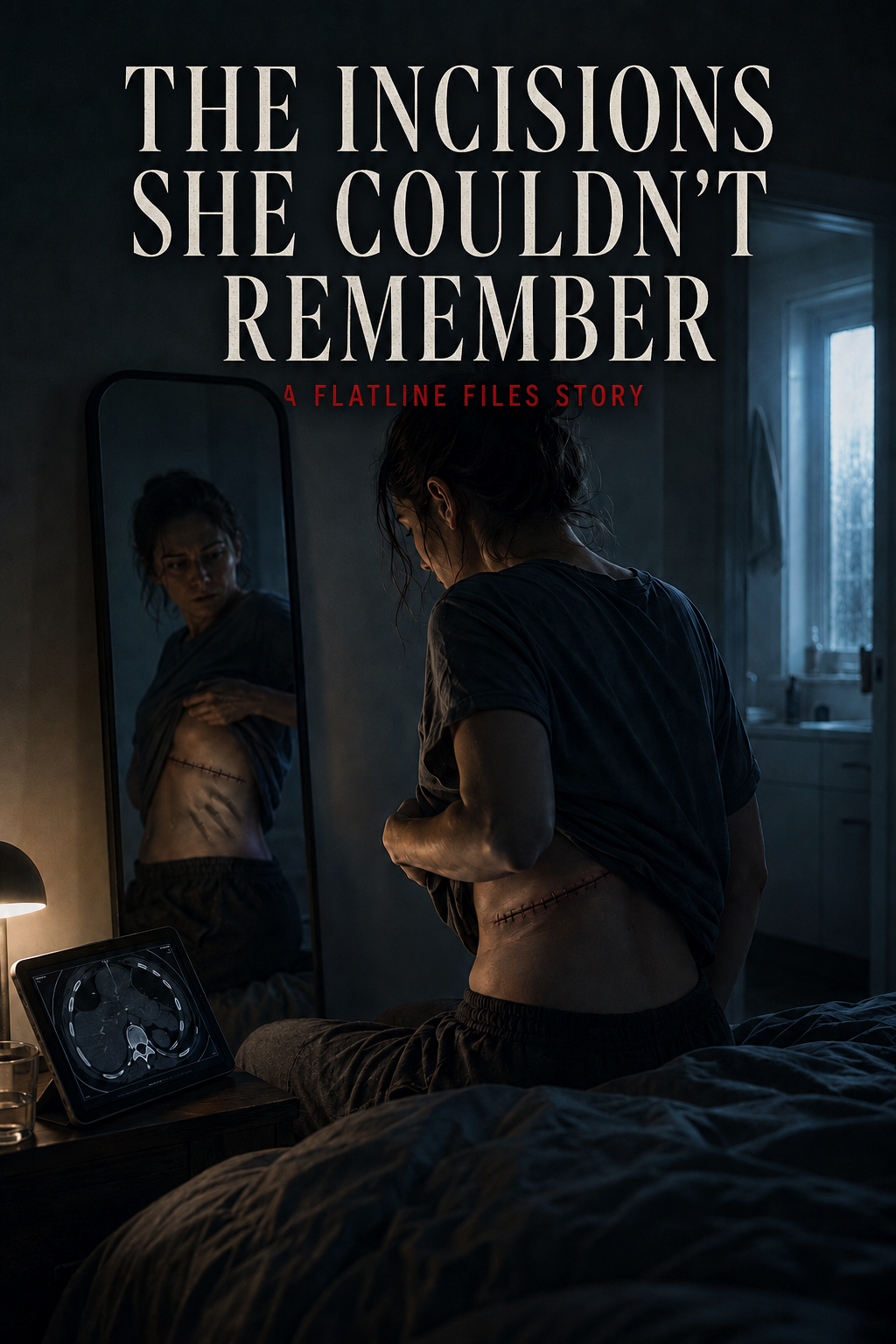
    Elena woke with blood beneath her fingernails and a surgical incision under her left ribs.

    It was four inches long, closed with nine perfect black sutures. The skin around it had been scrubbed so clean that the rest of her body smelled dirty by comparison. There was no blood on the sheets. No torn clothing. No open window or unlocked door.

    Her phone lay charging beside the bed. According to its health app, she had slept for six hours and walked eleven miles.

    Elena lived alone on the seventh floor.

    She stood in front of the mirror, lifting her shirt with a shaking hand. The cut was too straight to be accidental. Whoever had made it had known where to place the needle, how far apart to space each stitch, and how tightly to pull without puckering the skin.

    When she touched the center of the incision, something hard shifted beneath it.

    Not bone. Not muscle.

    Something small and angular moved under her fingertip, then slid deeper between her ribs.

    Elena stopped breathing.

    In the mirror, her reflection kept pressing the wound after her real hand had fallen away.

    Then the reflection smiled.

    Elena did not.

    She stumbled backward, struck the dresser, and looked again.

    The woman in the mirror was only frightened now. Her shirt hung loose around her waist. Her hand covered her mouth. Nothing smiled.

    But beneath the sutures, something tapped three times from inside her body.

    At the emergency department, Elena repeated the story until it sounded rehearsed even to her. She had gone to bed at ten. She had taken no alcohol, sleep medicine, or drugs. She had no surgical history. She had not harmed herself. No one else had a key to her apartment except the building manager, and the deadbolt had been locked from the inside.

    The triage nurse photographed the incision. A physician examined it beneath a white light and said it looked recent, perhaps less than twelve hours old. The wound edges were precisely aligned. The sutures were monofilament nylon, the kind stocked in clinics and hospitals. There was no redness, drainage, bruising, or defensive injury.

    “Someone did this correctly,” he said, then seemed to regret the wording.

    Blood tests showed mild anemia but no infection, no major electrolyte disturbance, and no obvious evidence of intoxication. A urine drug screen was negative. The physician ordered a CT scan because Elena insisted that something had moved beneath the wound.

    The radiology technician positioned her on the narrow table. As it carried her into the scanner, Elena smelled something sharp and sweet beneath the disinfectant. It reminded her of overheated plastic after rain.

    A voice came through the speaker. “Hold your breath.”

    The machine hummed around her.

    Behind the closed lids of her eyes, three white lights appeared in a row.

    She opened them. The scanner’s interior was blank except for a seam in the plastic above her face. Still, she heard a second voice beneath the technician’s, too low to be human speech.

    Hold her still.

    Elena tried to move. Her arms would not obey.

    The table slid out, and control returned all at once. She sat up so quickly the technician rushed into the room.

    “Did you say something else to me?” Elena asked.

    “Just breathing instructions.”

    The first CT images showed a metallic object beneath Elena’s tenth rib. It was triangular, no larger than a grain of rice, with three thin projections extending into the surrounding tissue. The physician enlarged it on the monitor. The object was sharply defined on one image and blurred on the next, as though it had moved while the scan was being taken.

    “Could it be a surgical clip?” Elena asked.

    “You said you’ve never had surgery.”

    “I haven’t.”

    The physician ordered a repeat scan without contrast and called a surgeon. Elena waited under a thin blanket, watching the clock advance toward morning. The hard object remained beneath the incision. Whenever she pressed it, it retreated from her touch.

    The second CT showed nothing.

    No metal. No foreign body. No inflammation. Even the tissue directly beneath the sutures appeared undisturbed.

    The surgeon removed one stitch, spread the wound edges slightly, and found a shallow cut that stopped at the fatty layer beneath the skin. It had not entered her abdominal cavity. There was no tunnel through which an object could have passed.

    “Could the first scan have been wrong?” Elena asked.

    The physician looked at the printed image in his hand. “Scanners create artifacts. But not usually like this.”

    They offered admission for observation and a psychiatric evaluation. Elena heard caution in their voices, not cruelty, but she also heard the conclusion forming behind their careful words. She declined. The wound was dressed, instructions were printed, and she was told to return for fever, worsening pain, bleeding, confusion, or any new symptoms.

    No one included disappearing objects or smiling reflections on the list.

    Elena changed the locks that afternoon. She wedged a chair beneath the doorknob and placed flour across the entryway. She aimed an old security camera at her bed and another at the hall. Before sleeping, she photographed every inch of her skin.

    She did not intend to fall asleep. At 2:13 a.m., according to the video timestamp, her eyes closed.

    The bedroom camera recorded her lying motionless for eleven minutes. Then the picture bent inward. The walls stretched toward the bed as if the room had taken a breath. The timestamp skipped from 2:24 to 3:51.

    When the image returned, Elena was standing beside the bed in a pale hospital gown she did not own.

    Her bare feet were wet.

    She faced the camera for twenty-three seconds without blinking. Then she removed the gown, folded it, placed it beneath the bed, and went back to sleep.

    The hallway recording showed no one entering or leaving. The flour remained smooth. The chair remained beneath the knob.

    Elena woke with a second incision behind her right knee.

    This one had seven stitches.

    The hospital gown was still beneath the bed. It had no label, seams, or fasteners. Under a bright light, the fabric looked less woven than grown. When Elena cut a corner with kitchen scissors, the material contracted away from the blades.

    She sealed it in a plastic container and took it to the police along with the recordings. An officer watched the footage twice and asked whether she had edited it. Another suggested carbon monoxide exposure. Firefighters tested the apartment and found normal readings.

    The building manager’s electronic key log showed no entry. The cameras in the lobby and elevator showed Elena arriving home from the hospital and not leaving again.

    A detective accepted the gown as evidence. Two days later, he called to say the property bag was empty.

    “The seal wasn’t broken,” he told her. “There was just nothing inside.”

    That evening, Elena found the missing strip of fabric curled beneath her tongue.

    She stopped sleeping for as long as she could. Coffee made her hands tremble. Bright lights seemed to gather in the corners of her vision. On the third night, she heard metal wheels rolling across the apartment above her, although the unit had been vacant for months.

    On the fourth morning, she collapsed at work.

    Her sister Nadia brought her to a sleep specialist who listened without interrupting. Dr. Sato did not say the word delusion. She ordered an overnight study to evaluate seizures, parasomnias, and other causes of unusual behavior during sleep.

    Electrodes were attached to Elena’s scalp and chest. Bands measured her breathing. A camera watched from the ceiling. A technician sat behind a window in the next room.

    At 2:13 a.m., Elena entered REM sleep.

    At 2:14, every employee in the sleep center fell unconscious.

    The recordings did not fail. For forty-seven minutes, they showed Elena asleep beneath a white sheet while three shadows stood around her bed.

    They were too narrow to be people. Each bent at several places between shoulder and wrist. Their heads remained outside the camera frame, even when they leaned over her.

    No faces appeared. No tools were visible. Yet the skin over Elena’s right collarbone opened in a straight red line.

    The wound closed behind their hands one stitch at a time.

    The technician woke at 3:01 with blood coming from both nostrils. Elena woke with five new sutures and the taste of pennies in her mouth.

    Dr. Sato reviewed the recording alone, then with the hospital’s security director. When Elena and Nadia were invited into the room, the video showed only static during the missing interval.

    “You saw it before,” Elena said.

    Dr. Sato’s face had gone gray. “The file was corrupted.”

    “You saw them.”

    “I can’t document something that is no longer there.”

    As they left, Dr. Sato pressed a folded sheet of paper into Elena’s hand without looking at her.

    It was a single frame printed from the deleted recording. Three elongated figures surrounded the bed. One held its hand above Elena’s open skin.

    Between its fingers was the triangular object from the first CT scan.

    On the back, Dr. Sato had written: They were taking it out, not putting it in.

    Elena returned to her mother for the first time in almost a year.

    Teresa Ruiz lived in the same small house where Elena had grown up. She opened the door, saw the stitches near her daughter’s collarbone, and whispered, “Not again.”

    Inside, Elena placed the printed image on the kitchen table.

    Her mother sat without touching it. “You were six the first time.”

    The memory came back in pieces: a summer meteor shower, her father’s telescope in the yard, three lights descending behind the orange grove. Elena remembered waking barefoot beside an irrigation ditch with dried mud to her knees. She remembered her mother’s hands searching her body. She remembered a narrow scar hidden beneath her hairline.

    “You were gone six hours,” Teresa said. “The police found you less than half a mile away. You said the white people had fixed you.”

    “Fixed what?”

    Teresa retrieved a metal cashbox from the bedroom. Inside were photographs arranged by year. Elena at six with a stitched cut behind her ear. Elena at eleven with sutures along her hip. Elena at seventeen with a healing line beneath her breast.

    There were medical reports, all inconclusive. Foreign objects appeared on imaging and vanished on repeat examinations. A biopsy from one wound contained Elena’s own cells, but the laboratory estimated the tissue to be decades older than she was.

    At the bottom lay a drawing made in purple crayon. A child stood beneath three lights while tall figures leaned over an open body. Across the page, young Elena had written the same sentence again and again:

    THEY TAKE OUT THE DOORS.

    “Why didn’t you tell me?” Elena asked.

    “Because it stopped when your father died.”

    Her father had suffered a sudden cardiac arrest twelve years earlier. He had been forty-six, healthy, and alone in the backyard. The autopsy found an unexplained scar encircling his heart and a triangular metallic object lodged inside his pericardium.

    The object disappeared before the body reached the funeral home.

    That night, Elena slept in her childhood bedroom while Nadia watched from a chair. They covered the mirrors. They left every light on. Teresa placed her husband’s old telescope across the locked door as though it could serve as a barricade.

    At 2:12 a.m., Elena woke unable to move.

    Nadia slept beside her with her chin against her chest. Teresa was slumped in the hallway. Every light in the house had turned the color of moonlit bone.

    Something rolled on metal wheels beneath the bed.

    The ceiling unfolded.

    There was no opening, only depth where flat plaster should have been. Three figures lowered themselves through it. They were not gray aliens from movies, nor spirits in human form. Their bodies changed depending on where Elena looked. Arms became jointed instruments. Faces became lamps. Beneath translucent skin, shapes moved like hands searching through pockets.

    One placed its fingers over Elena’s sternum.

    A voice entered her without passing through her ears.

    The doors are returning.

    Images flashed behind Elena’s eyes: cells dividing, strands of DNA folding incorrectly, tiny black geometries forming inside healthy tissue. She saw the objects branching into vessels and nerves. She saw them opening passages that did not lead through space but through flesh.

    The figures had not implanted the objects.

    Her body was growing them.

    Each incision marked a place where they had removed one before it finished opening.

    The figure above her chest pressed harder. Pain spread beneath her ribs in a cold, exact circle.

    Why me? Elena thought.

    The answer arrived in her father’s voice.

    Because he gave you his half.

    She understood then that her father had not died of a heart attack. He had carried the same thing. When the final object formed around his heart, the figures had arrived too late.

    A line of pressure crossed Elena’s chest. Her skin opened without a blade.

    She remained awake. That was new. She felt no cutting, only the terrible sensation of fingers moving behind her breastbone, separating structures that should never be touched. The figures drew out a black triangular object threaded with wet filaments.

    It pulsed once in the air.

    The bedroom vanished.

    For an instant Elena saw the place above the ceiling: endless rows of narrow tables, each holding a sleeping human body. Some were infants. Some were ancient. Some had faces she recognized from missing-person posters. Above every chest floated a black shape at a different stage of opening.

    Then she was back in bed.

    The incision sealed itself from the inside. The stitches surfaced last, pushed through her skin by invisible needles.

    Before the figures withdrew, one turned its changing face toward her.

    Three lights burned where its eyes should have been.

    We cannot keep repairing the passage, it said. The next one must open.

    Elena woke screaming at 3:01 a.m.

    Nadia and Teresa woke with blood beneath their noses. The ceiling was intact. A fresh incision crossed Elena’s sternum, closed with thirteen black sutures.

    On the carpet lay the object they had removed.

    It was warm and impossibly heavy. Three filaments contracted from its corners when Elena approached. Nadia trapped it beneath a glass bowl while Teresa called emergency services.

    The responding paramedics saw it. The emergency physician saw it. A pathologist placed it in a sealed container and signed the chain-of-custody form. For the first time, the evidence remained when other people looked.

    Testing found calcium, iron, carbon, and human proteins. The surface contained Elena’s DNA. Its inner cavity contained no material at all, only a depth the laboratory instruments could not measure. One technician described looking into it as seeing a night sky where the bottom should have been.

    The object disappeared during an attempted biopsy.

    The pathology report was amended to read: Specimen misplaced.

    Elena was admitted for observation. Her incision healed without infection. Cardiac testing was normal. A full-body CT found no remaining foreign objects.

    For three weeks, she slept without missing time.

    The police stopped calling. Dr. Sato refused further appointments. Elena moved in with Nadia and covered every mirror in the house.

    Nadia tried to make the new bedroom ordinary. She bought yellow curtains, filled the dresser with clean clothes, and left the radio playing through the night. Elena appreciated the effort, but ordinary things had begun to feel staged. The curtains never moved when the air conditioner turned on. The radio lost its signal at 2:13 every morning. Sometimes she woke to find Nadia standing in the doorway, listening to a sound Elena could not hear.

    The scars changed as they healed. Instead of fading, they darkened into thin geometric lines. When Elena photographed them separately, they looked random. When Nadia printed the images and arranged them according to their positions on Elena’s body, the incisions connected into a branching pattern. Teresa recognized it from her husband’s telescope charts: not a constellation, but the map he had drawn of the three lights’ movement across the sky on the night Elena disappeared.

    At the center of the map was Elena’s sternum.

    She returned to the hospital and requested another scan. The radiologist found nothing abnormal, but Elena noticed that the CT images had been reordered. Viewed in the sequence shown on the screen, they were clean. Viewed by acquisition time, a black triangle appeared in one slice, then two, then dozens. They formed a narrow column extending from her heart to the ceiling above the scanner. When she called the radiologist back into the room, the images reset themselves.

    That night, Elena dreamed of the endless rows of tables. This time none of the bodies were asleep. Every patient had opened their eyes. Every head turned toward her at once. Some mouths moved silently. Others had black triangles where their mouths should have been. At the far end of the room, her father sat upright with the old scar around his heart. He pointed toward something standing behind her and said, “They are not repairing you anymore. They are repairing the door.”

    She began to believe the episode was over.

    Then, one morning, her phone reported that she had walked eleven miles during the night.

    She checked her skin and found no new incision.

    In the bathroom, she removed the sheet from the mirror.

    Her reflection stood perfectly still while Elena raised her hands, turned, and lifted her shirt. No stitches. No blood. Nothing beneath her ribs.

    She almost laughed.

    Then the reflection lifted its own shirt.

    A black triangular opening occupied the center of its chest. Beyond it stretched rows of narrow tables beneath three white lights.

    The reflected Elena pressed both hands against the glass from the other side.

    Words fogged the mirror between them.

    FINAL RETRIEVAL: 2:13 A.M.

    Behind the real Elena, something tapped from inside the wall.

    Three times.